

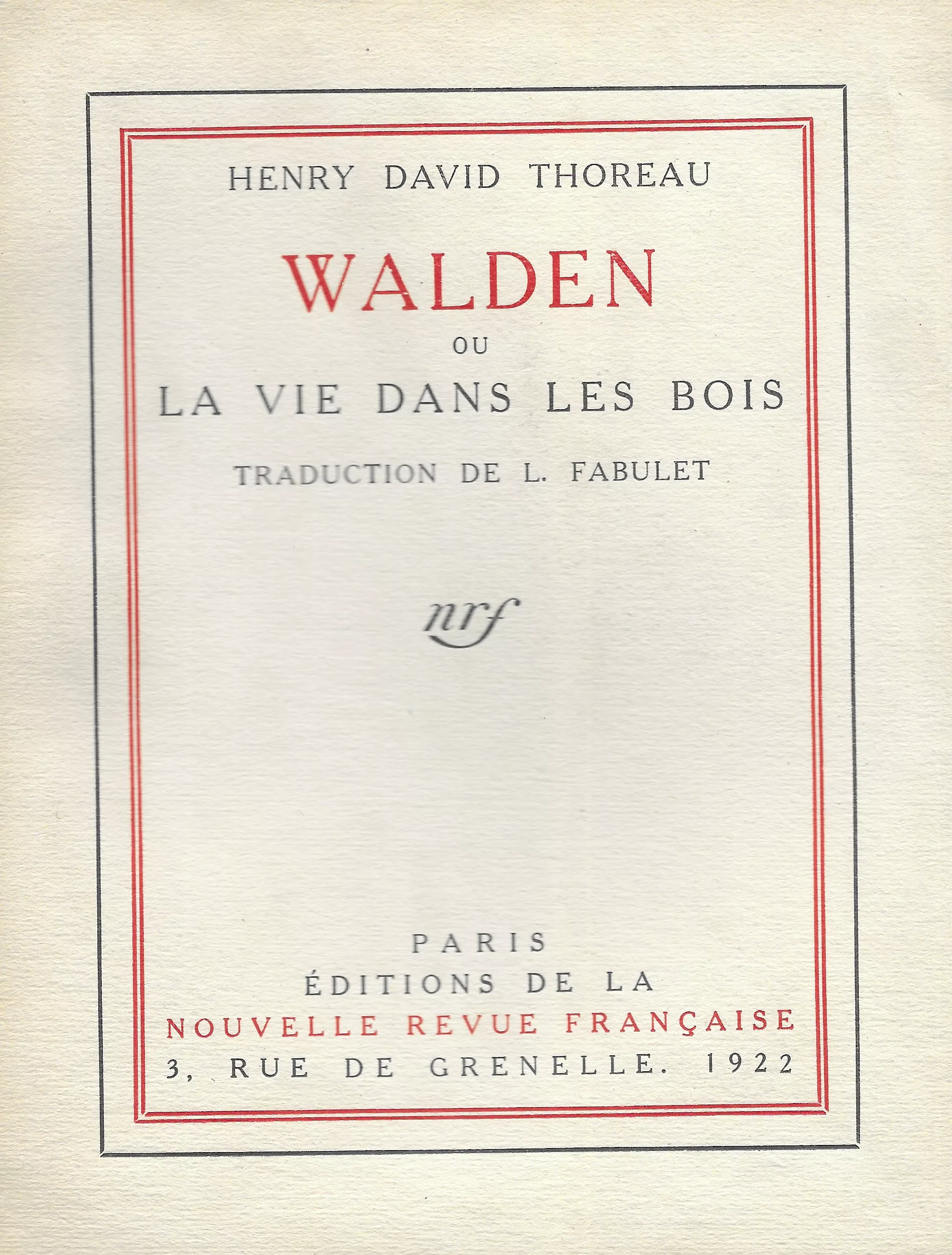
Walden, ou la vie dans les bois
One of 108 copies from the deluxe issue, réimposé in quarto on vergé pur fil paper (no. XCI), nominative copy for Louis Solvay.
The son of a Massachusetts pencil manufacturer, Thoreau loved his native town of Concord and its surrounding countryside with a passion. He lived there, left only twice, and died there at the premature age of forty-four.
Concord was then a town of some 2,000 souls, distinguished by the presence of the philosopher Ralph Waldo Emerson, founder of the transcendentalist school in which Thoreau took part. Thanks to Emerson, Thoreau achieved in 1845 what he most desired: to live alone, in the woods. His masterpiece, Walden, grew out of that experience. Near Concord, by the pond after which the book is named, Thoreau built a small cabin on wooded land that Emerson had just acquired and placed at his disposal. Thoreau lived there for two years, walking, gathering observations, baking his own bread and writing.
Revised many times, the text of Walden, drawn from the journal he kept during his retreat, was published in 1854. Its unexpected success left him unmoved: “these books weigh more than they shine — my back knows it, having carried them up two flights of stairs.” The fame Walden brought him did not change his way of life in the slightest. He was unhappy in the city, where, he said, “one meets no living being.”
Gide became acquainted with the English text at the beginning of the last century and began a translation of his own, at the very moment when Louis Fabulet — translator of Kipling — had also begun his, and turned to the Nouvelle Revue française and André Gide: “before I had even mentioned the author’s name or the title of the work, but from the nature of the good I spoke of both, Gide smiled, put his hand in his pocket, and drew out a book, which he handed to me. It was Walden, and he told me he had begun translating it a few days before. We had met at a crossroads … In the friendly fellowship we know him for, and knowing that I had made it my profession to give our country the versions of what I felt would benefit it, he generously yielded to me the privilege of translating Walden. I thank him publicly here.” (Preface).