

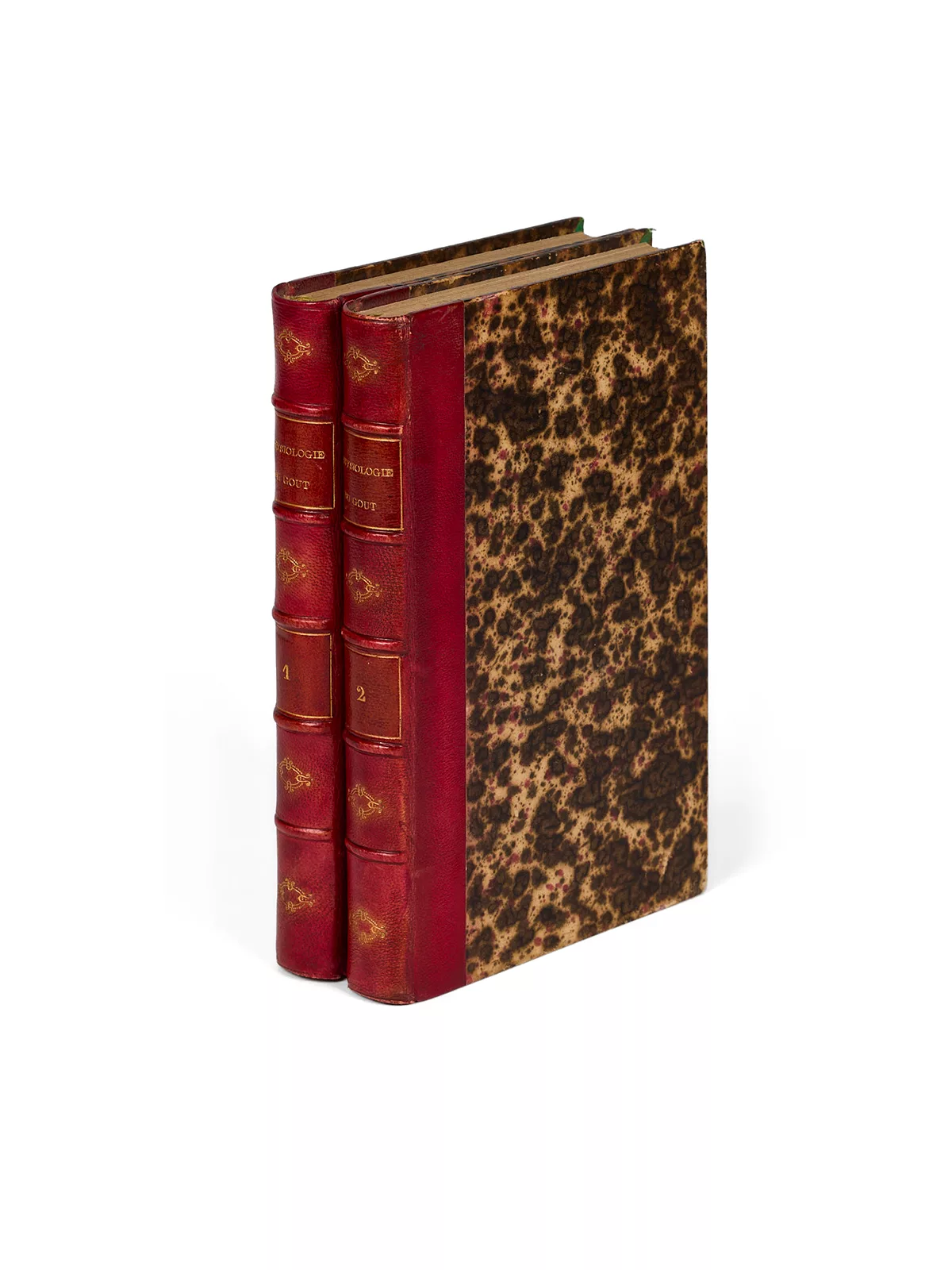

Physiologie du goût
Printed at the author’s expense in 500 copies, the book was put on sale in December 1825.
Brillat-Savarin, who died less than two months after publication, had little time to enjoy the success of his masterpiece.
There is no need to dwell on the importance and history of the work, but it is worth recalling a categorical and rather chilling verdict from one of its illustrious readers a few years later: “A very famous man, who was at the same time a great fool — the two things often go together — dared, in a book on the Table, to write the following under the entry WINE: ‘The patriarch Noah is said to be the inventor of wine; it is a liquor made from the fruit of the vine.’ And then? Nothing more: that is all. However much you leaf through the volume, turn it every which way, read it backwards, upside down, from right to left and left to right, you will find nothing else about wine in the Physiologie du goût of the most illustrious and most respected Brillat-Savarin: ‘The patriarch Noah…’ and ‘it is a liquor made…’. I imagine an inhabitant of the moon, or of some distant planet, traveling through our world and, weary from his long journey, thinking of refreshing his palate and warming his stomach. He wishes to learn about the pleasures and customs of our earth. He has vaguely heard of delicious liquors with which the citizens of this globe could procure courage and gaiety at will. To be sure of his choice, the moon-dweller consults the oracle of taste, the famous and infallible Brillat-Savarin, and finds, under the entry WINE, this precious piece of information: ‘The patriarch Noah’… and ‘this liquor is made’… That is thoroughly digestive. That is most explanatory. It is impossible, after reading that sentence, not to have a clear and precise idea of all wines, their various qualities, their drawbacks, their effect on the stomach and the brain. Ah, dear friends, do not read Brillat-Savarin. God preserve those he loves from useless reading; that is the first maxim of a little book by Lavater, a philosopher who loved mankind more than all the magistrates of the ancient and modern world put together. No cake has ever been named after Lavater; but the memory of that angelic man will live on among Christians long after even good honest bourgeois have forgotten the Brillat-Savarin, a sort of insipid brioche whose least fault is to serve as a pretext for a spouting of foolishly pedantic maxims drawn from the famous masterpiece.” Three-star, triple-fork verdict signed Charles Baudelaire (in Les Paradis artificiels, “Du Vin”).
Whatever Baudelaire may have thought, La Physiologie du goût is “one of the masterpieces of world gastronomic literature. Along with Grimod de la Reynière, Brillat-Savarin is the writer who reflected most seriously on the transcendental art of eating well” (Oberlé).
A fine copy; rare in a contemporary binding of this quality.