

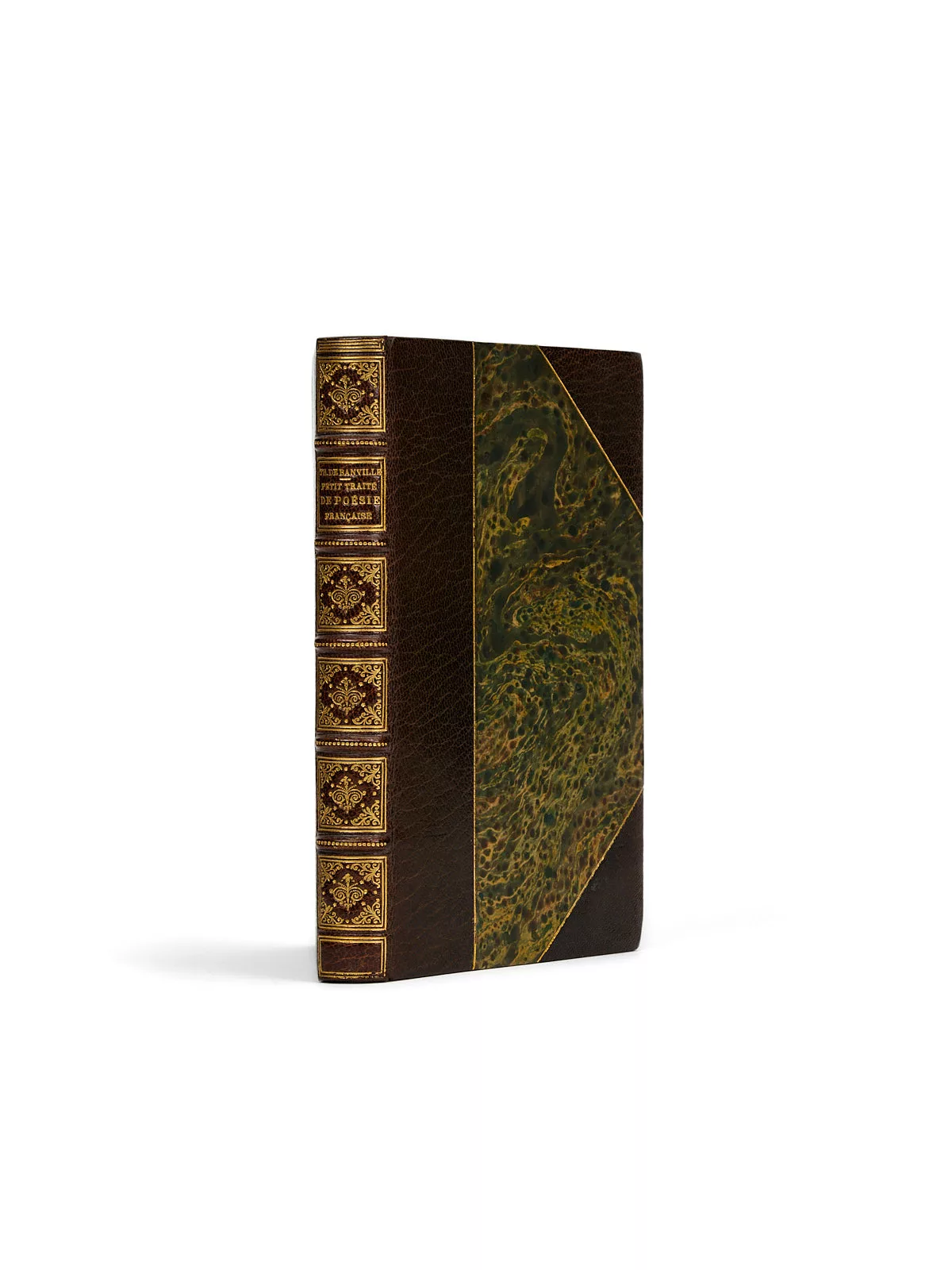
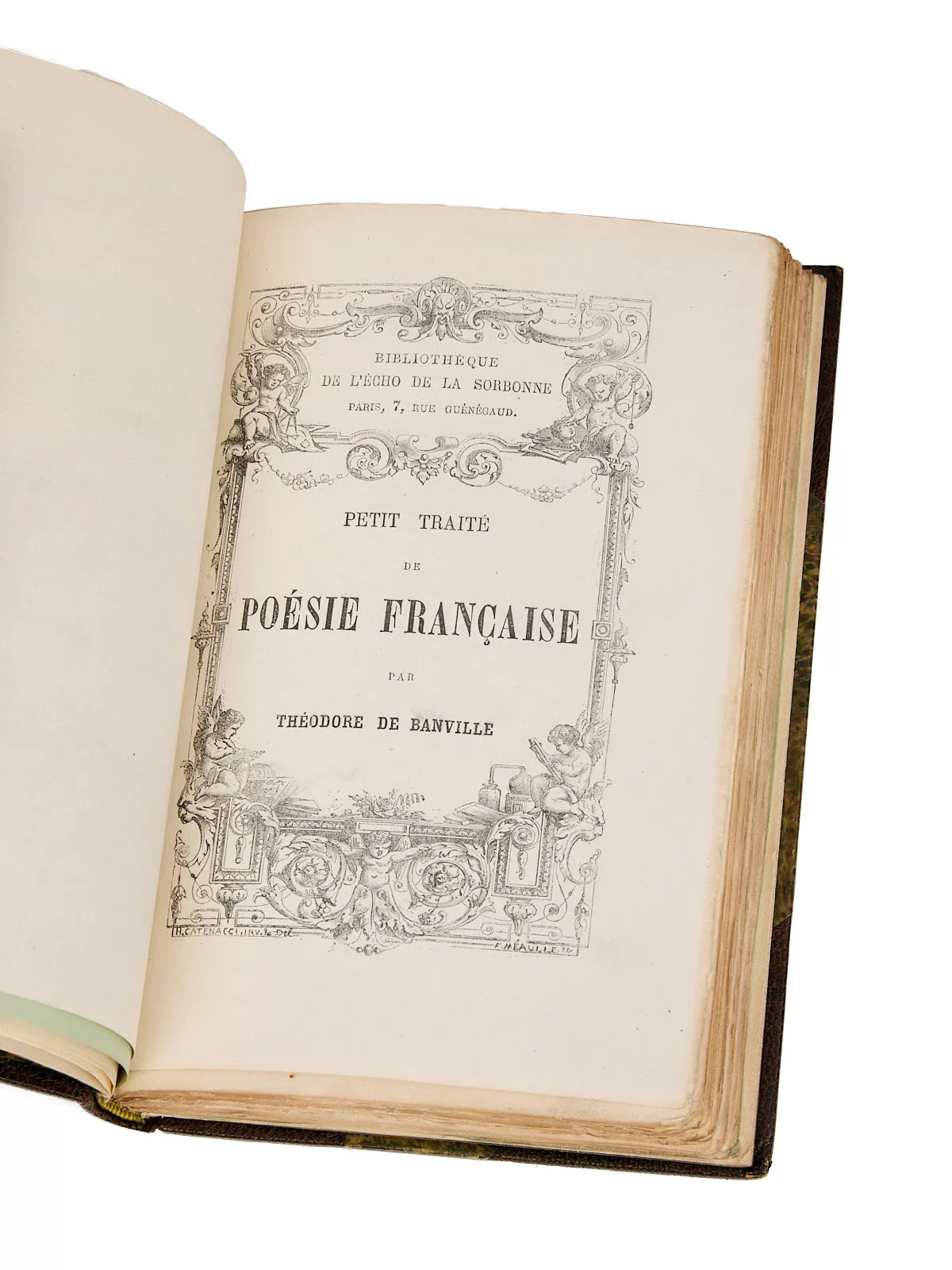
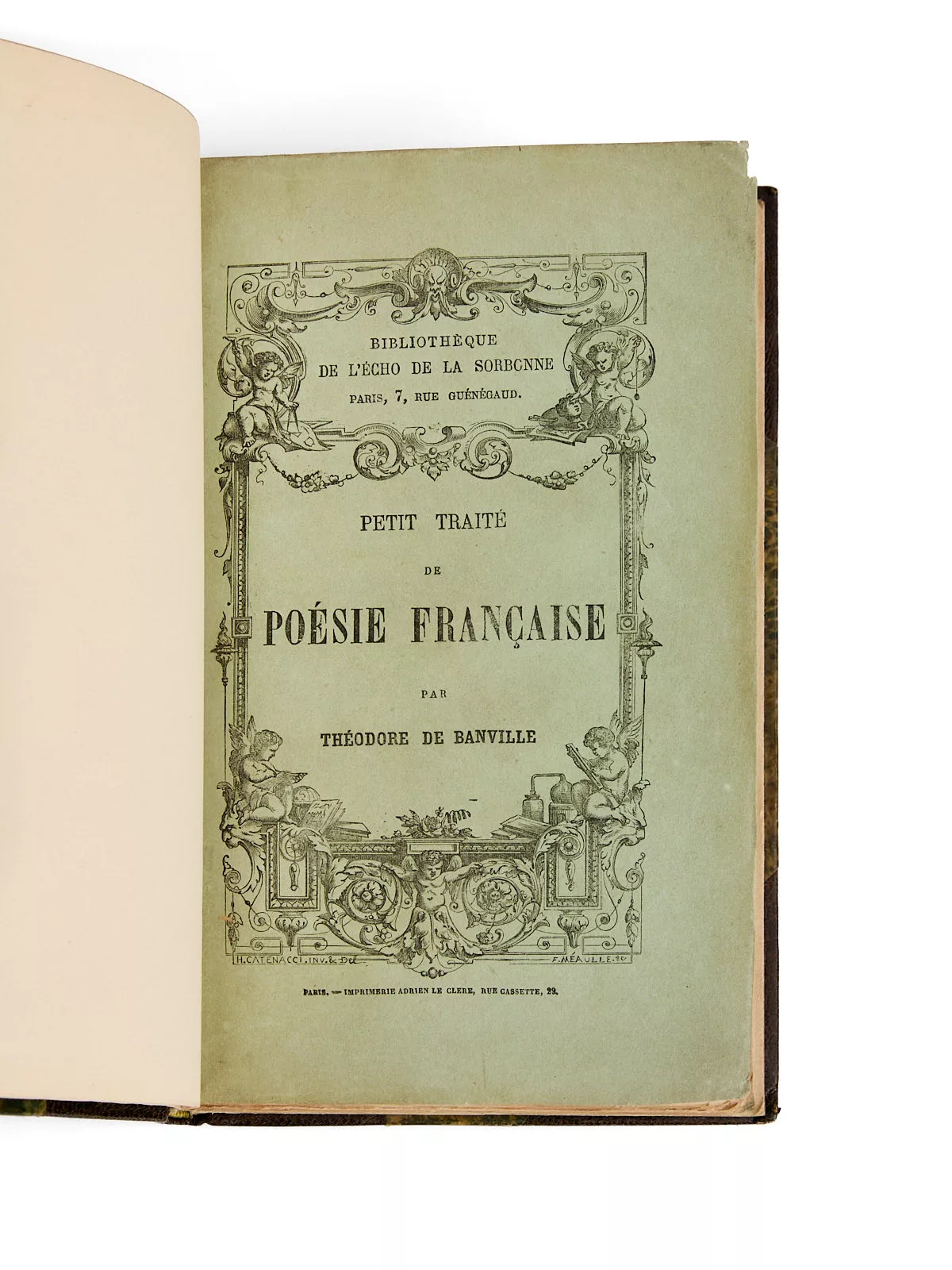
Petit traité de poésie française
Title-frontispiece by H. Catenacci, engraved by H. Catenacci, engraved by F. Meaulle.
The Traité appeared in installments during the summer and autumn of 1871, at the very moment Rimbaud arrived in Paris, where he stayed successively with Verlaine, in September, then with Banville, in November. Banville made an observation that was accurate at the time: “Our tool is sixteenth-century versification, perfected by the great poets of the nineteenth century, a versification whose entire science is contained in a single book, Victor Hugo’s La Légende des siècles, which must be the Bible and Gospel of every French versifier.”
Accordingly, Banville becomes the fierce defender of rhyme (“Rhyme is the sole harmony of verse, and it is the whole of verse”), as shown by the pantoum, which he defines, models and theorizes, by the acrostic, and by the sestina, which he attributes, at the head of chapter X, De quelques curiosités poétiques, to its dedicatee, the Comte de Gramont: “It is one of our most learned and refined poets, M. le comte de Gramont, who, following Petrarch’s Italian sestina, invented and created the French sestina, overcoming countless formidable difficulties.”
His first sestina appeared in Balzac’s Revue parisienne, Balzac himself turning critic for the occasion and taking it upon himself to explain to readers what a sestina is and “to enlighten them as to the impeccable taste and the prodigious craftsmanship it demands of the poet” (Anthologie des poètes français). When Rimbaud arrived at Verlaine’s in Paris in September 1871, the publication of Banville’s little treatise was concluding in the installments of L’Écho de la Sorbonne. Since Rimbaud is known to have lodged with Banville in November 1871, after having stayed with Verlaine and then Charles Cros, it is highly unlikely that Rimbaud and Verlaine could have been unaware of this publication. In any case, the Traité was issued in volume form at the end of 1871 (and not in 1872, as is commonly assumed).
“The first important French art of poetry since those of Malherbe and Boileau” (Berès, Stendhal, Baudelaire et leurs émules, 69).
From the Albert Natural library (bookplate).