

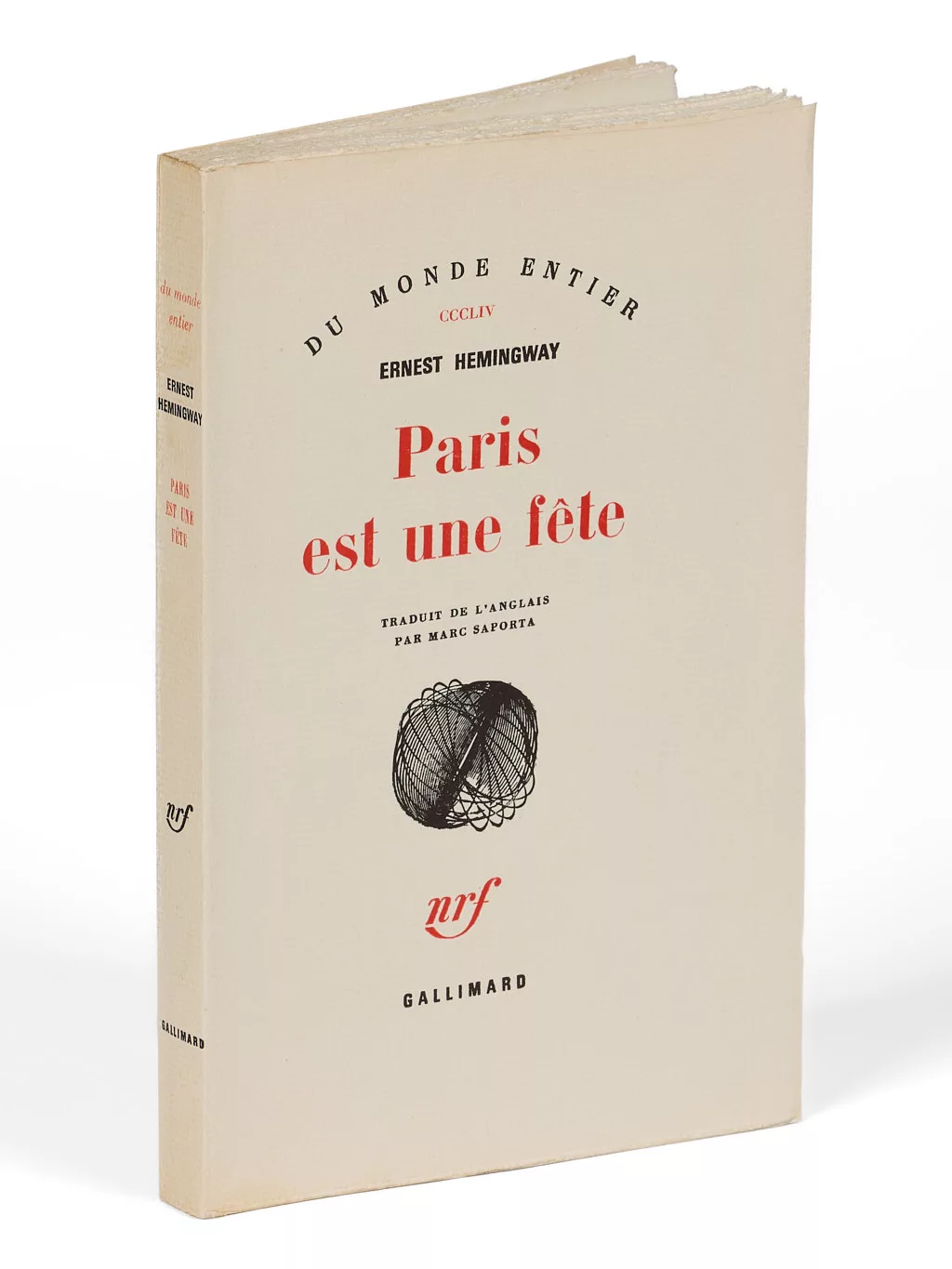
Paris est une fête
It was during the summer of 1957 that Hemingway began working on his “Parisian sketches”: notes and embryonic short stories, forgotten in a trunk and rediscovered by a Ritz porter almost forty years later. The rediscovery of the manuscripts came as a shock to Hemingway, who set to work in Cuba and Ketchum, carrying the manuscripts with him to Spain in the summer of 1959, then to Paris in the autumn of that same year, working relentlessly to compose the collection — an epiphany of his youth at the very moment when alcohol and melancholy were consuming him. He would take his own life three years later, without having finished this last work, completed by Mary Welsh, his fourth wife, to whom we also owe the famous title: A Moveable Feast, a feast that never leaves you.
“Anyone discovering these stories should head straight for the one detailing the improbable Renault journey Fitzgerald and Hemingway made to Lyon (count the glasses of cognac downed by Scott), or the one about the boxing lesson given to Ezra Pound under the disapproving eye of Wyndham Lewis, or the legendary scene in which the owner of the Select coins the phrase “lost generation,” later claimed by Miss Stein as her own. Joyce’s poor eyesight, Adrienne Monnier’s kindness, the fantasy of Joan Miró or Pascin, the self-satisfaction of Ford Madox Ford, the escapades to Schruns or Pamplona complete this breviary of unspoiled happiness.” (Jean-Paul Enthoven, in Le Point, 2011).
A hymn of love to France and to Paris, which the November 2015 attacks brought back into the public eye: 125,400 copies were sold between November 20 and December 31, propelling the collection to the top of the bestseller lists, for a title normally printed at 80,000 copies a year.
A very fine copy.