

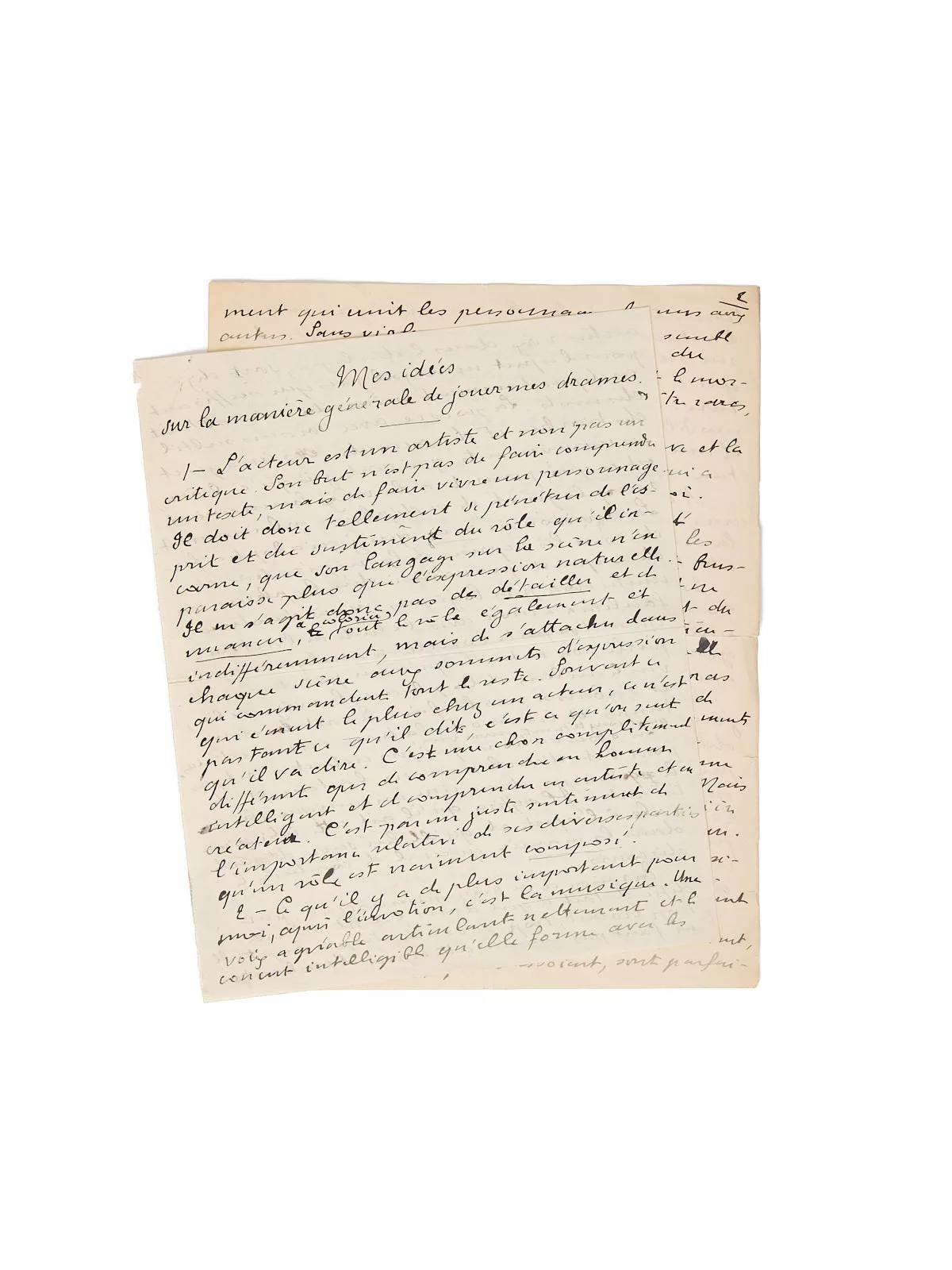
« Mes idées sur la manière générale… »
A genuine plea, written while he was overseeing the first rehearsals of L'Annonce faite à Marie, due to be performed in December.
A precious theatrical manifesto by Claudel, setting out his aesthetic principles: “The actor is an artist, not a critic. His aim is not to make a text understood, but to bring a character to life. He must so thoroughly absorb the spirit and feeling of the role he embodies that his language on stage seems only its natural expression. It is not a matter of detailing, nuancing and coloring the role equally and indifferently, but of focusing in each scene on the peaks of expression that govern everything else […]. What matters most to me, after emotion, is music. A pleasant voice articulating clearly, and the intelligible concert it forms with the other voices in dialogue, are already an almost sufficient delight for the mind, independently even of the abstract sense of the words. Poetry, with its subtle sense of tone and harmony, its images and its movements reaching to the soul, is what allows the human voice to be fully employed and deployed. The division into verse that I have adopted, based on the taking of breath and cutting the sentence, so to speak, into units that are not logical but emotive, will in my view make the actor’s study easier… Because of this musical principle, I distrust anything in delivery that is too violent, too jerky, too abrupt. One must not break the kind of enchantment that unites the characters with one another […]. The principle of great art is to strictly avoid what is useless. Now, the movements of actors who continually pace back and forth on stage under the pretext of filling it, who stand up, who turn around, who sit down, are perfectly useless. Nothing irritates me more than an actor who tries to paint in detail on his face every emotion his partner’s speech gives him. Let him know how to remain calm and still when necessary, even at the cost of a certain awkwardness for which the spectator will, at bottom, be grateful. Each moment of the drama corresponds to an attitude, and gestures should be only the composition and decomposition of that attitude. One should not play for the audience: the actor must be capable of the disinterestedness of a great artist and be concerned not with success, but with the best realization of the work of art to which he must give life. — And it is perhaps precisely in this indifference to the audience that lies the best secret of reaching and moving it.”
The play premiered on 22 December 1912 at the Théâtre de l’Œuvre, the Symbolist-inspired venue founded by the actor Lugné-Poe, the poet Camille Mauclair and the painter Édouard Vuillard. This was the first time a work by Claudel had been staged, and the author wished to play a significant part in the production of “his” play, refining the set and guiding the actors toward a “musical” diction that would prove influential. At first working at a distance from Frankfurt, where he held the post of consul general, and before his first stay in Paris beginning 10 October, many questions were discussed and settled by letter: Claudel agreed to make various cuts to his text, directed the planned musical accompaniment, and above all indicated the qualities he wished to find in his future performers. The first rehearsals took place in October, with Claudel remaining in Paris until the 28th. It was during this stay that he wrote this staging manifesto, which he then left at Lugné-Poe’s disposal as the latter began promoting the play.
As soon as Claudel had returned to Germany, Lugné-Poe devoted the October issue of the Bulletin de l’Œuvre to presenting the author and his play, including a facsimile reproduction of Claudel’s text, Mes idées sur la manière générale de jouer mes drames. When Claudel returned to Paris on 3 December, he could observe the progress of the work, but certainly also its shortcomings, for he devoted nearly all his days to the play, attending rehearsals. In refining the staging he had only sketched out with the actors in October, the playwright took immense pleasure, as he confided to Gide: “Shall I confess to you that these scenic studies, far from repelling me, interest me on the contrary extremely? It is truly fascinating to work on a gesture, an ensemble, an attitude, and to see all this come alive and take shape. I do not know what this will yield for the audience, but for myself I already have great satisfactions” (Alain Beretta, “Claudel et la mise en scène,” in Autour de L’Annonce faite à Marie, Presses universitaires de Franche-Comté, 2000).
Though there were only three performances (20, 22 and 23 December 1912), the audience of initiates who attended made themselves heard. L’Annonce was a success, prompting the young Éditions de la NRF, for the first time since their founding in 1911, to issue a reprint, which appeared on 13 February 1913: 2,200 new copies came off the presses to meet demand after the first edition sold out. Claudel, still stationed in Germany, was at the same time preparing to stage his play once more, at the Hellerau Art Institute north of Dresden.