

Mémoires d’espoir
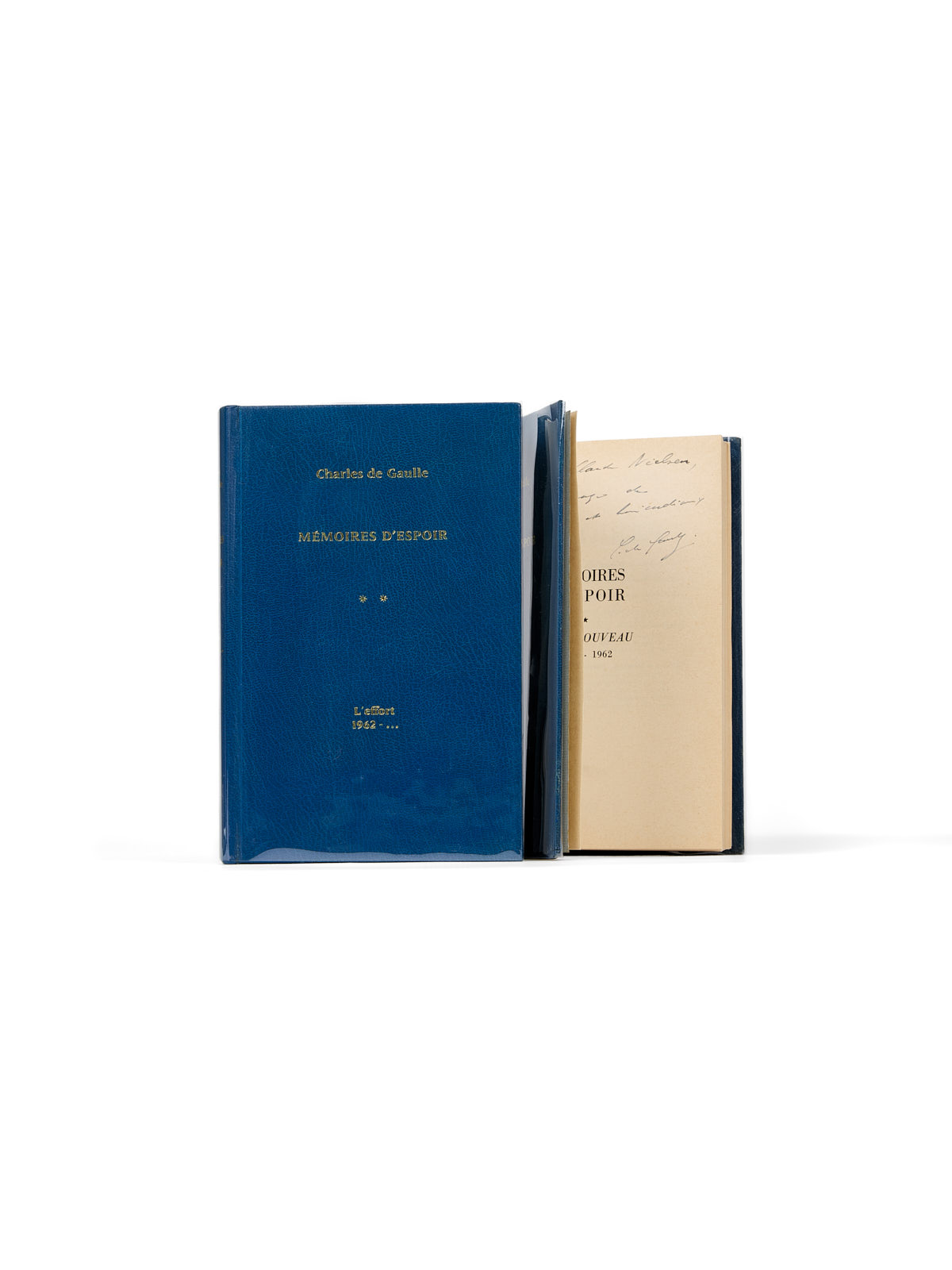
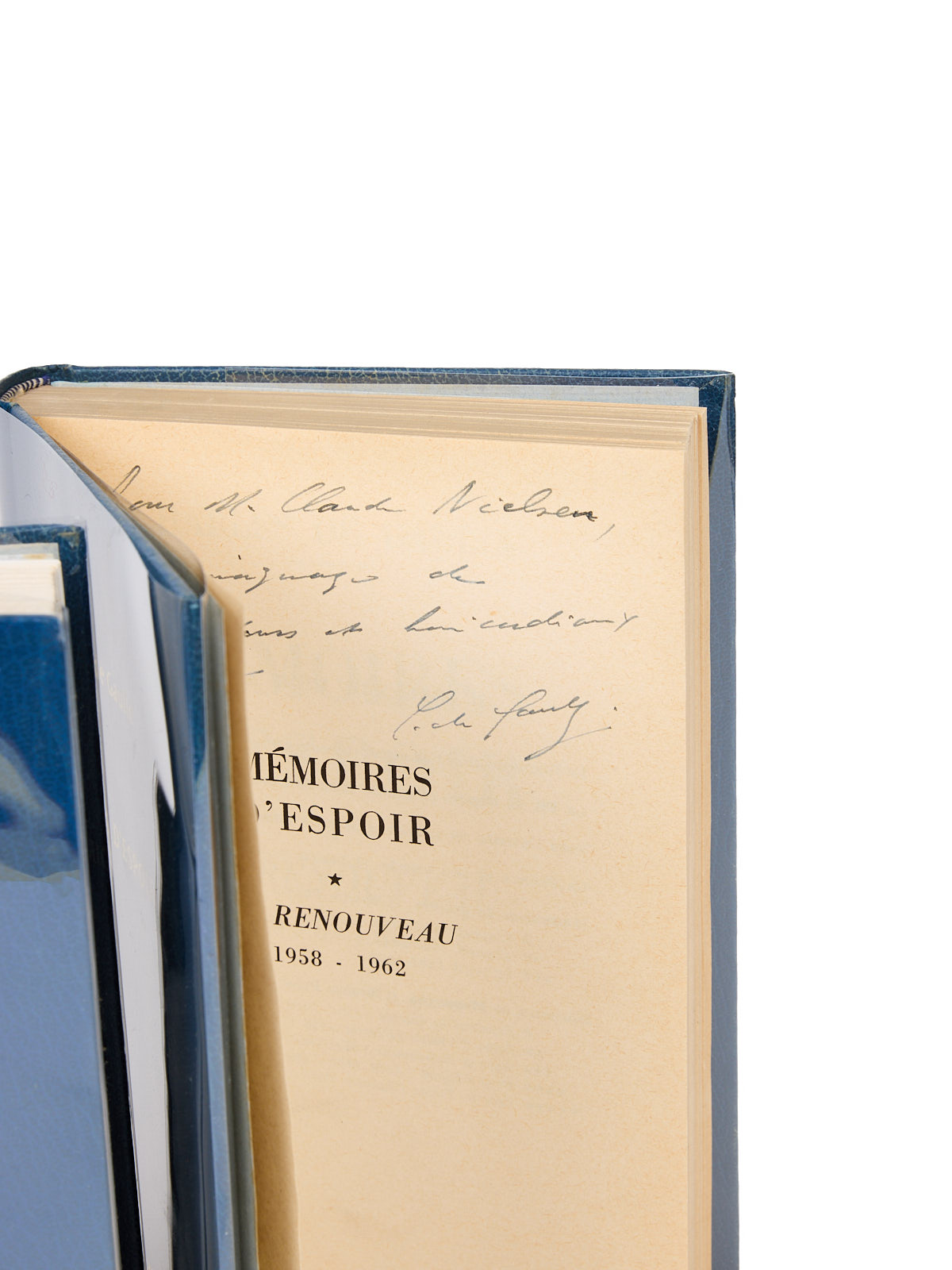
Presentation copy inscribed by Charles de Gaulle to Claude Nielsen: “Pour M. Claude Nielsen, en témoignage de mes meilleurs et bien cordiaux souhaits. 27.10.70, C. de Gaulle.”
Copy presented by Charles de Gaulle to his publisher, Claude Nielsen, Chairman and CEO of Presses de la Cité, to which the Plon publishing house belonged.
In 1954, when de Gaulle completed the first volume of his Mémoires de guerre, he turned to the publisher Plon, never having forgotten that it had published his earliest books. He remained loyal to the firm even after it changed hands and was taken over by Sven Nielsen, who built an empire with Presses de la Cité and passed its management to his son in the mid-1960s.
“A dialogue began between Marcel Jullian, chairman and CEO of Plon, who had chosen for the General the best proofreader at the firm, in any case the strictest. There was no question of changing a single word of the General’s text, but M. Petit could not help reacting to the author’s highly personal punctuation. He took the liberty of removing commas wherever they seemed unnecessary to him. The General restored every one of them. He explained to Marcel Jullian: ‘If you remove these commas, you no longer find de Gaulle.’” (Alain Decaux, Charles de Gaulle, solemn session of 18 October 1990 at the Académie française).
The first volume of the Mémoires d’espoir is entitled Le Renouveau, 1958–1962. When death overtook him, he had not finished composing the second volume, and the manuscript was published as he had left it, appearing in spring 1971. Its success was immense.
The first copies of volume 1 arrived at La Boisserie in October: “For his final book, de Gaulle held exhausting signing sessions at La Boisserie. It was to meet with considerable success. The General signed nearly five hundred copies […]. The Plon bookshop announced that after a first printing of two hundred fifty thousand copies, distributed from Wednesday morning, it had had to begin, on Friday, printing an additional one hundred thousand copies of the book. Among the recipients of the seventeen copies bearing the words ‘printed specially for…’ and an inscription by the author were, besides Mme de Gaulle and her children, Mrs. Eisenhower, in memory of her husband, the son of Chancellor Adenauer, the Pope, the Queen of England, Messrs. Khrushchev and Macmillan, as well as the General’s three former prime ministers. For his part, M. Georges Pompidou had received his copy as early as Tuesday, shortly before his departure for the U.S.S.R. […]. The General’s memoirs were awaited with a mixture of impatience and apprehension, since they deal with events about which passions and prejudices remain strong. But General de Gaulle proves once again that he knows how to give historical perspective to the recent past.” (Le Monde, 12 October 1970).
General de Gaulle died a few days later, on 9 November 1970.