

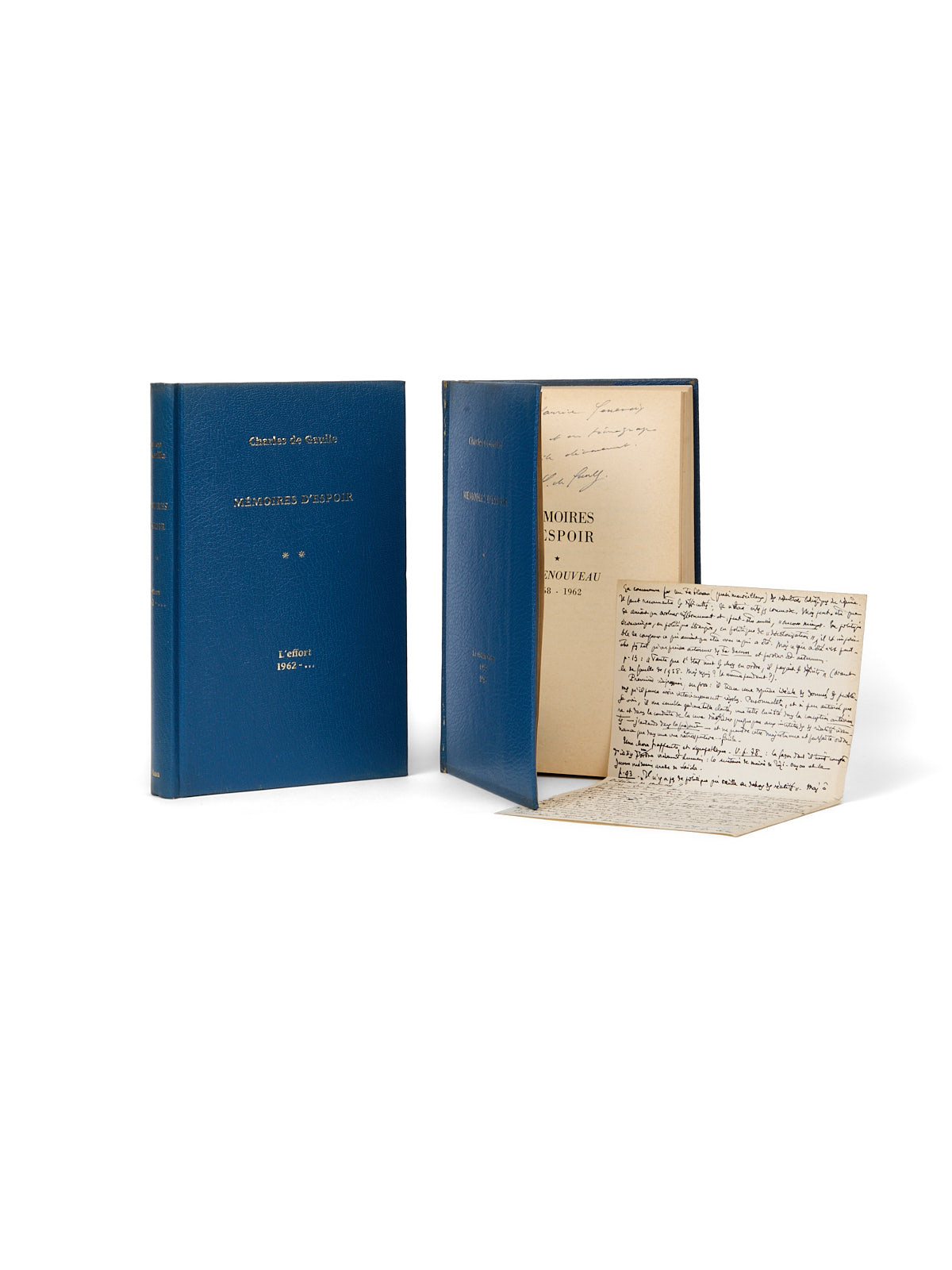
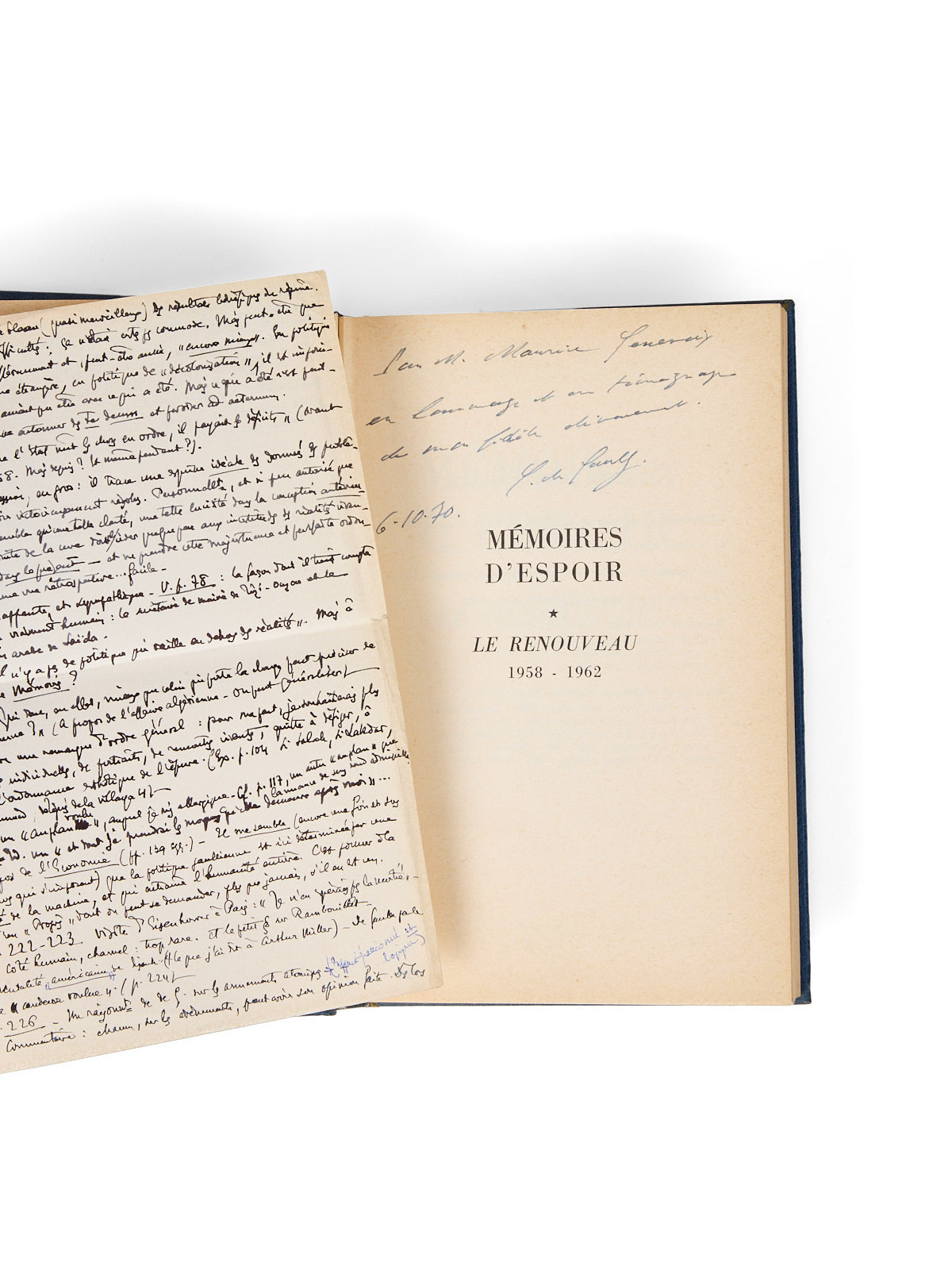
Presentation copy inscribed by de Gaulle to Maurice Genevoix: “Pour M. Maurice Genevoix, en hommage et en témoignage de mon fidèle dévouement. C. de Gaulle, 6.10.70.”
Accompanied by a long reading note by Genevoix on this text, 1 1/2 p. on 1 leaf (148 x 210 mm), on Académie letterhead.
Published two months before General de Gaulle’s death, this text was intended to open a new trilogy. Only two volumes appeared: Le Renouveau, then L’Effort, published posthumously in the first quarter of 1971, together with the reissue, in the same series, of the Mémoires de guerre.
The Mémoires d’espoir constitute the author’s political and literary testament. The first copies of volume 1 reached La Boisserie in October: “For his final work, de Gaulle held exhausting signing sessions at La Boisserie. It would prove a considerable success. The General signed nearly five hundred copies […]. The publisher Plon has announced that after a first printing of two hundred and fifty thousand copies, distributed from Wednesday morning, it had to begin, on Friday, printing an additional one hundred thousand copies of this book […]. The General’s Mémoires were awaited with a mixture of impatience and apprehension, since they deal with events about which passions and prejudices remain strong. But General de Gaulle proves once again that he knows how to give a historical perspective to the recent past.” (Le Monde, 12 October 1970).
General de Gaulle died one month after this signing, on 9 November 1970.
A hero of the Second World War, he had been just as valiant a combatant in the First. Fifty-four years earlier, in March 1916, Captain Charles de Gaulle, commanding the 10th company of the 3rd battalion of the 33rd infantry regiment, was taken prisoner by the Germans during the first capture of Fort Douaumont: “One of them thrust a bayonet at me that went straight through my map case and wounded me in the thigh. […] I lay on the ground for a moment.” His command believed him dead. A citation in army orders and the Legion of Honor were even awarded to him posthumously, on 7 March 1916! Both were confirmed in 1919, this time as honorary distinctions.
De Gaulle and Maurice Genevoix came together to inaugurate, on 18 July 1968, the commemorative ceremonies for the Second Battle of the Marne, on the Butte Chalmont, near Villers-Cotterêts. The Permanent Secretary of the Académie française and historiographer of the Great War spoke first, recalling the fighting of this second Battle of the Marne, and General de Gaulle answered him by painting an epic picture of the last great confrontation of the First World War: “Fifty years ago, between the Aisne and the Marne, on this ground where, as Soissons, Reims, Château-Thierry and Villers-Cotterêts attest, France had already sealed many pages of her history, the great victory was launched. Yes! It was from here, and from 18 July 1918, that within sixteen weeks the French army, aided by the forces of its allies, broke the invaders and drove them from our territory until the Reich had capitulated.”
A fine copy of fine provenance.
From the library of Maurice Genevoix (bookplate).