

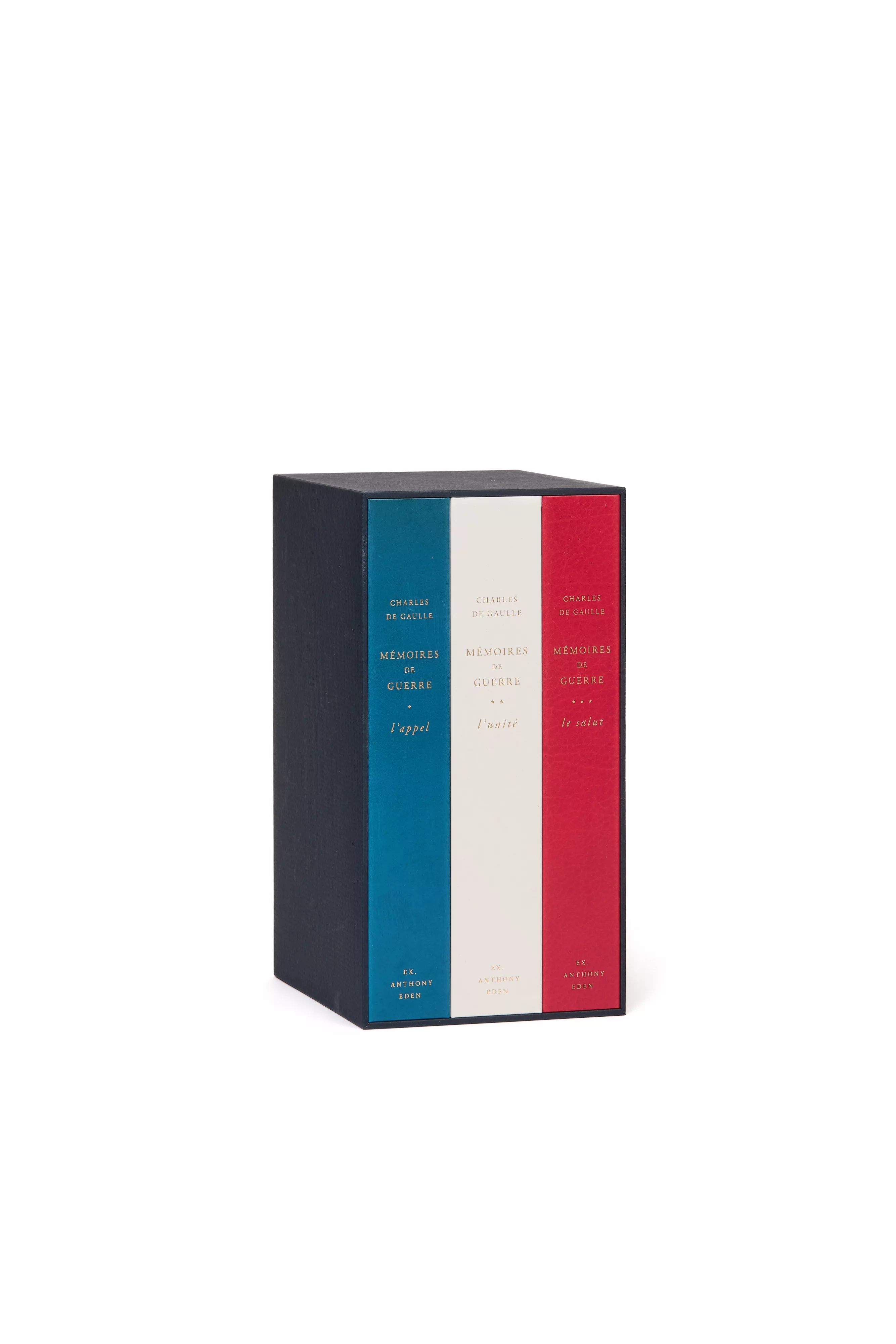
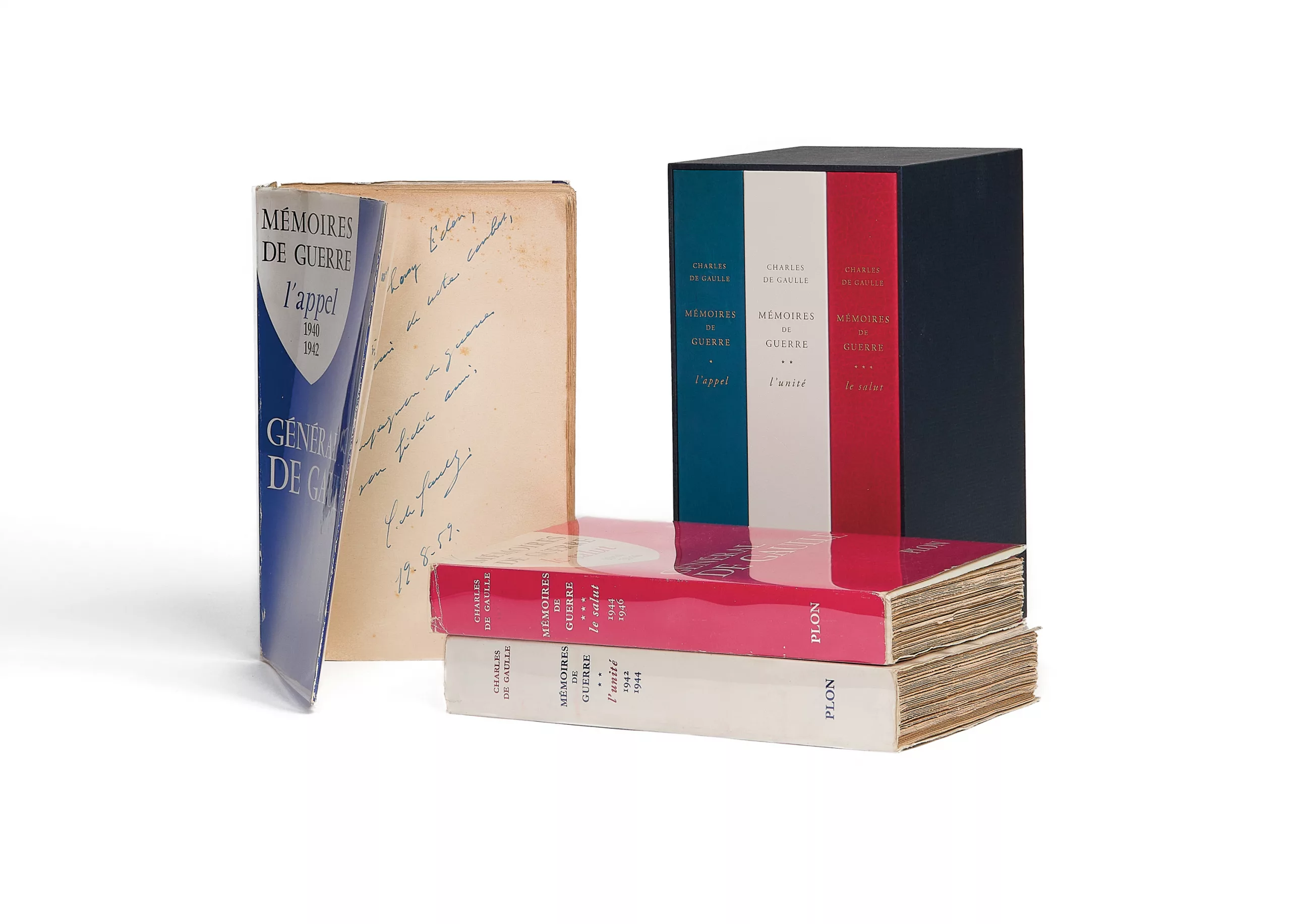
Mémoires de guerre : L’Appel. L’Unité. Le Salut
Signed presentation inscription: “à Sir Anthony Eden, en souvenir de notre combat, son compagnon de guerre et son fidèle ami. C. de Gaulle, 19.8.59.”
A magnificent association between two essential figures of the Second World War.
As Churchill’s Secretary of State for War during the conflict, Eden did much to secure de Gaulle’s standing as head of the French government in exile, and — despite occasional disagreements — was always regarded favorably by the General, unlike Roosevelt.
Eden played a central role in wartime diplomacy between the great powers and the governments in exile, and did much to preserve the often difficult relations between Churchill, de Gaulle and the Free French Forces. Eden’s support for France — he was, moreover, a Francophile and fluent French speaker — was not forgotten by de Gaulle after the war; Eden was regarded as “the only British statesman for whom France ever felt affection” (Merry Bromberger and Serge Bromberger, Secrets de Suez, p. 160).
It is in the course of the narrative of the years 1939–1945 that the figure of Charles de Gaulle takes shape. From his efforts to make his views heard by the military and political establishment at the outbreak of the conflict to the glorious hours of Free France — from L’Appel to Le Salut — he sketches this portrait of what he felt himself becoming: “an old man, worn down by trials, detached from undertakings, feeling the eternal cold approach, but never tired of watching in the shadows for the gleam of hope!” After commanding a tank unit that achieved victory in one of the few counter-offensives of the Battle of France, he was appointed Under-Secretary of State for Defense in Paul Reynaud’s cabinet, one of the few at that time to give him his support. When the regime fell, de Gaulle went to London — the rest is well known. Among the many interests of the Mémoires de guerre, the reader can gauge just how difficult and heroic it was for the future general to convince the entire world that official France was in London. Beyond its strict historical value, de Gaulle’s literary talent is real, and the text has for some years featured on the terminale L syllabus, in the “Literature and Debates of Ideas” section.
Unlike so many statesmen, de Gaulle, the son of a teacher of literature, wrote all his speeches and books himself. Examination of his manuscripts reveals an extraordinary concern for composition and style. The Mémoires de guerre sold a cumulative total of some two and a half million copies in France, were published in nearly twenty-five foreign languages, met with an enthusiastic reception from press and public at each publication, and appeared in a reference edition in the Bibliothèque de la Pléiade. In the same genre, only Churchill’s Memoirs of the Second World War surpassed this success.