

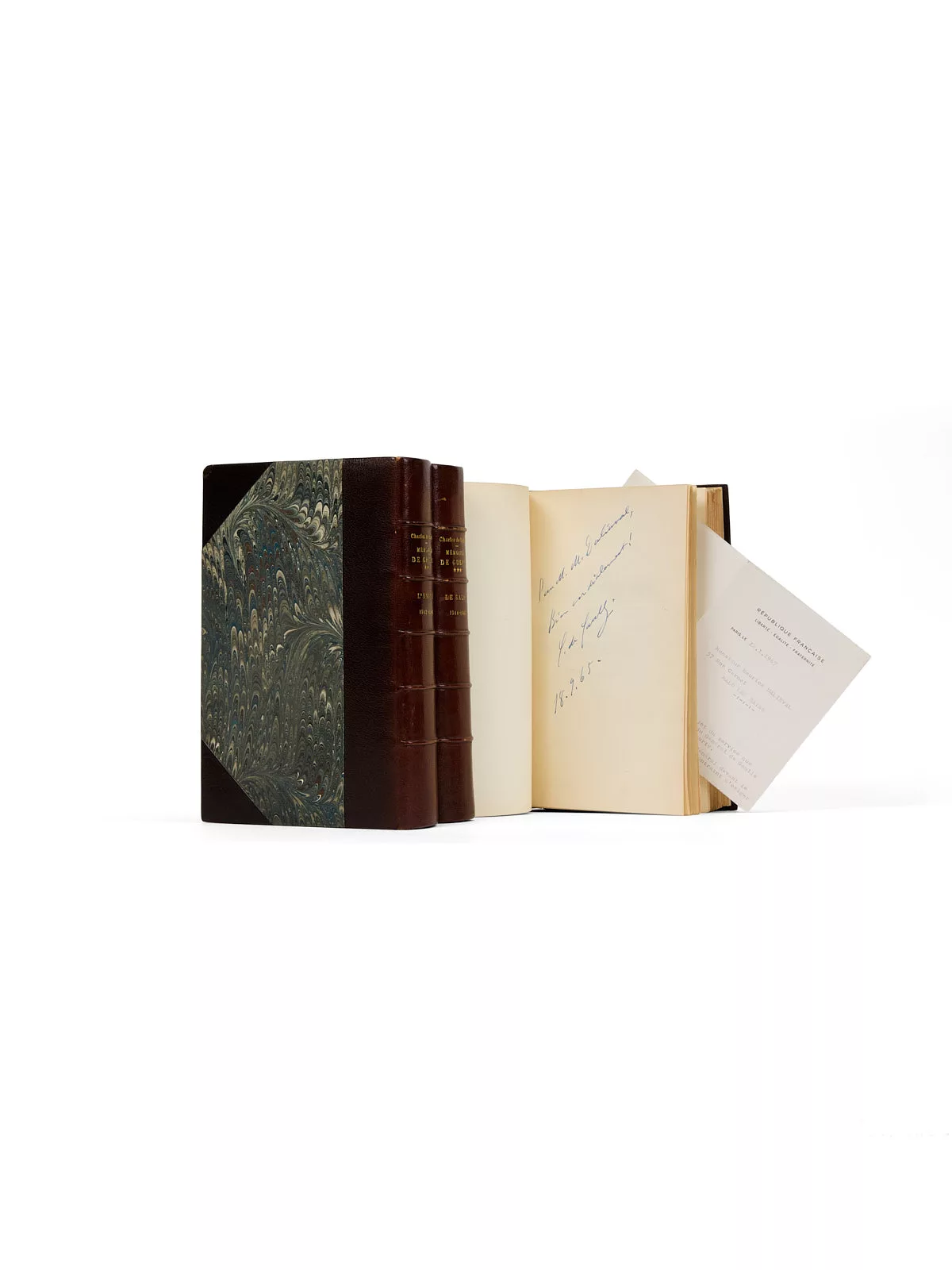
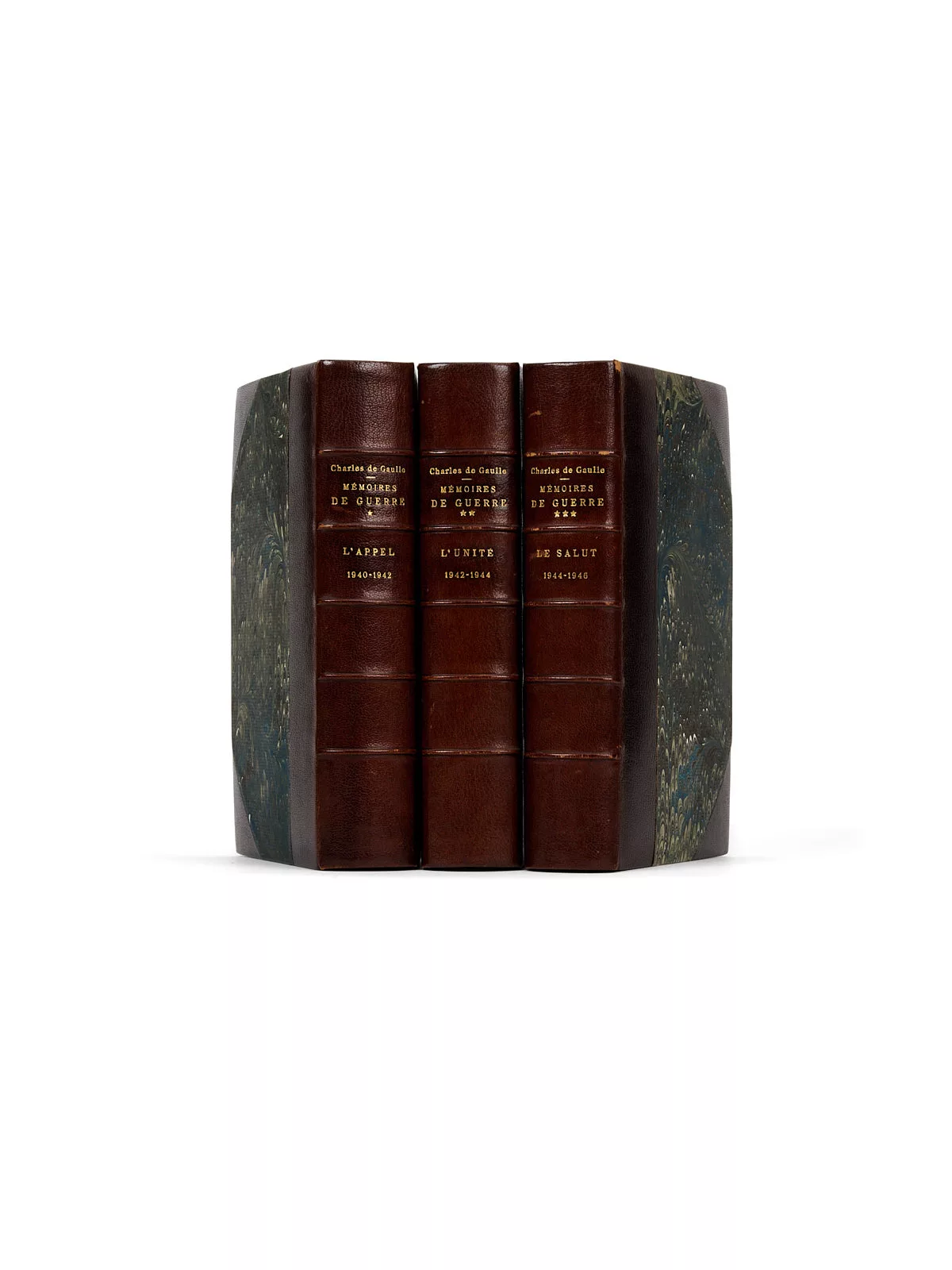
One of 1,550 numbered copies on white roto paper (no. 1074).
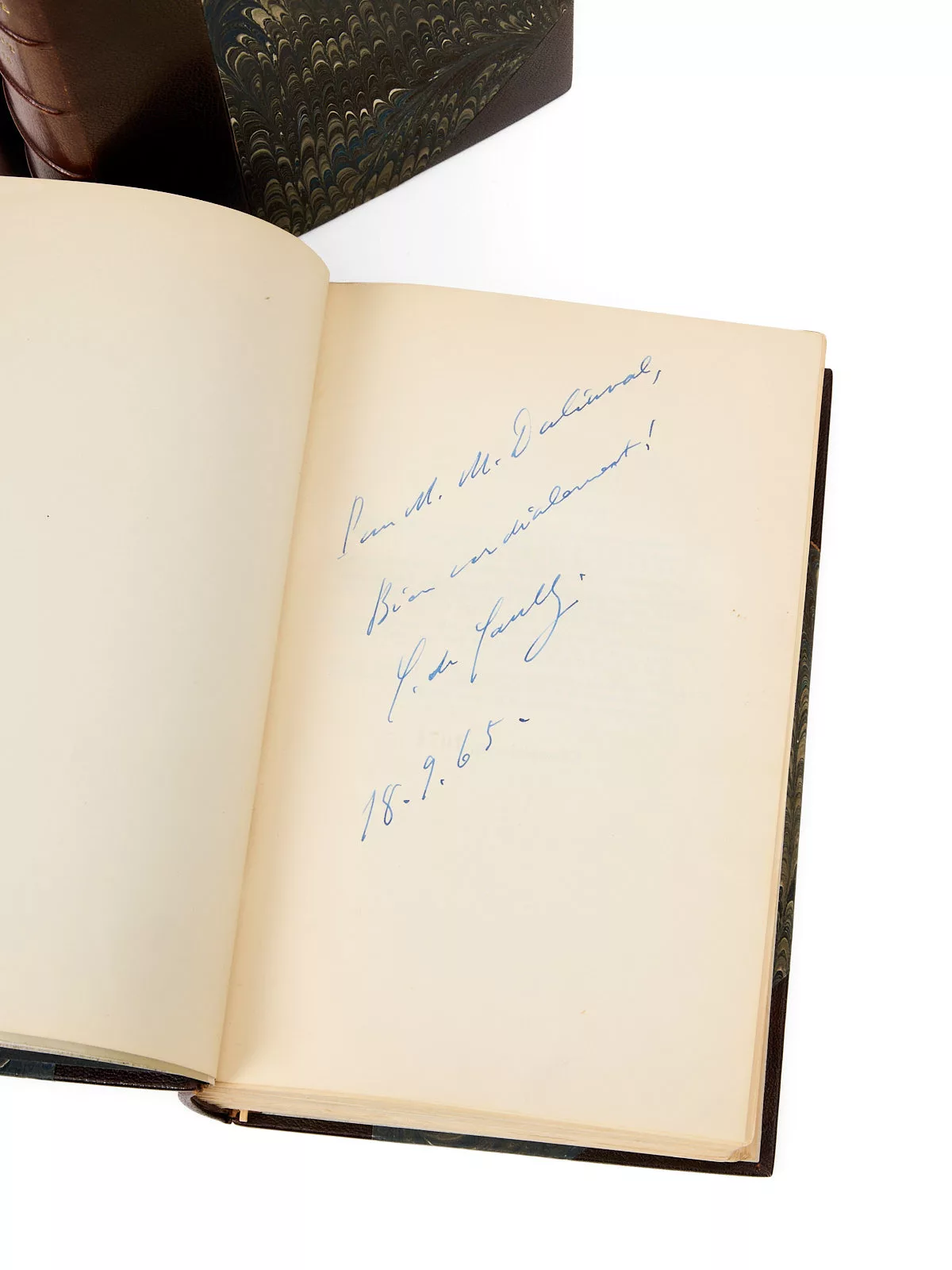
Signed presentation inscription: “Pour M. M. Dalinval, Bien cordialement ! C. de Gaulle. 18.9.65.”
Accompanied by: a typed letter from a deputy to Maurice Dalinval, in response to his request for an autograph.
Written between de Gaulle’s resignation from the government on 20 January 1946 and his return to power in 1958, the Mémoires de guerre allowed Charles de Gaulle to set out his own account of the fight for the liberation of France. He described in detail the epic of Free France, presenting himself as the patriotic defender of his country’s greatness: “All my life I have had a certain idea of France. This is inspired in me as much by feeling as by reason (…) Only vast undertakings are capable of counterbalancing the ferments of dispersion which are inherent in her people; I sense that Providence has created her either for complete successes or for exemplary misfortunes. If, in spite of this, mediocrity shows in her acts and deeds, it strikes me as an absurd anomaly, to be imputed to the faults of Frenchmen, not to the genius of the land. In short, to my mind, France cannot be France without greatness.”
It was thanks to Charles Orengo, and out of loyalty to the firm that had published him just before the war, that de Gaulle turned to Plon for these volumes, against the advice of Malraux, who had recommended Gallimard. He remained faithful to Plon for the rest of his memoirs (Mémoires d’espoir, Discours et Messages, then Lettres, notes et carnets).
Unlike so many statesmen, de Gaulle, the son of a teacher of letters, wrote all his own speeches and books himself. Examination of his manuscripts reveals his extraordinary care for composition and style. The Mémoires de guerre sold some two and a half million copies in France in total, were published in nearly twenty-five foreign languages, received an enthusiastic reception from press and public alike, and were later included as a reference edition in the Bibliothèque de la Pléiade. In the same genre, only Churchill’s The Second World War achieved greater success. The text was recently at the center of a controversy over whether it should be included in the literature curriculum for the final year of secondary school, in the “Literature and Debates of Ideas” section. The answer seems obviously to be yes.
From the library of Maurice Dalinval (bookplate).