

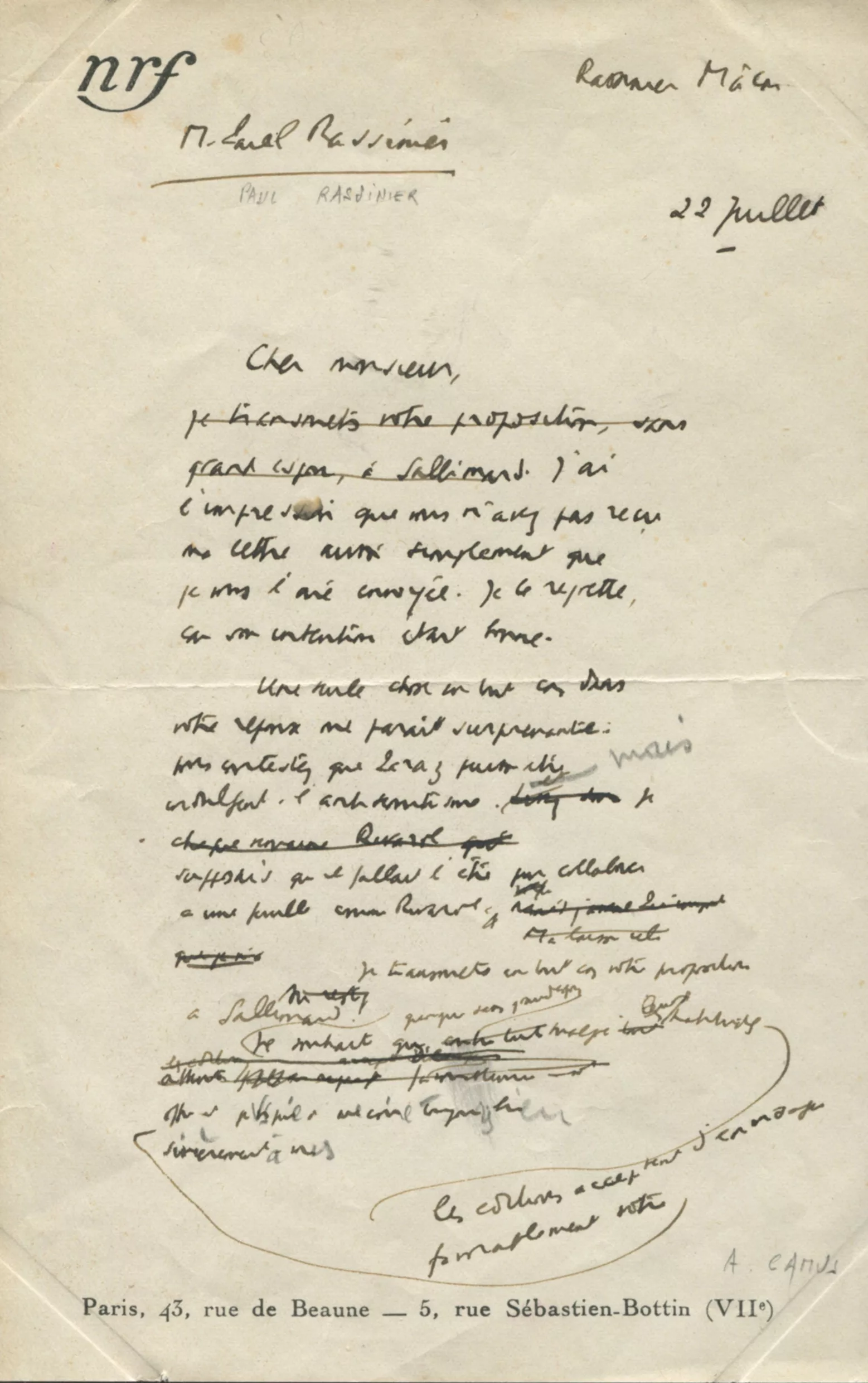
Lettre et brouillon autographes [à Paul Rassinier]
A second letter follows an earlier one, dated 18 July, in which Camus informs Rassinier that his proposed text, submitted to Gallimard, had been politely turned down: “Gaston Gallimard […] refuses to publish purely political essays, which he claims do not sell. I regret this, for my part.” But Camus goes further, and takes Rassinier to task on the substance of the matter: “I have never had anything against your works on the concentration camps. They represent a serious contribution, among others, to the study of this problem. I simply feel that Paraz’s preface was enough to cast suspicion on any such undertaking. On this subject, I continue to think that the libertarian spirit cannot allow itself the slightest indulgence toward antisemitism without denying itself and beginning to degrade itself. This needed to be said, since I believe it […].”
His “Discours de la dernière chance” would eventually be published by “La Voie de la Paix” in 1953.
Paul Rassinier (1906–1967) was a French left-wing political activist who, after the Second World War, became an important figure in Holocaust denial, later cited in 1979 by the denier Robert Faurisson as an essential source. From 1949 onward, he published writings that reveal his gradual drift toward the far right, antisemitism and denialism; he contributed to the journal Rivarol from its founding. In his letter of the 24th, Camus reproaches him for this: “you deny that Paraz could be indulgent toward antisemitism. I, for my part, assumed one had to be, in order to contribute to a paper like Rivarol.”
The typescript presents the same text, reworked, with a few autograph modifications.