

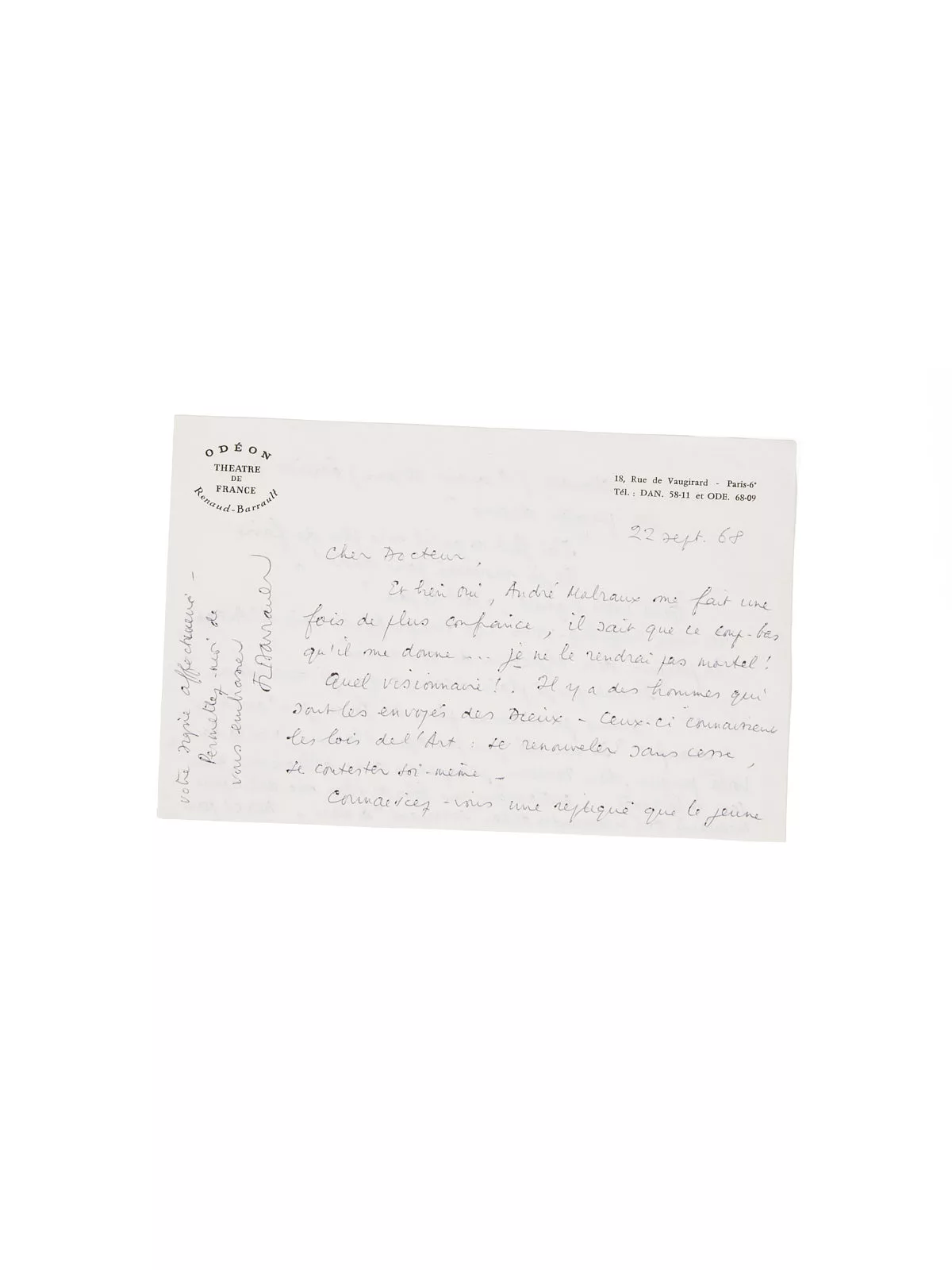
Lettre autographe signée
On 2 September 1968, Jean-Louis Barrault received a letter from André Malraux, Minister of Cultural Affairs, terminating his position as director of the Théâtre de France. Malraux had entrusted him with the direction of the Théâtre de l’Odéon in 1959. This dismissal, officially justified by “various statements,” appears in fact as a punishment: as soon as the May protesters made their first attempts to occupy the theater, Malraux had demanded that the staff, including its director, evacuate the premises. Barrault refused. The very next day, the ministry publicly disavowed the director of the Théâtre de France for not having left the premises as requested, for having sided with the protesters, and for having made “statements that appear very far removed from the mission entrusted to him” — an allusion to his reply on 17 May, before a packed house, to Daniel Cohn-Bendit, who had called for a theater that would be “a weapon of struggle against the bourgeoisie.” Personally targeted, Barrault had then declared: “At the risk of disappointing you, I will say that I completely agree with you. Barrault is no longer the director of this theater, but an actor like any other. Barrault is dead!”
Three months later, this statement received its official confirmation. Malraux specified before the National Assembly that “the talent of Mr. Jean-Louis Barrault, to whom the greatest artistic freedom has been granted since the founding of the Théâtre de France, is not in question. But he has made various statements manifestly incompatible with the position of director of a national theater.” Malraux never forgave Barrault, his protégé, for having wavered before the enemy.
In a letter later made public, Jean-Louis Barrault explained his conduct, and in particular why he had refused, as the ministry demanded, to leave the Odéon after cutting off electricity and telephone service. He considered that, given the circumstances, the ministerial disavowal seemed to him rather honorable. He concluded his letter, “in the fashionable style: a servant, yes; a valet, no,” writing: “…I suffered from an official silence that lasted for weeks and weeks. Silence-as-absence is the cruelest thing there is. It is silence-as-torture. I understand everything, or at least I try to, but that I cannot manage! But what good does it do to dwell on the past? Our fate, Madeleine Renaud’s and mine, is to start our lives over again every ten years.” This is precisely what Barrault evokes here in this letter, with the “joy” of once again taking up his “knapsack and the road.” Barrault would go on to stage a new production, Rabelais, at the new Élysée-Montmartre theater, feeling “neither bitterness nor resentment… cherishing my contemporaries, that is my creed,” as he explained in the December 1968 issue of Le Figaro Littéraire.