

Letter to Michael and Babette Wills
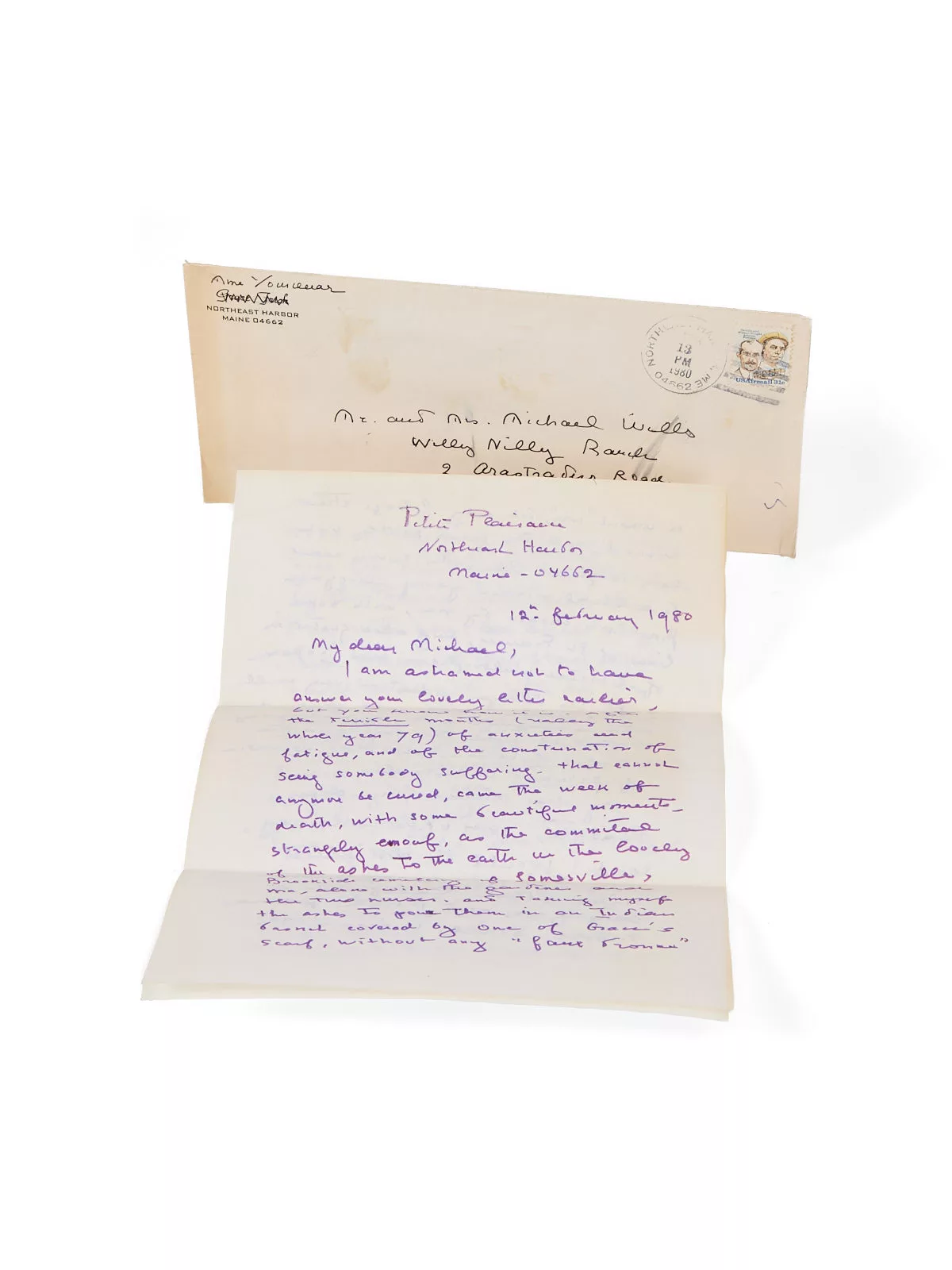
Grace Frick had died at Petite Plaisance on November 18, 1979, after a long illness. Yourcenar looks back here on “the terrible months (nearly the whole year 79) of anxiety and fatigue” spent at her companion’s side as her suffering could no longer be relieved, and then on the week of her death, during which, she writes, there were nonetheless “some beautiful moments.”
She describes, in particular and with great precision, the burial of the ashes at the Brookside Cemetery in Somesville. Accompanied only by the gardener and two nurses, she herself had carried the ashes, placed not in a funerary urn but in an Indian basket covered with one of Grace’s scarves. The return to the earth was to take place without any funerary apparatus, among the foliage, the turf then replaced.
The ceremony itself matched this same simplicity. A young minister chosen by Yourcenar read texts by Saint Francis, Chinese philosophers and Japanese poets. She had in particular selected a passage from Zhuangzi on death, noting that the villagers, a fishing community, grasped its meaning perfectly.
The letter then turns from mourning to travel plans. Michael and Babette Wills had invited her to stay with them at Willy Nilly, their house in Portola Valley, California. Yourcenar, who by now detests air travel, imagines a fabulous journey: sailing from New York to San Francisco via the Panama Canal, then spending three weeks with them, then returning by automobile through the national parks — perhaps even continuing on to Japan! “You see that my plans are all made.” She nonetheless postpones the trip, anxious to set aside time for her unfinished work, and mentions the ever-possible prospect of a return to Paris, a city she says she no longer loves, “too big, too Americanized, and too many futile visitors for me.”
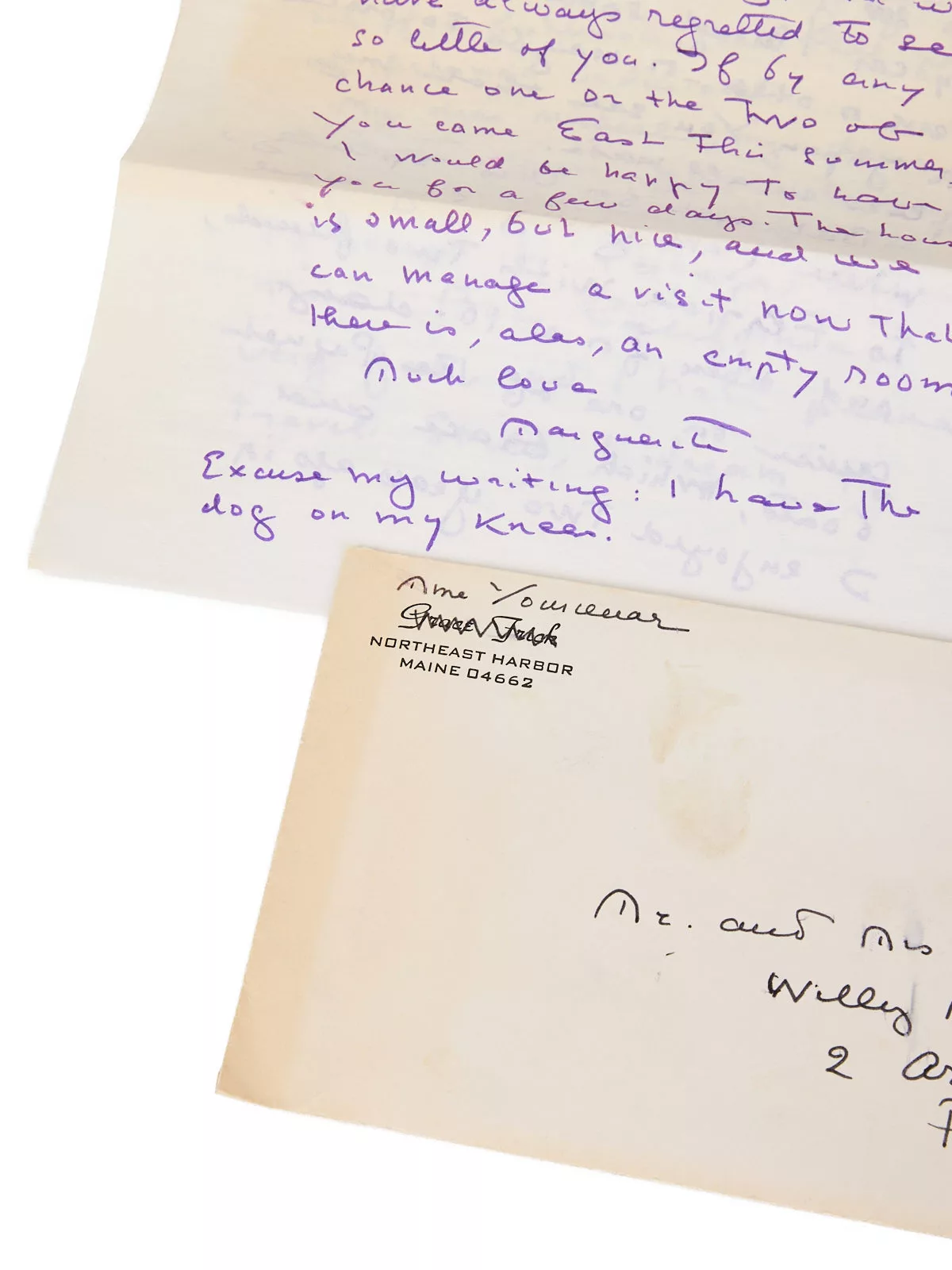
The end of the letter spells out the Wills’s place in Yourcenar’s American life: “Babette and Michael, you are among my best and earliest friends in this country.”
Elisabeth “Babette” Wills (1912–2009), born in Saint-Gobain, had lived in the artistic circles of 1930s Paris with her first husband, the American painter Paul Ullman. Having taken refuge in the United States in 1940, they settled in Connecticut; Ullman was killed in France in 1944 while working for the Office of Strategic Services. Babette married Michael Wills in 1945.
Later settled in Portola Valley, the Wills made Willy Nilly a gathering place for artists, intellectuals and activists. The friendship Yourcenar evokes here was a long-standing one: Michael Wills appears in her correspondence as early as the postwar years. The present letter, however, offers a particularly explicit testimony of it, nearly thirty-five years after the Wills’s marriage. It closes on a homely note that contrasts with the gravity of its opening pages: “Excuse my writing! I have the dog on my knees” — the dog being Zoé, the faithful companion of Petite Plaisance, whom Yourcenar mentions several times in her correspondence and whom a journalist still describes at her side some months later, in September 1980.
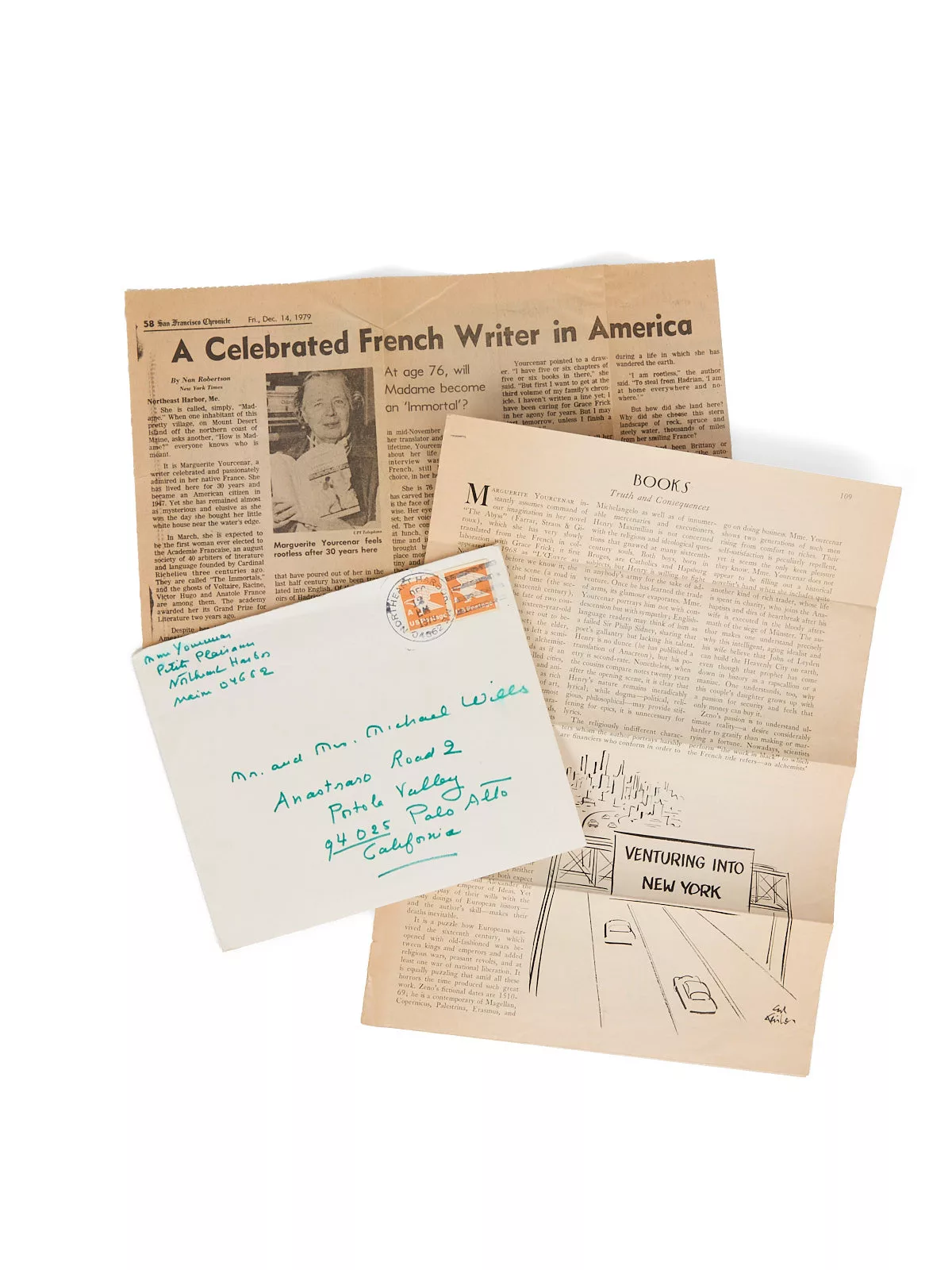
Accompanied by: a set of six American press clippings (one a photocopy) kept by the Wills, concerning Marguerite Yourcenar and in particular her election, on March 6, 1980, to the Académie française, of which she was the first woman member. An autograph envelope by Yourcenar addressed to “Mr. and Mrs. Michael Wills, Anastasia Road 2, Portola Valley, Palo Alto, California,” postmarked Northeast Harbor, December 13, 1980, attests to the sending of this documentation. Among the clippings are also articles devoted to Grace Frick and her death in November 1979.
Letters by Marguerite Yourcenar of this quality are particularly rare.