

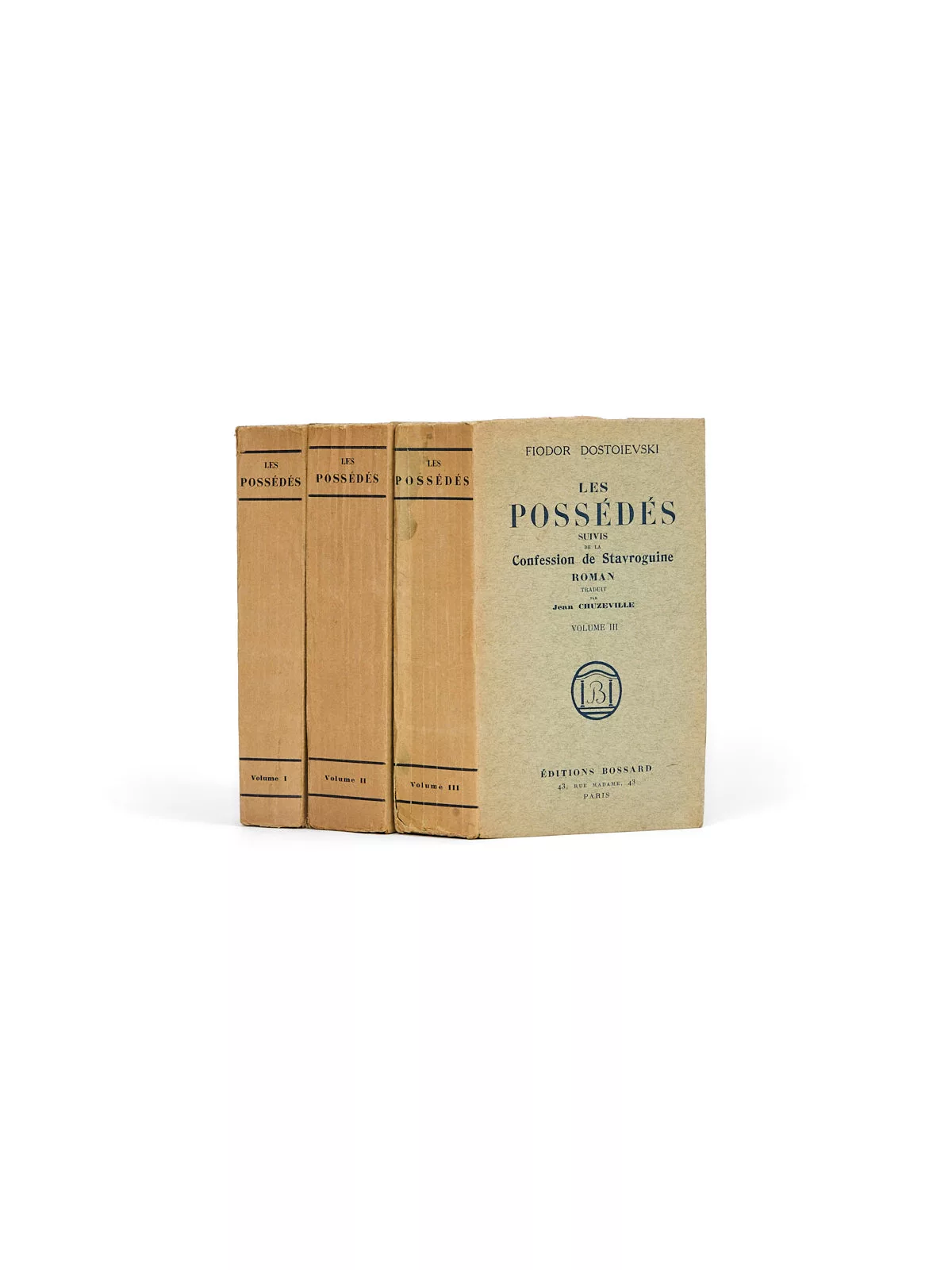
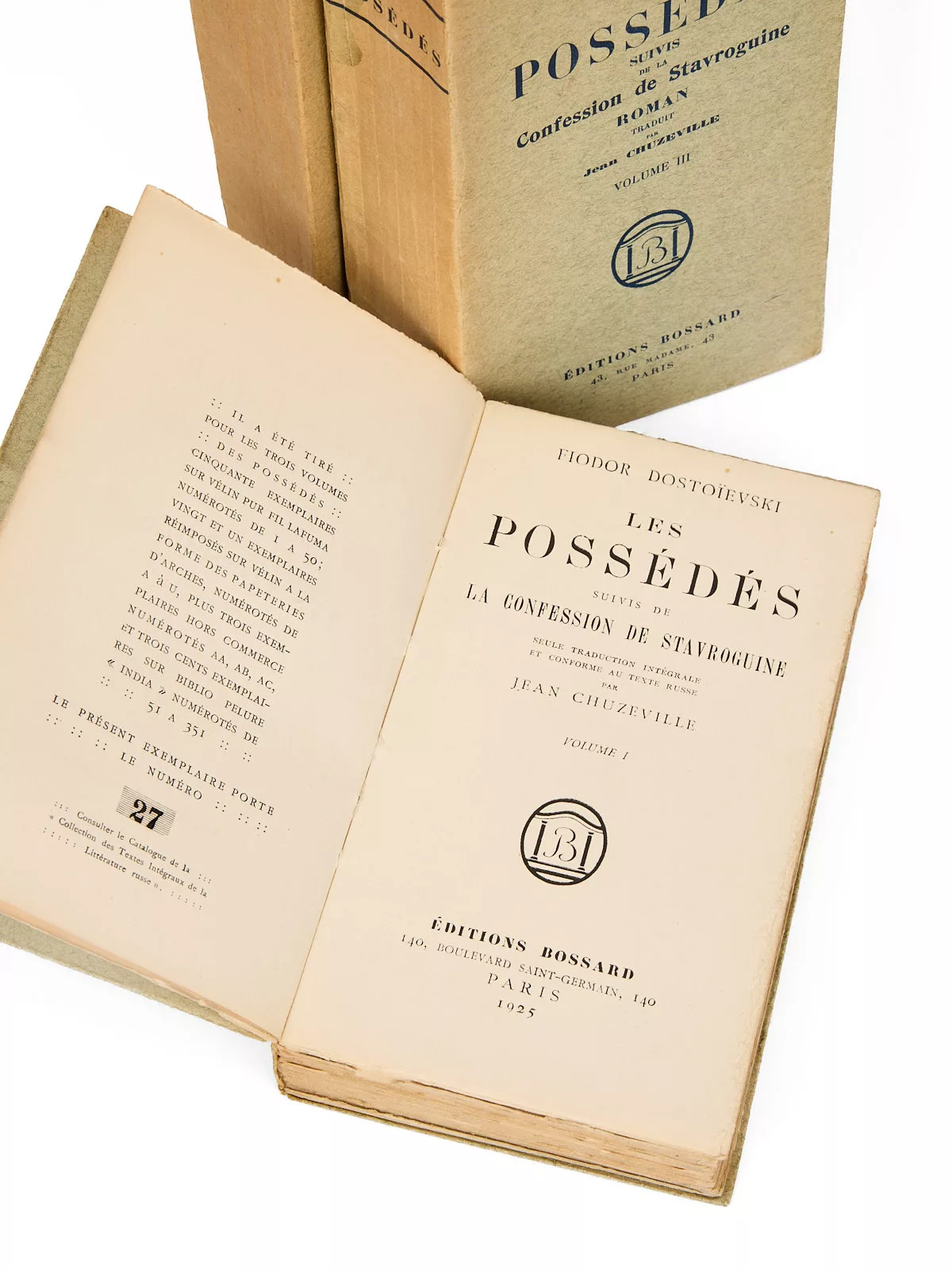
Les Possédés
One of 50 copies on vélin pur fil (no. 27).
Serialized in Russia between 1871 and 1872, The Demons — later known as The Possessed — is arguably the most directly political of Dostoevsky’s great novels.
Its genesis lies in the writer’s years of European exile. From 1867 to 1871, weighed down by debt and pursued by creditors, Dostoevsky left Russia with his young wife Anna and lived successively in Germany, Switzerland and Italy. In Geneva, in September 1867, he attended sessions of the Congress of Peace and Freedom, where some of the leading European political and intellectual figures of the day gathered. The experience repelled him: Dostoevsky saw in it the embodiment of everything he despised in a certain Western intelligentsia — abstract internationalism, the negation of homelands, materialism and absolute faith in political progress. A Russian event soon gave these anxieties the dramatic material for his novel: the Nechaev affair.
In November 1869, the revolutionary Sergei Nechaev had the student Ivan Ivanov murdered in Moscow, a member of his own clandestine group whom he suspected of wanting to break away from it. The affair both fascinated and horrified Dostoevsky, who saw in it the concrete realization of what he had already sensed: an ideology that, pushed to its ultimate consequences, ends by sanctioning lies, manipulation and murder in the name of an abstract future.
This event supplied one of the sources of The Possessed, which thus became at once a political satire, a metaphysical tragedy and an extraordinary study of the mechanisms of radicalization — a text Camus discovered very young, probably in this very edition. In 1955 he confided: “I encountered this work at twenty, and the shock it gave me still lasts, twenty years later.” It is no accident that he would later choose The Possessed for one of his most ambitious theatrical undertakings. His adaptation, staged in 1959, brought to the stage the same question already at the heart of The Rebel: at what point does revolt, claiming to liberate man, end up justifying his destruction?