

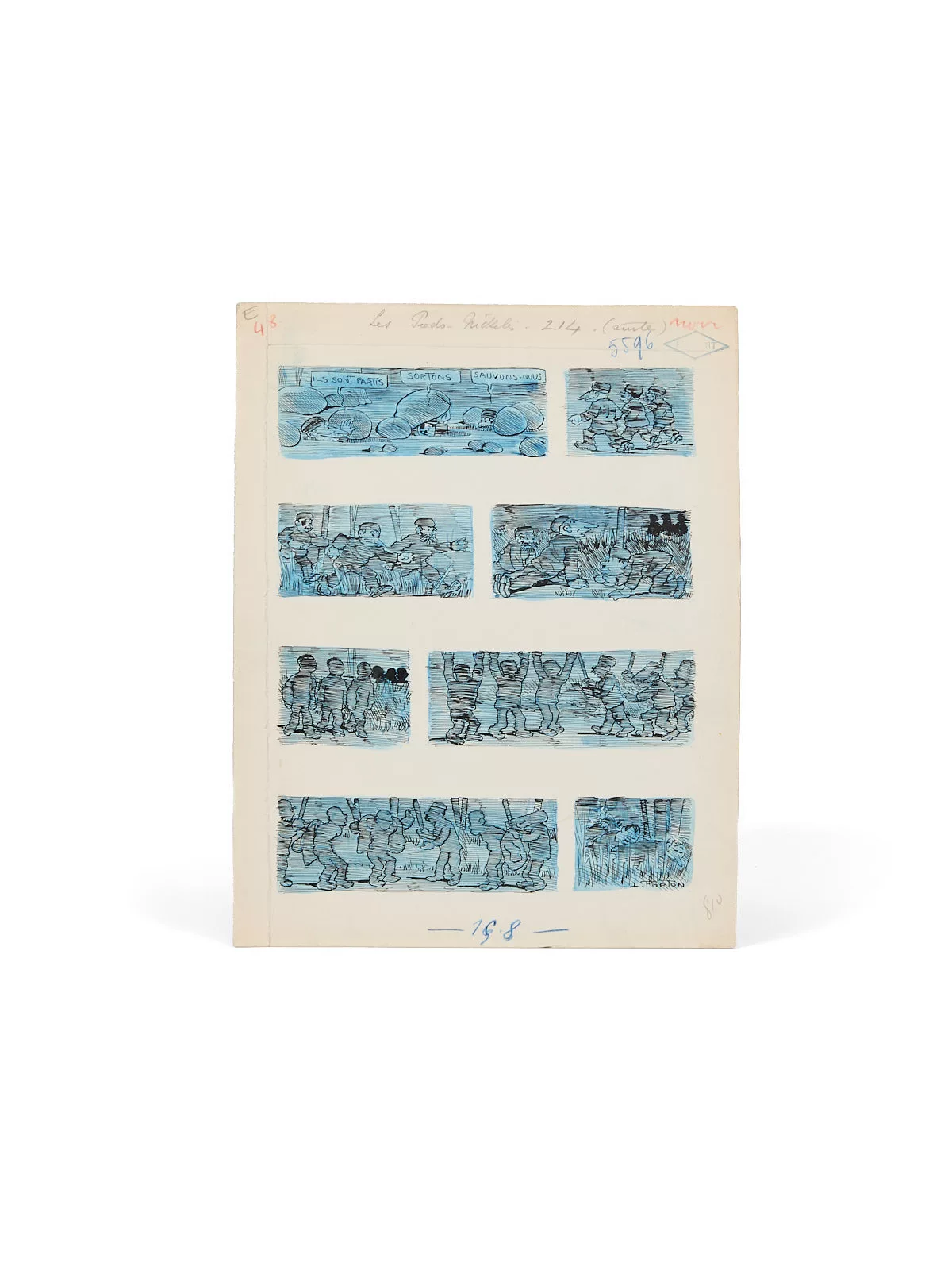
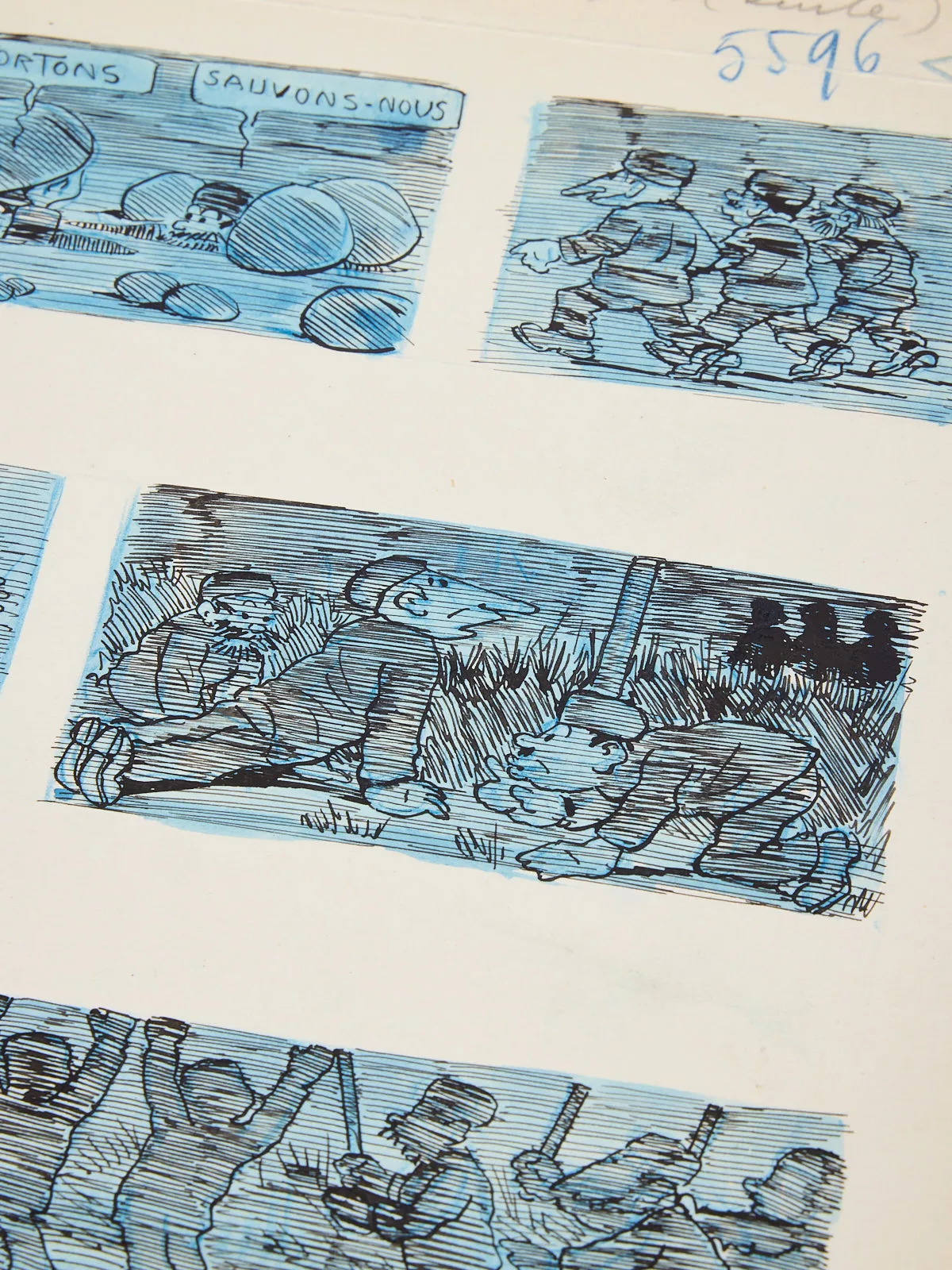
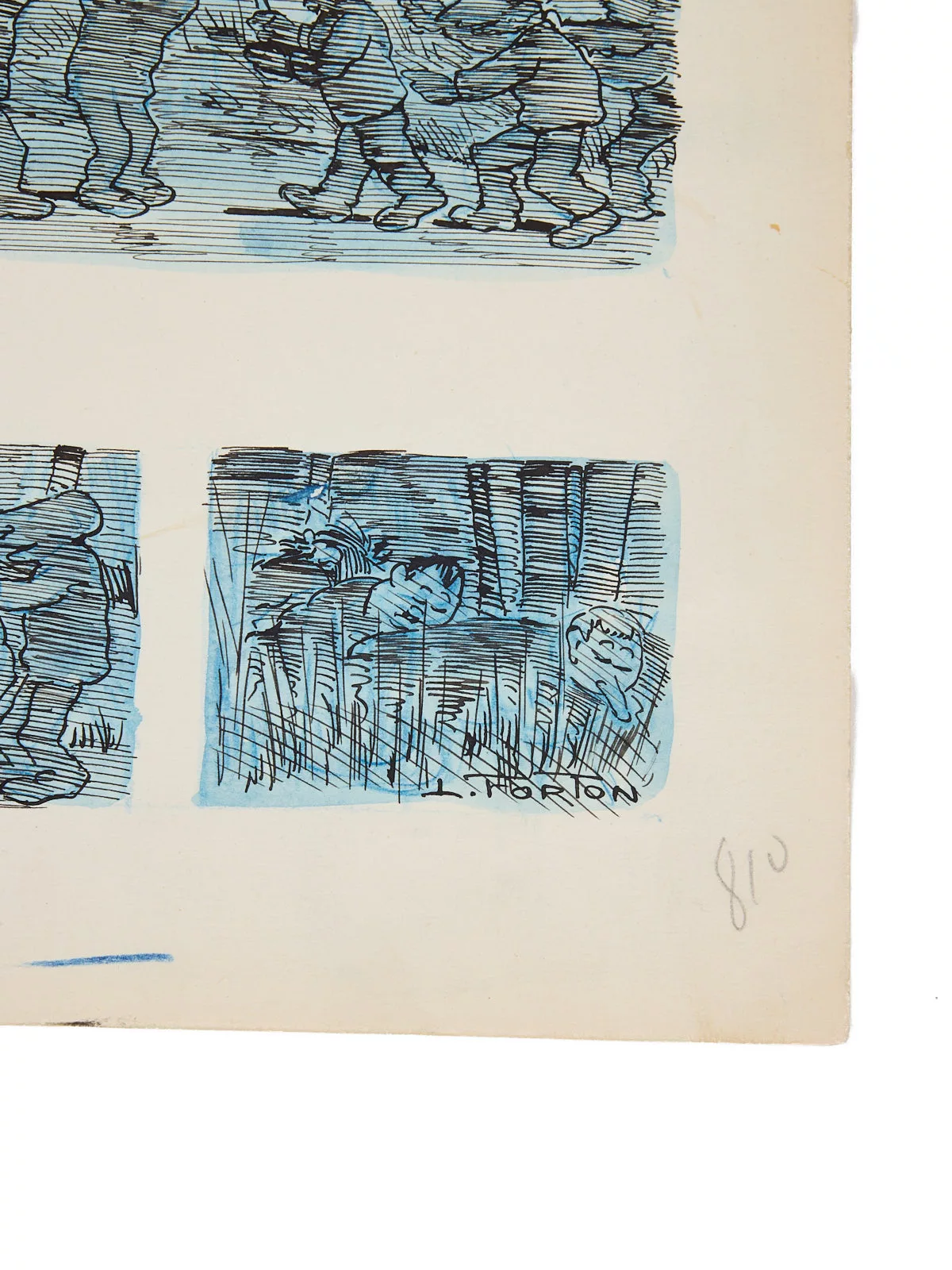
India ink and blue pencil on paper. Eight panels, with several “Forton” signatures.
Production notes reading “Les Pieds Nickelés – 214 – suite,” “5596” and “198.”
At the start of the twentieth century, unlike La Jeunesse illustrée and Les Belles Images from Arthème Fayard, or Gautier-Languereau’s La Semaine de Suzette, which populated the dreams of well-behaved bourgeois children, the Offenstadt publishing house chose to address a working-class readership with L’Illustré (1904), which became Le Petit Illustré (1906), L’Épatant (1908), L’Intrépide (1910) and Le Cri-Cri (1911). All inexpensive (5 centimes until 1917), running 10 to 16 pages (a quarter in color) and in a format easily handled by children (approximately 20 x 30 cm), these weeklies spread the comic strip: a revolution in reading that allowed young readers to follow the story through the succession of images, despite the continued dominance of text.
Of all these periodicals, L’Épatant was the most popular, thanks in particular to the publication of the “Pieds Nickelés,” but also to its highly attractive color covers, its cheeky, slang-inflected tone, its systematic celebration of mischief, and its use of barracks-room humor. This humor, sometimes bordering on vulgarity, appealed to working-class readers, who were also the audience for the earliest slapstick films. The high point came with the arrival of the “Pieds Nickelés,” in no. 9 of April 4, 1908.
Created by Louis Forton, Croquignol, Filochard and Ribouldingue established one of the first great popular myths of French comic strips: three rogues who resisted all forms of work, living by their wits through schemes, swindles and adventures as improbable as they were irreverent. Forton was notably one of the pioneers in France of the regular use of the speech balloon, which he here still combines with narrative text placed beneath the images.
This plate belongs to the adventure published in L’Épatant between September 1930 and April 1931, which was collected two years later by the Société parisienne d’édition under the title Les Pieds Nickelés en Amérique. The first edition of the album appeared in 1933.
The three Pieds Nickelés appear here as escaped convicts, hiding in the grass to evade their armed pursuers. The plate also bears witness to a pivotal moment in the history of French comic strips. Forton, who had been one of the pioneers of the speech balloon in France as early as 1908, still retains here the traditional narrative structure of captions placed beneath the images, while also giving his characters direct speech: “Ils sont partis,” “Sortons,” “Sauvons-nous”: three speech balloons, a device whose use was still far from standardized, and a coexistence of the two narrative modes particularly characteristic of his work.
The captions visible in L’Épatant were added typographically beneath the panels at the time of publication.