

Le Flagellant de Séville
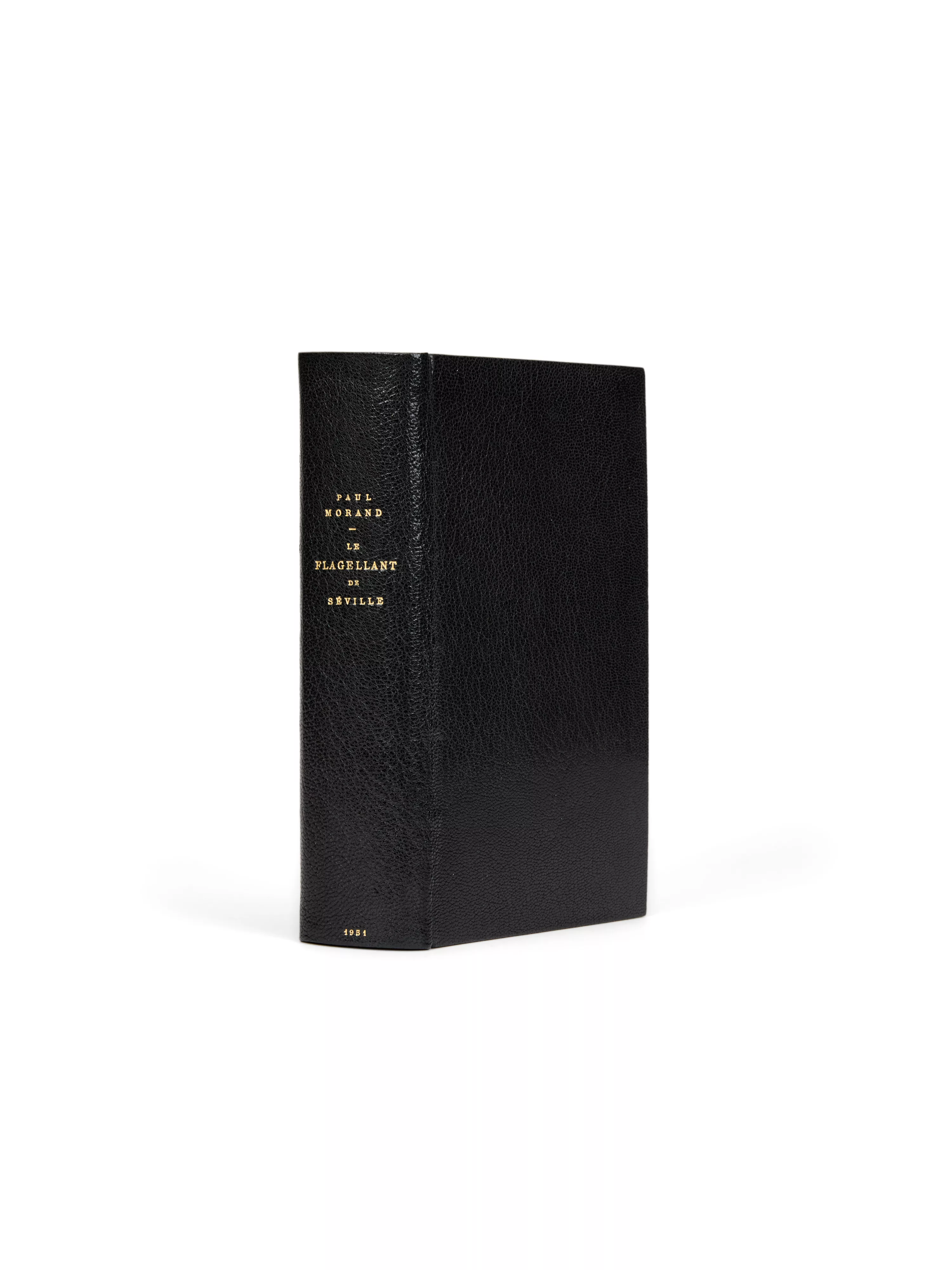
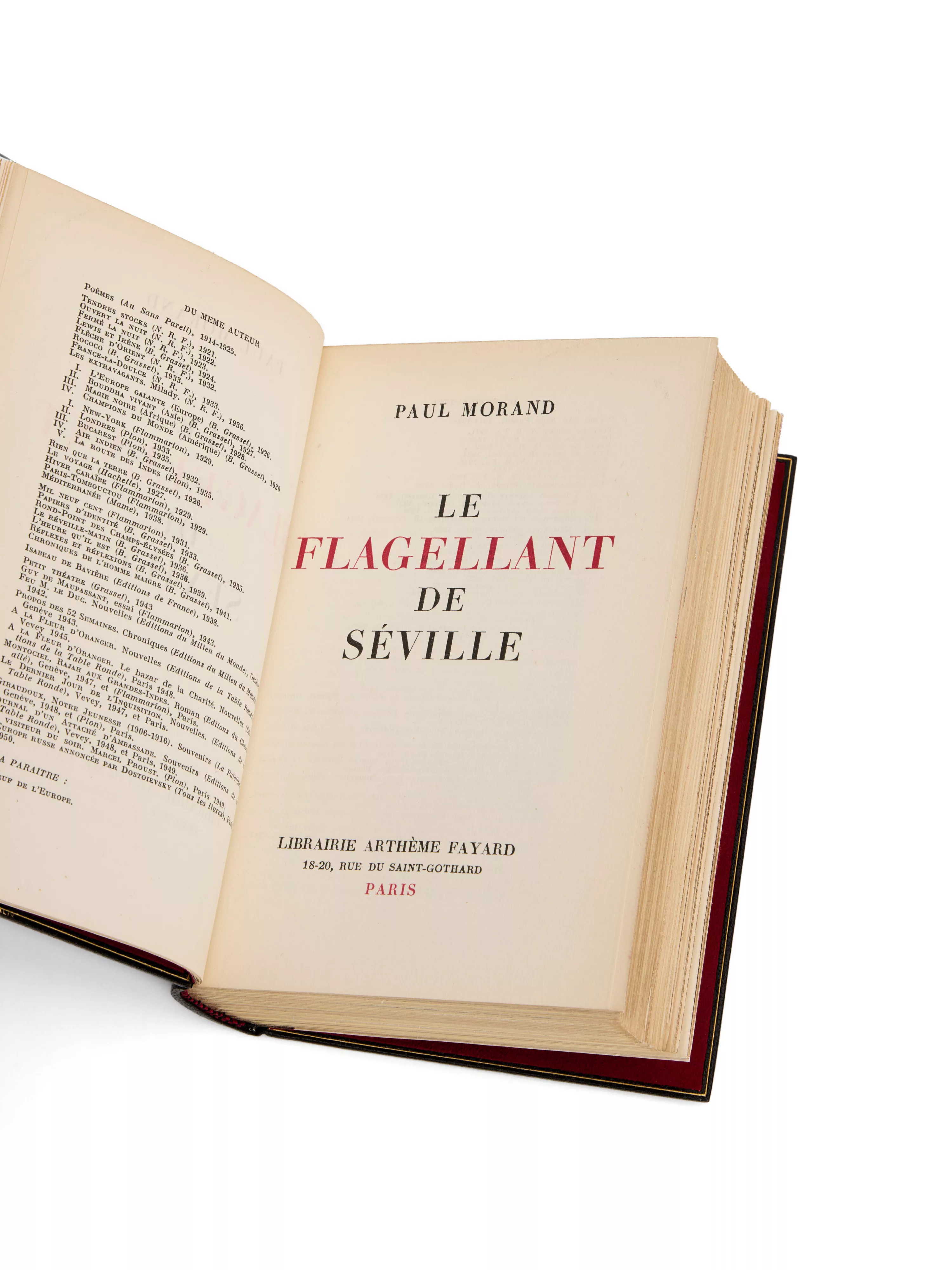
One of 5 deluxe copies on vélin de Hollande Van Gelder Zonen (no. II).
Published in 1951, Le Flagellant de Séville belongs to a very particular moment in Paul Morand’s career. Removed from the diplomatic service at the Liberation and settled in Switzerland, he turned to the historical novel, undertaking a book of unusual scope and construction for a writer more accustomed to works celebrating speed, concision and the instantaneous.
The action takes place in Spain under Napoleonic occupation, between 1808 and 1813. Morand stages the conflict between Spaniards who took up arms against the French occupier and those who, out of admiration for Enlightenment France and for Napoleon, agreed to serve the new regime. Beneath the surface, the subject is occupation, loyalty, resistance and collaboration — words that had inevitably acquired a particular ambiguity for a French writer in 1951.
On 7 September 1949, while still working on the novel in Vevey, Morand himself gave Jacques Chardonne this striking description: he was writing, he said, “a long novel of 500 pages which will be the ordeal of a Spaniard collaborating with the French (1808–13) out of love for Napoleon.”
The parallel with the 1940s is all the more significant since Morand was writing in the aftermath of his own experience of Vichy. A career diplomat, he had continued to serve under the regime, which appointed him Minister of France in Bucharest in 1943 and then Ambassador in Bern in 1944. At the Liberation, this record led to his removal from the Quai d’Orsay; he remained in Switzerland and was not reinstated until 1954. It was during this period of withdrawal that Le Flagellant was conceived.
Michel Collomb, who selected Le Flagellant de Séville among the eight Morand novels collected in the Pléiade edition, stresses precisely this double level of reading: Napoleonic Spain gives Morand the historical distance through which he revisits, without ever naming them directly, the Occupation, the Collaboration and the Purge. Beneath the historical accuracy of the Spanish narrative, numerous allusions surface to what Morand himself had known and lived through.
The nature of this transposition remains debated. Some commentators have read the novel as an indirect justification of the Collaboration; others have emphasized the book’s ambivalence and the way Morand distributes reasons, loyalties and blindness between the two camps. As early as his response to Morand’s reception speech at the Académie française, Alain Peyrefitte noted this ambiguity: while presenting the hero as caught in the “drama of collaboration with the occupier,” he observed that the novelist’s sympathy sometimes seemed to lie more with the uncompromising Marisol, hostile to the French, than with her husband Don Esteban.
The publication of the correspondence with Jacques Chardonne has since made the personal and political background of this postwar work even more apparent, without reducing the novel to a simple roman à clef. Le Flagellant de Séville remains above all a vast historical novel, informed by extensive documentary research, and one of Morand’s most ambitious undertakings in the genre.
Peyrefitte considered it “perhaps [his] most constructed work” and, above all, “the one into which [he] had put the most of [himself].” Morand himself readily acknowledged, late in life, the personal investment behind this “drama of collaboration.”
A very fine copy, beautifully bound by Hélène Alix. Trained by her father, the binder Paul Guglielmoni, Hélène Alix (1920–2006) worked with her husband Henri Alix in the workshop they founded in 1947 at 52 rue Saint-André-des-Arts. Until Henri’s death in 1959, their bindings bore the signature “H. Alix.” Hélène continued the workshop alone, adopting the signature “Alix” by itself, before being joined by her son Jean-Bernard, who in turn took over the workshop in 1985, keeping the same signature.
The early character of this admirable jansenist binding allows it to be confidently attributed to Hélène Alix.
The smallest deluxe printing among Morand’s novels.