

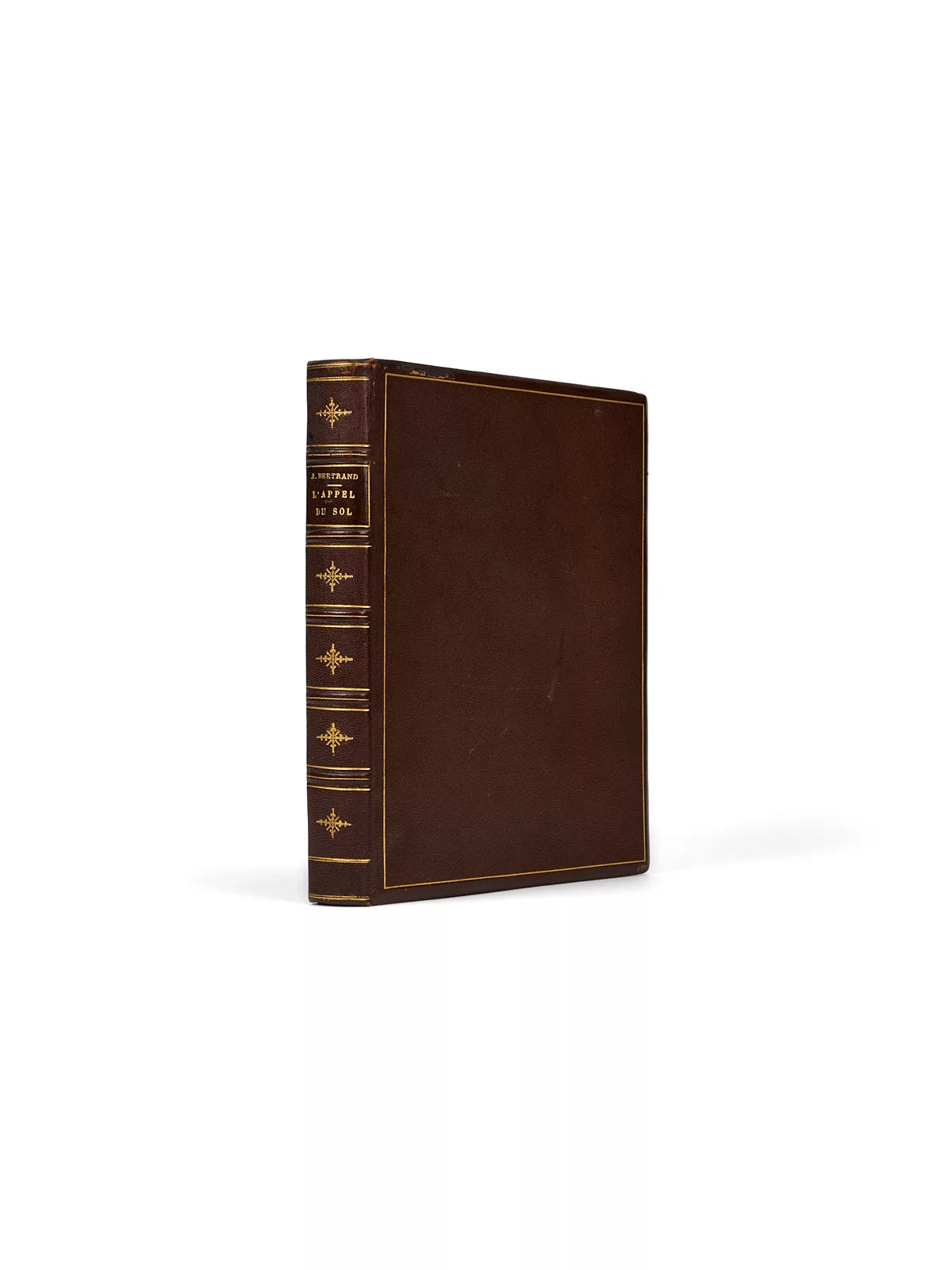
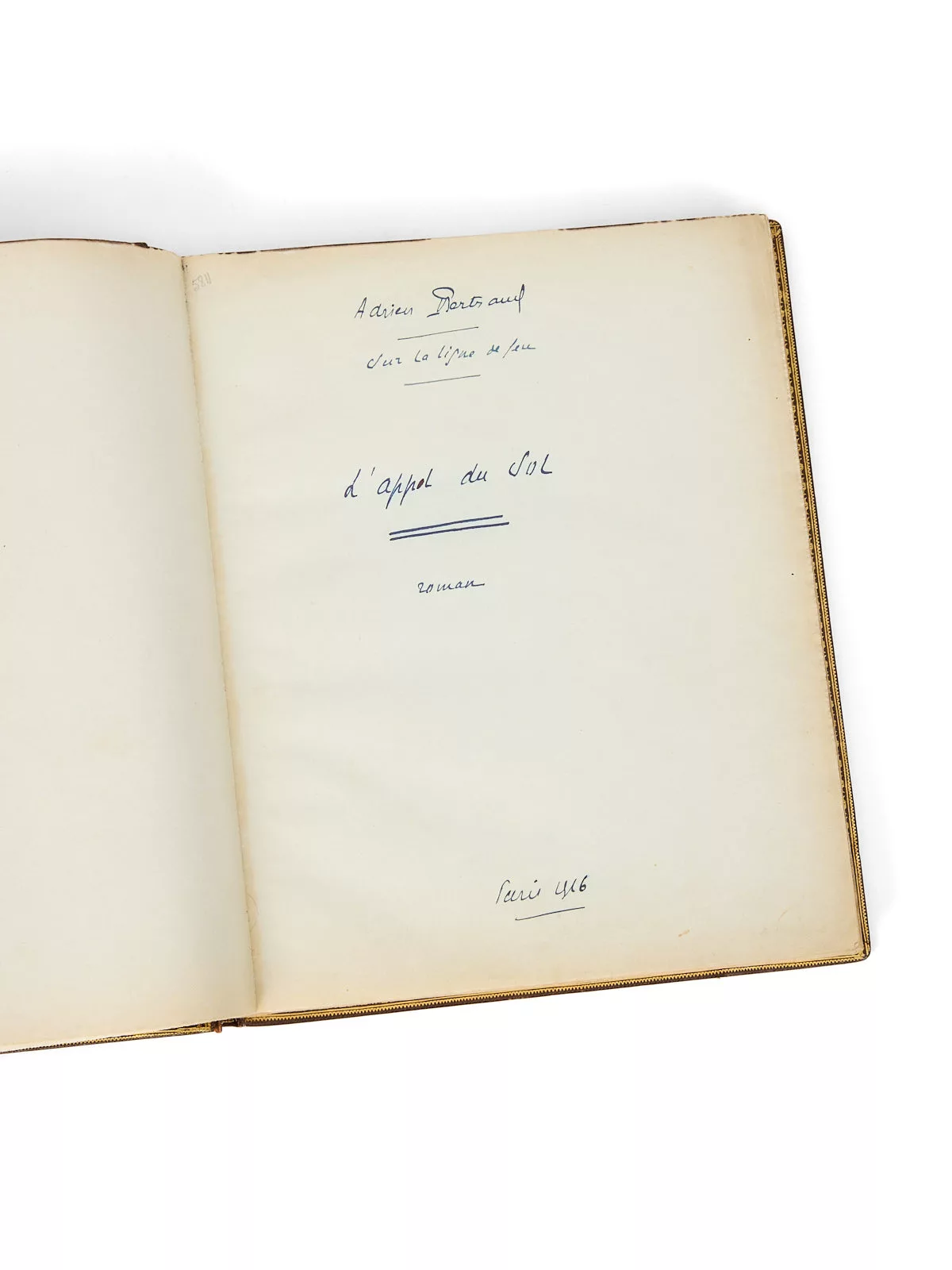
L’Appel du sol
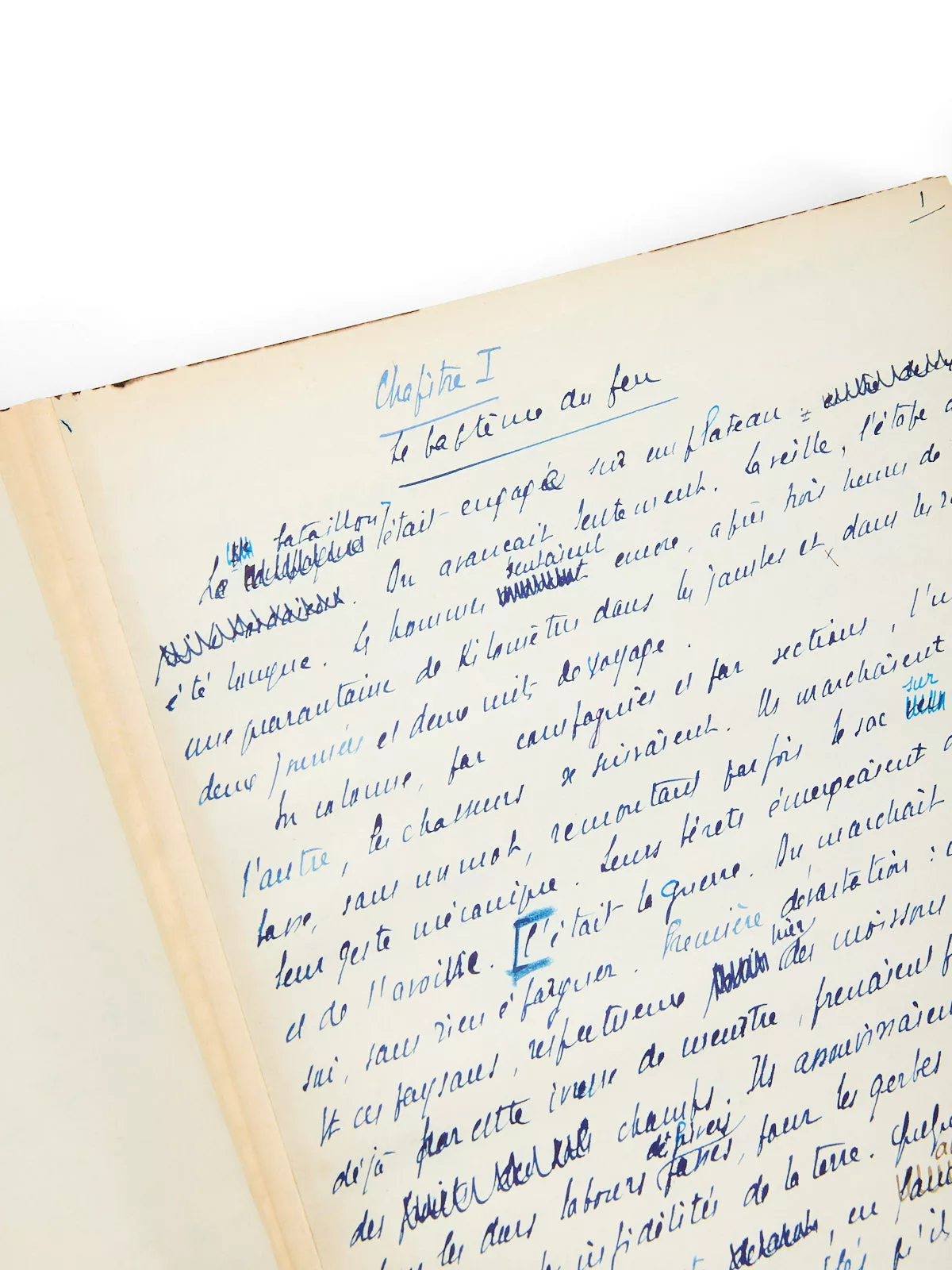
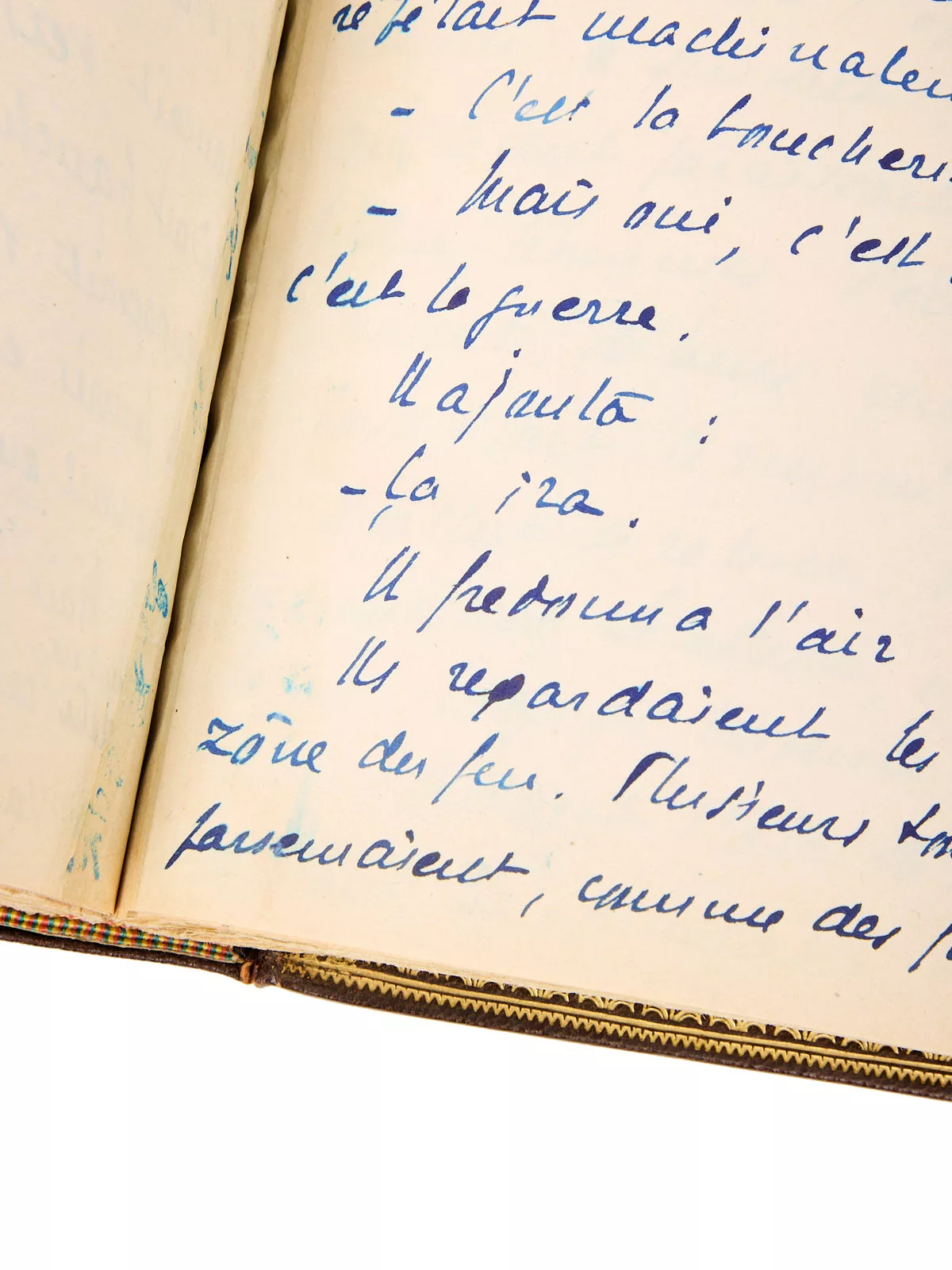
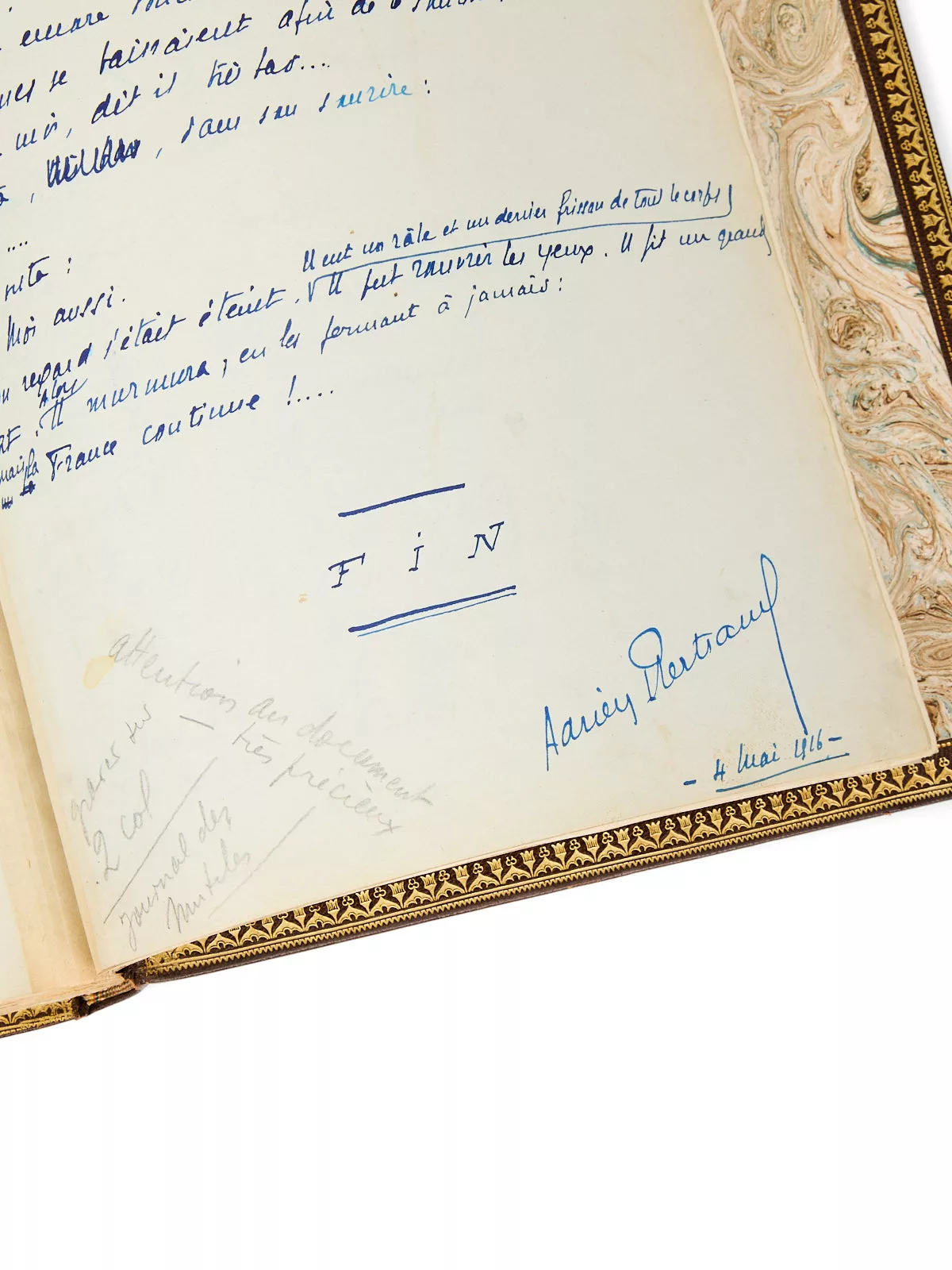
It contains extensive corrections, with several previously unpublished passages.
Signed and dated “4 mai 1916” by the author, this is a unique piece directly linked to the novel's serialization in the Revue des Deux Mondes (beginning in August 1916), and its subsequent publication in book form (October 1916).
Two months later, it was awarded the 1914 Prix Goncourt, exceptionally granted in December 1916, over Maurice Genevoix's Sous Verdun.
Born on 4 August 1888 in Nyons (Drôme), educated at the École alsacienne and then the Lycée Louis-le-Grand, admitted to the École normale supérieure two years before Maurice Genevoix, Adrien Bertrand turned early to journalism (Gil Blas, Le Siècle, Clemenceau’s L’Homme libre, among others). An antimilitarist by temperament, but unhesitating when it came to action, he joined the 2nd Dragoon Regiment in August 1914. On 7 September, a daring reconnaissance mission “toward Clairefontaine and Héméril” earned him a citation and a battlefield promotion: “The General is pleased to bring to the Division’s attention the extremely bold and highly successful reconnaissance carried out on 7 September […] under the command of Sergeant Bertrand (Adrien) of the 2nd Dragoon Regiment. […] Sergeant Bertrand is promoted to sub-lieutenant” (Croix de guerre, silver star). Roland Dorgelès later fixed the legend in his Anthologie des écrivains morts à la guerre: daring reconnaissance missions, a surprised group of Germans, six enemies killed including a captain, and trophies brought back — a helmet and a saber “with a jewel-encrusted hilt.” In the last days of October 1914, near Hénaménil (Lorraine), a shell fragment struck him in the chest; the wound became infected and pulmonary tuberculosis set in. Moving between sanatoriums and hospitals, he wrote lying down, in pencil, “knowing himself lost” but determined to leave a body of work: La Victoire de Lorraine, verse, tales, and then L’Appel du sol.
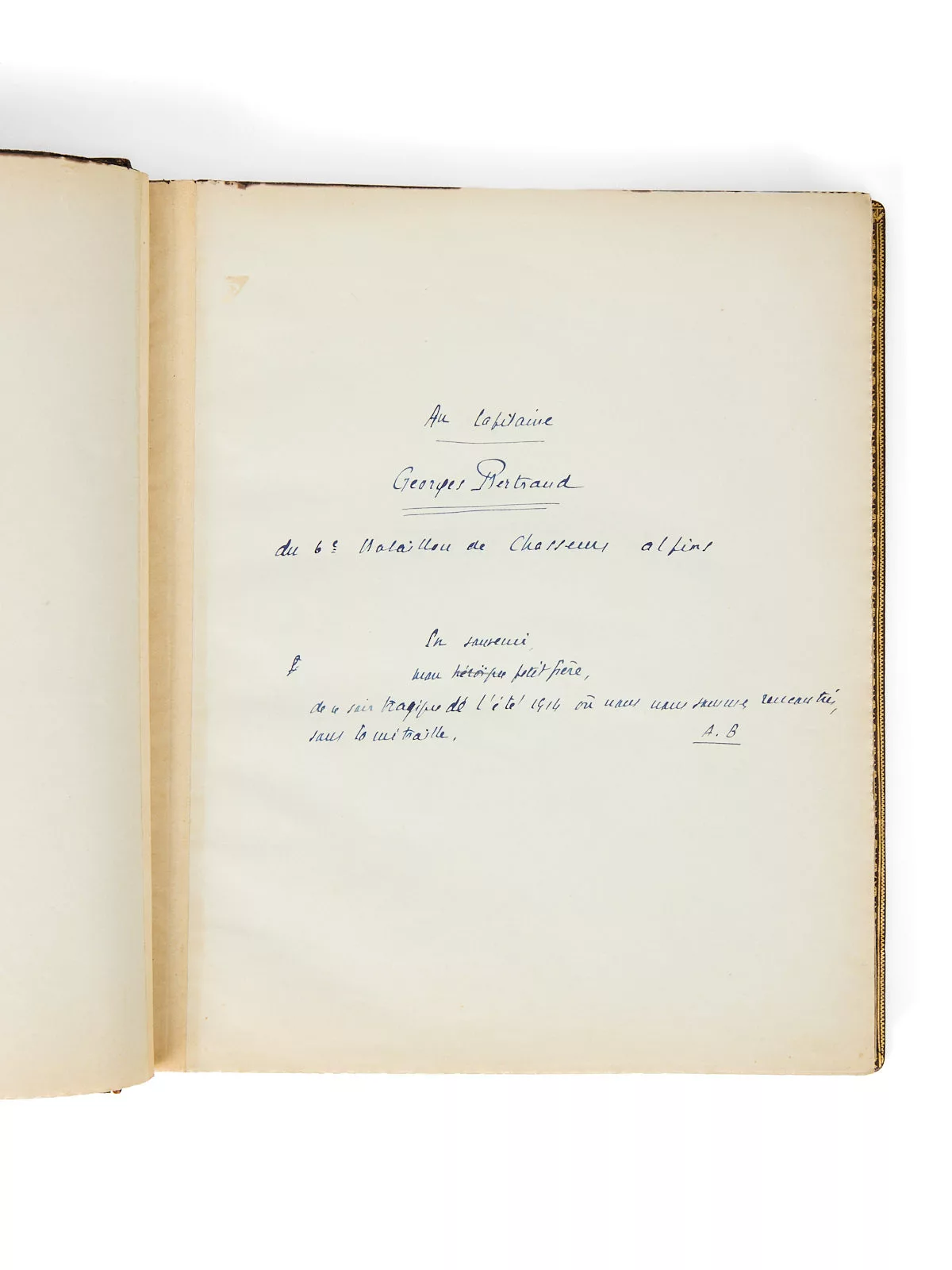
A novel of mobile warfare seen at ground level, the narrative follows Vaissette, a sergeant promoted to officer, to his death on the line, within a group of Alpine infantrymen fighting in Lorraine and the Marne against the German breakthrough. Every episode is marked by death and the spirit of sacrifice, without emphasis or rear-echelon rhetoric. The book, dedicated to his brother Georges Bertrand (Saint-Cyr class of 1911, Moskowa promotion; wounded several times, losing his left eye; five citations; he went on to serve as an instructor and later as military attaché in Washington, ending his career as colonel), was serialized in the Revue des Deux Mondes beginning in August 1916, then published in book form in November. A second deliberation in December allowed it to be awarded the 1914 Prix Goncourt, which had not previously been given.
A word on the context: the war threw the Académie Goncourt into disarray. Meeting for the first time at the restaurant Drouant on 31 October 1914 (they had previously lunched at the Café de Paris, avenue de l’Opéra), the Academy issued the following statement on 19 December 1914: “The Académie Goncourt, unable without violating its statutes to devote the amount of its annual prize to a national or literary relief effort, has decided not to award it in 1914. It has further considered the injustice of ruling only on works published up to August, since many announced volumes ready for publication remained with the printer owing to the mobilization of authors and publishers. But what is deferred is not lost, and the reserved Goncourt prize will not be merged with next year’s. Two will be awarded in 1915.” In fact, only one prize was awarded in 1915 (to René Benjamin for Gaspard), and the catching-up therefore did not occur until December 1916: Henri Barbusse won that year’s Goncourt for Le Feu (eight votes to two), and Adrien Bertrand received the reserved 1914 Goncourt for L’Appel du sol (nine votes to one), with Octave Mirbeau casting his vote for Maurice Genevoix’s Sous Verdun: “the April favorite had been overtaken by a shooting star and a dying man,” as Jean-Yves Le Naour summed it up.
Jean Norton Cru, in Témoins, praises Adrien Bertrand’s remarkable literary gifts, ranking the book “among the finest works” of its kind and counting Bertrand’s death at twenty-nine among “the most cruel losses literature suffered because of the war”; André Billy praised this “very noble and very proud work,” whose descriptive passages are “among the most poignant produced by combatants.” Despite being overshadowed by Le Feu and Genevoix’s rapidly rising fame, L’Appel du sol retains a crucial place in the literature of the First World War, periodically rediscovered by critics.
Adrien Bertrand’s cut-short life adds to the aura of this manuscript. Discharged in March 1917, he died in Grasse on 18 November 1917. His widow, Suzanne Périn, magnificently perpetuated his memory by endowing the Académie Goncourt with a fund intended to reward poets for their body of work: the Bourse Goncourt | Adrien Bertrand. The Goncourt Prize for Poetry, created in 1985, has thus honored authors such as Yves Bonnefoy, Andrée Chedid, Philippe Jaccottet and Christian Bobin. Only one author has had the honor of winning both Goncourt prizes — fiction and poetry: Jacques Chessex (1973 and 2004).
A centerpiece for a Goncourt collection or a group devoted to writer-combatants, this manuscript embodies and explains the extraordinary circumstances of the 1914 Prix Goncourt, first reserved and then awarded two years later: the determination to write against death, the desire to honor combatants, and the birth of a book that Dorgelès considered a “magnificent soldier’s testimony.”
A black ink stain touches the upper part of the back cover and the top edge, without affecting the text.
Jean Norton Cru, Témoins, pp. 88–90 and 578–580; Anthologie des écrivains morts à la guerre, I, 72; Talvart, I, 419; serialized in the Revue des Deux Mondes (August 1916); Jean-Yves Le Naour, La Gloire et l’Oubli. Maurice Genevoix et Henri Barbusse, Michalon, 2020.