

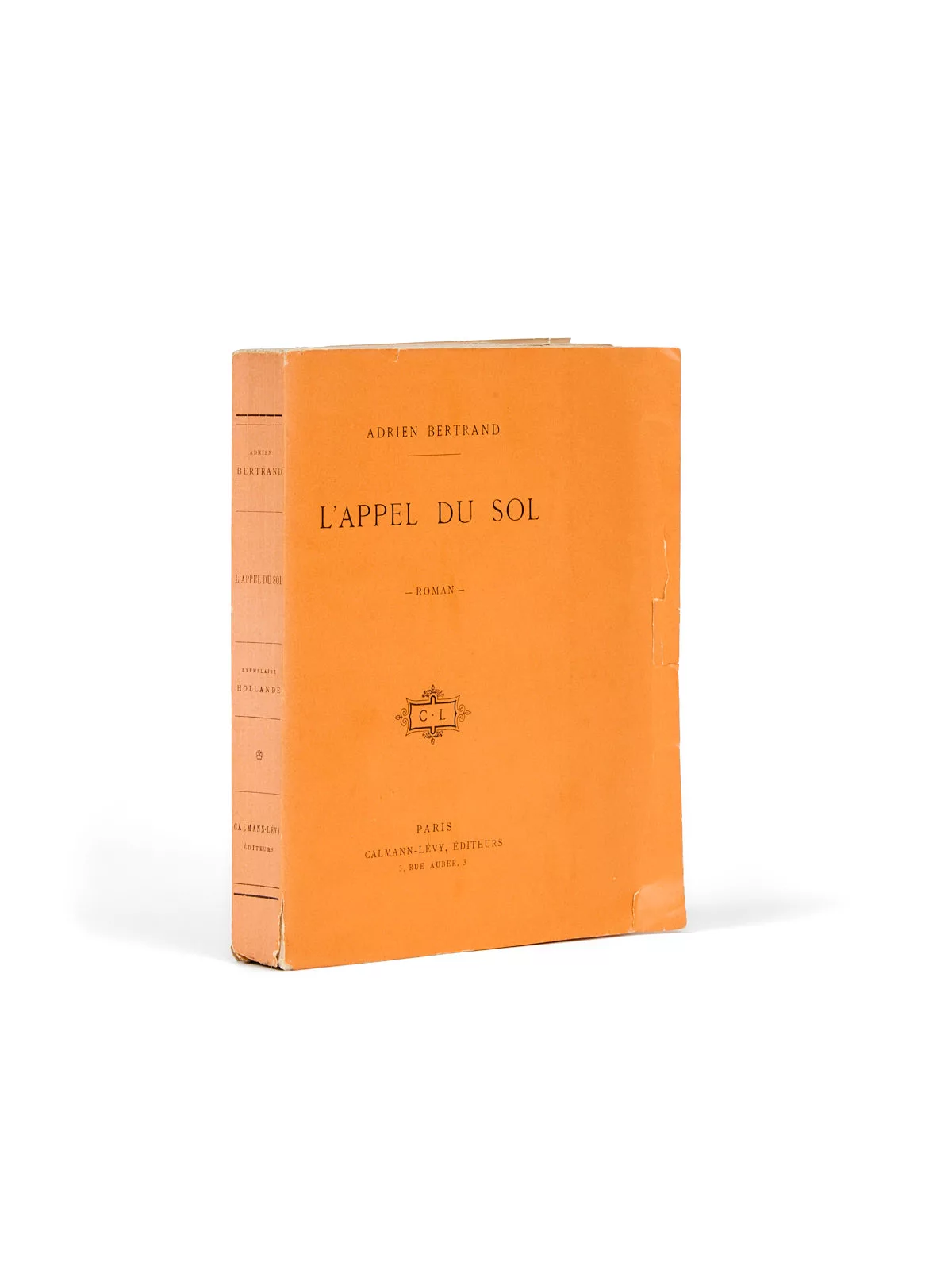
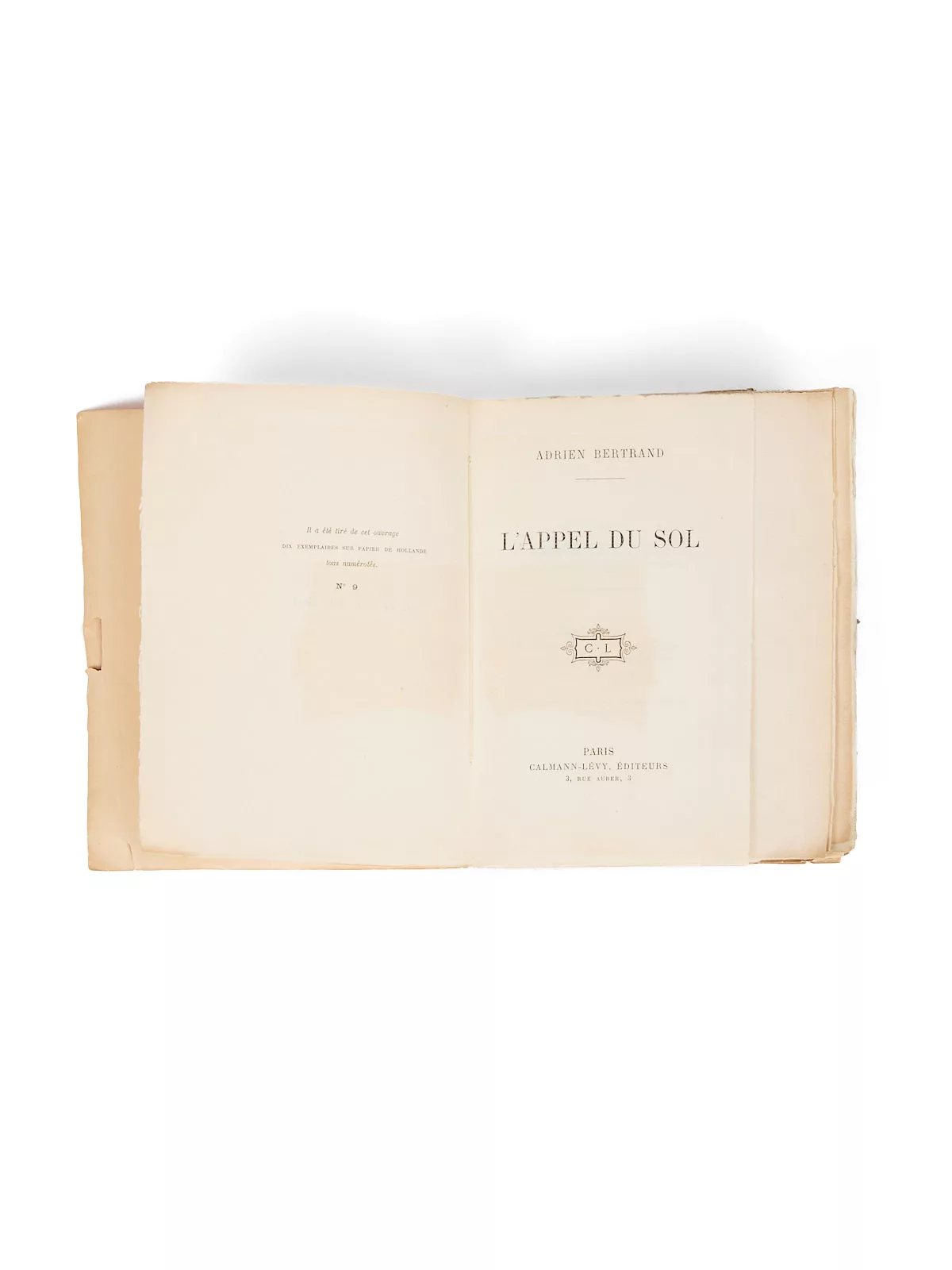
L’Appel du sol
One of the first 10 copies on vergé de Hollande paper (no. 9).
The circumstances of the second half of 1914 made the award of the Prix Goncourt difficult, if not impossible.
On 31 October, meeting for the first time at the restaurant Drouant (previously the Ten had lunched at the Café de Paris, avenue de l’Opéra), the jurors deliberated, and on 19 December, having re-elected its officers, the Académie adopted Hennique’s proposal and issued the following statement:
“The Académie Goncourt, unable without breaching its statutes to devote the amount of its annual prize to a relief effort, whether national or specific to Letters, has decided not to award it in 1914. It further considered the injustice of ruling only on works published up to the month of August, many announced volumes having remained with the printer owing to the mobilization of authors and publishers. But what is postponed is not lost, and the reserved Prix Goncourt will not be merged with next year’s. Two prizes will be awarded in 1915.”
In the end, only one prize was awarded in 1915, to René Benjamin’s novel Gaspard; the two prizes the Académie had announced were postponed to 1916: Henri Barbusse for Le Feu and Adrien Bertrand for L’Appel du sol, the latter having been in competition with Maurice Genevoix’s Sous Verdun.
Jean Norton Cru, in Témoins, praised the powerful, violent yet deeply humanist picture of the conflict given in Bertrand’s book:
“Adrien Bertrand had remarkable literary gifts (…). His death at twenty-eight is one of the cruelest losses literature suffered because of the war (…). His merit will help place the novel among the best works of its kind whose authors were not combatants (…).”
Adrien Bertrand wrote his novel from his hospital bed, having contracted pulmonary tuberculosis from which he never recovered. The novel appeared as a serial in the Revue des Deux Mondes from August 1916, then in book form in November; in December, the Goncourt jurors’ double deliberation held little suspense:
“In two ballots, the decision was confirmed by clear majorities: the 1916 Prix Goncourt was awarded to Barbusse by eight votes to two, and that of 1914 to Adrien Bertrand by nine votes to one, Octave Mirbeau casting his vote for Genevoix. Since his vote had to be justified somehow, the normalien was hypocritically criticized for having chosen a title [Sous Verdun] that suggested he would be writing about the great battle of 1916, whereas his book recounted the fighting that took place in the Meuse from August to October 1914. April’s favorite had been overtaken by a shooting star and a dying man.” (Jean-Yves Le Naour, La Gloire et l’Oubli. Maurice Genevoix et Henri Barbusse, témoins de la Grande Guerre, Michalon, “Histoire,” 2020.)
Adrien Bertrand, still ill, was discharged in March 1917 and died at Grasse a few months later, in November. Roland Dorgelès, who wrote the notice devoted to him in the Anthologie des écrivains morts à la guerre, painted this portrait:
“We had met in 1913 at Clemenceau’s L’Homme libre, and what struck me at once was that terrible gaze, direct and blazing, that unbearable look one imagines belongs only to the heroes of novels. One truly felt a soul burning in those eyes: it burned quickly… He loved ideas, things, life, passionately; his energy seized upon everything with a kind of fever. […] Indifferent to no one, loved by all who came near him, he was truly the most loyal of friends, the finest of minds.” To illustrate this, Dorgelès chose to share an extract from the text: chapter IV of L’Appel du sol, “Sur les tombes du cimetière.”
Jean Norton Cru, Témoins, pp. 88–90 and 578–580; Anthologie des écrivains morts à la guerre, I, 72; Talvart, I, 419.