

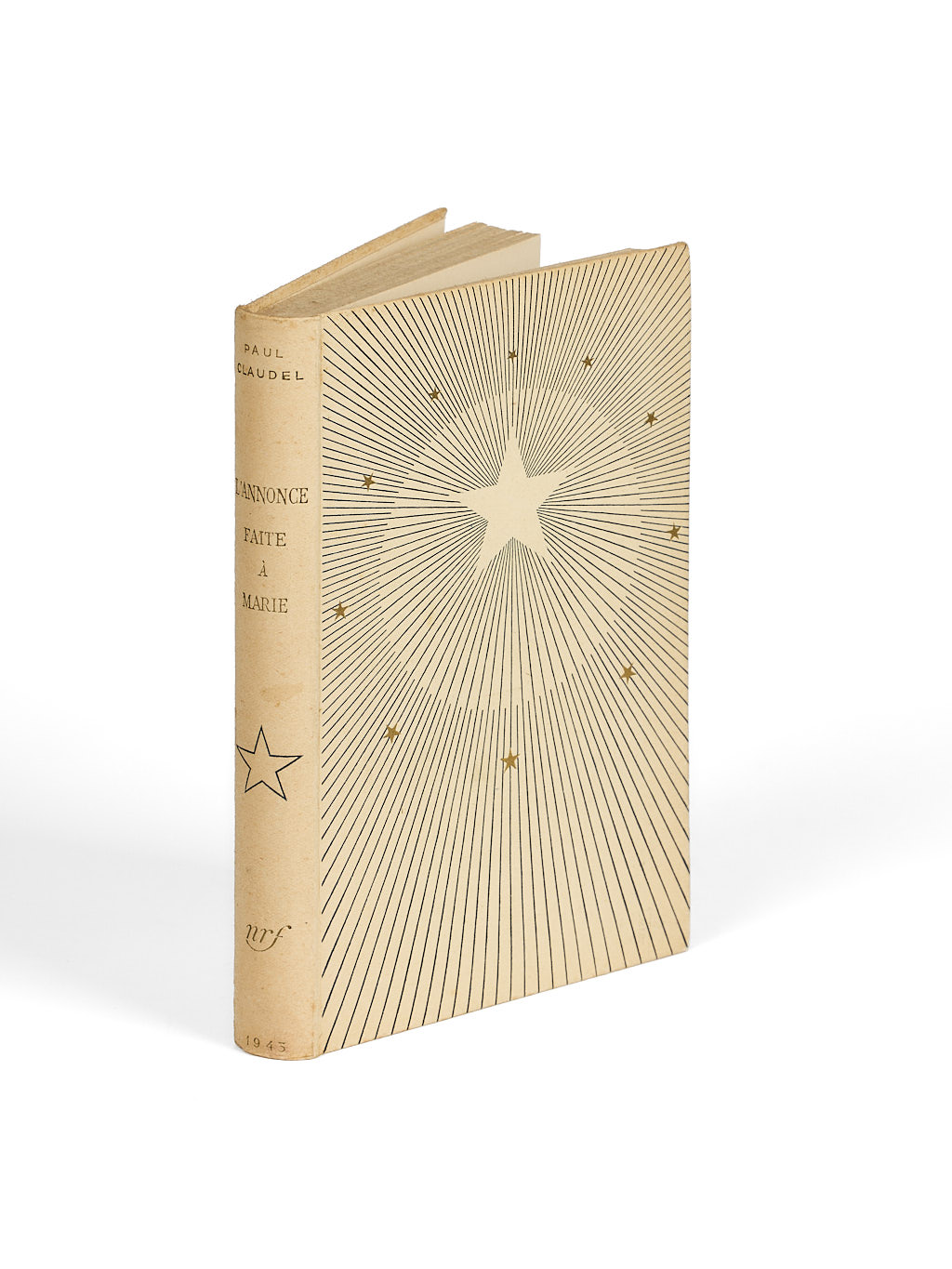
L’Annonce faite à Marie
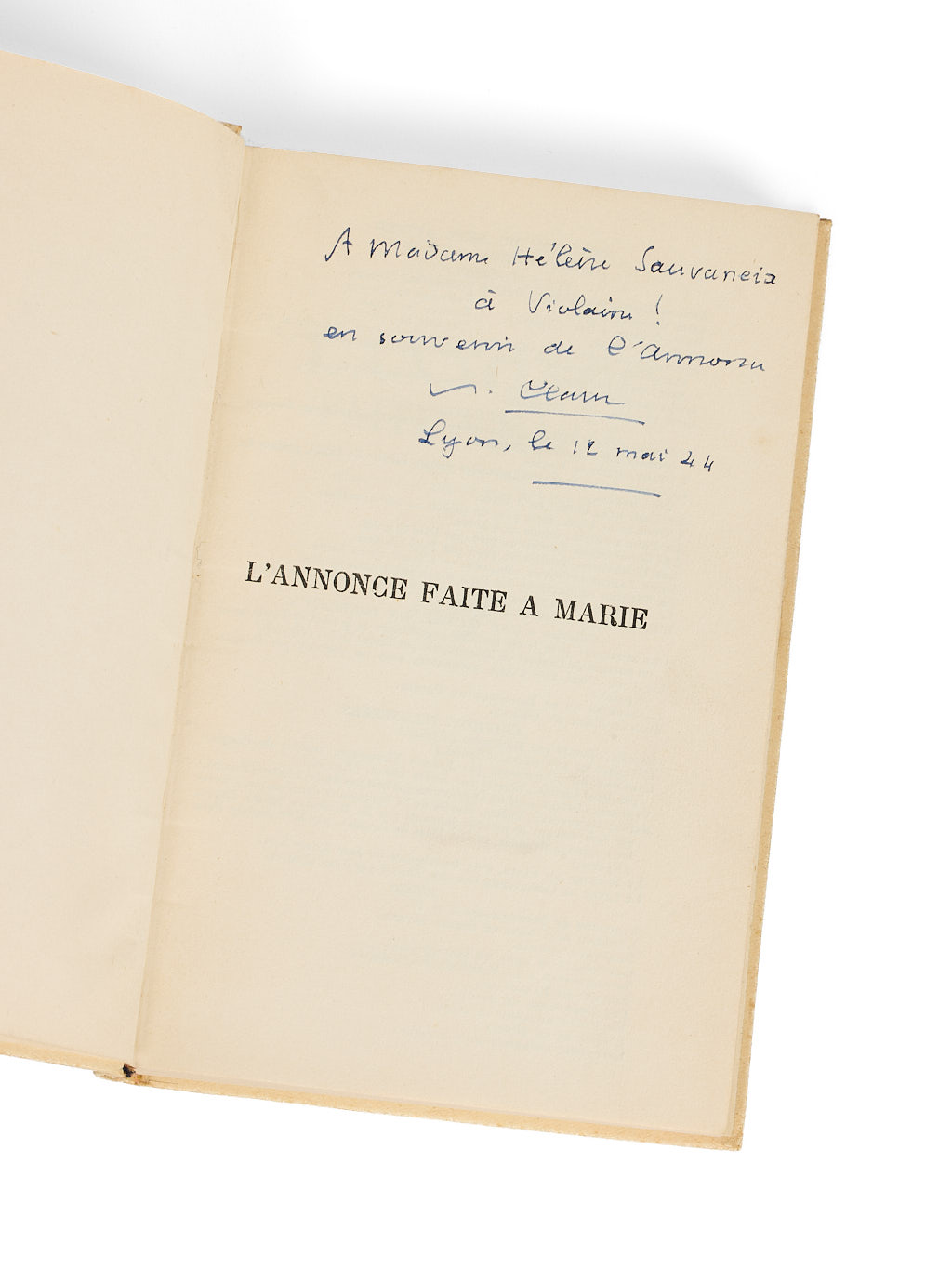
Signed presentation inscription: “À Madame Hélène Sauvaneix, à Violaine ! en souvenir de l'Annonce. P. Claudel. Lyon, le 12 mai 44.”
A moving and precious copy, given by Claudel on the day of the play’s first performance in Lyon, on 12 May 1944, to the actress who played the leading role of Violaine, and again three years later at the Théâtre Hébertot for the definitive version, at Claudel’s own request: Hélène Sauvaneix.
L’Annonce faite à Marie had been, in 1912, the first of Claudel’s plays to be staged, following an earlier version published under the title La Jeune Fille Violaine twenty years earlier, in 1892. The play was added to the program of Louis Jouvet’s long South American tour, from 1941 to 1945: the premiere took place on 19 June 1942 at the Teatro Municipal in Rio de Janeiro, before being revived on 11 June 1946 at the Théâtre de l’Athénée in Paris.
Meanwhile in France, it was Pierre Bertin who took up the author’s most famous play, for three performances in Lyon, from 12 to 14 May 1944. A member of the Comédie-Française, Pierre Bertin (1891–1984) had already, on behalf of administrator Pierre Bourdet, visited Claudel in April 1937 to request L’Annonce for the Théâtre-Français, without success.
Claudel attended the premiere, declaring of Hélène Sauvaneix, who played the role of Violaine: “This young actress, with her inspired face touched by grace, will one day become the saint of the theater.” So much so that when Claudel, in 1947, wished to have his play staged again in the definitive version he had just published, he turned to her to play the role, advising the actress, for the prologue, to “mime the bird’s flight in the sky through the movement of her joined hands, like an arrow pointing upward.”
Hélène Sauvaneix had earlier devoted her youth to dance and played minor roles on stage; she had drawn attention playing Stella in Crommelynck’s Le Cocu magnifique, which led to her being cast as Violaine in Lyon in 1944. Sauvaneix seems to have been predestined to embody the heroine once more: even before the 1944 Lyon performances, she had already played the miracle scene at the age of fifteen under René Simon, alongside Maria Casarès; she was also chosen because she was not yet an established actress, “she is a docile artist who is not a star and who has the good taste to put theater before film; moreover, she has style,” as Hébertot put it (unpublished letter to Claudel, 21 July 1947, BnF). The young actress (born in 1922) nevertheless had her own views, wishing to make Violaine a being of flesh and blood, since in her opinion “L’Annonce is always performed like a musical text in which the audience is lulled by a litany, a droning that harms the dramatic action” (interview titled “Paul Claudel finally finds the poetic young woman of his dreams,” France-Hebdo, 16 March 1948). This new Paris staging in 1947 would in fact give her her first major role, the one that opened the doors of theater and film to her.
From the library of Joël Dupont (bookplate).