

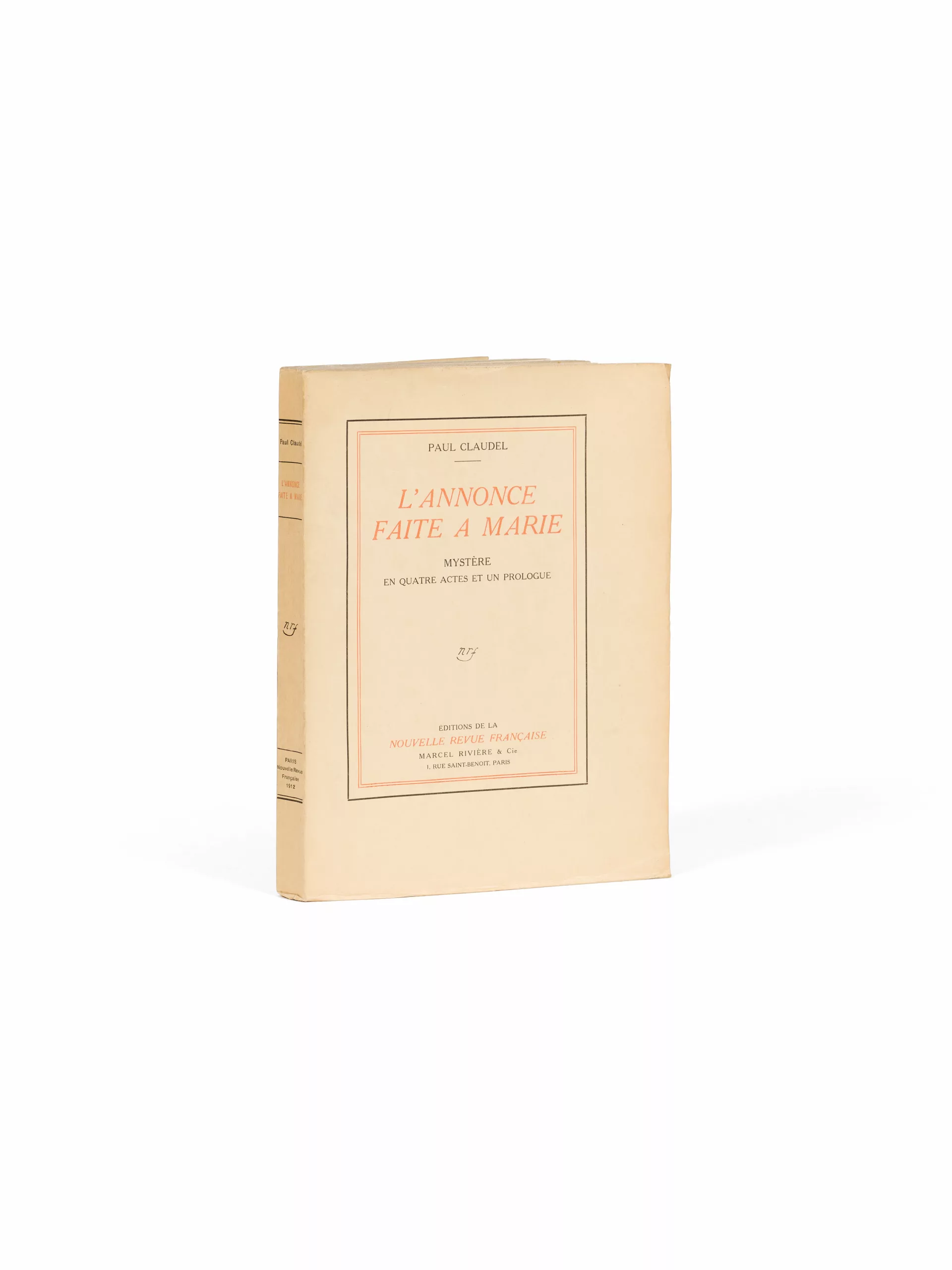
L’Annonce faite à Marie
One of 50 réimposé copies on vergé d'Arches paper, this copy no. 22.
Paul Claudel’s second dramatic work, but the first to be staged, L’Annonce faite à Marie inaugurated his theater and stands among his major plays alongside Le Soulier de satin.
True to his belief that “in art, nothing is ever definitive,” Claudel continually reworked and rewrote his texts. This play’s origins date back ten years earlier, to a text titled La Jeune Fille Violaine, itself revised in 1899 before being rewritten between 1910 and 1911 to become L’Annonce.
The premiere took place on 22 December 1912 at the Théâtre de l’Œuvre. Founded by the actor Lugné-Poe, the poet Camille Mauclair and the painter Édouard Vuillard, this theater was steeped in Symbolist aesthetics, following the precept of Stéphane Mallarmé, one of the movement’s leaders, who saw overly elaborate staging as “an obstacle to the spectator’s reverie.” Claudel’s mystical theater found an ideal home there. Claudel took an active part as co-director of his own play alongside Lugné-Poe. The stripped-down sets and the “musical” diction the author demanded of his actors established a distinctly Claudelian style that would prove influential. Although there were only three performances, the discerning audience who attended helped spread its reputation.
L’Annonce was a success, even though the text had already appeared some months earlier (April 1912) in book form and in the Nouvelle Revue française (nos. 36–40). André Gide urged the young publishing house, Éditions de la NRF, to print a new run: “What have we decided to do about the performances of L’Annonce faite à Marie? Nothing? It would really be good if the book could be found for sale in the lobby. Good, and almost essential — for Claudel as much as for us.” On 13 February 1913, the Éditions de la NRF carried out its first-ever reprint: 2,200 copies came off the press just as Claudel, then posted in Germany, was preparing to stage the play at the avant-garde theater of the Hellerau arts center (north of Dresden), where he introduced particularly innovative staging ideas.
Henri Vignes & Pierre Boudrot, Bibliographie des Éditions de la Nouvelle Revue française, 20.