

La Situation du Surréalisme entre les Deux Guerres
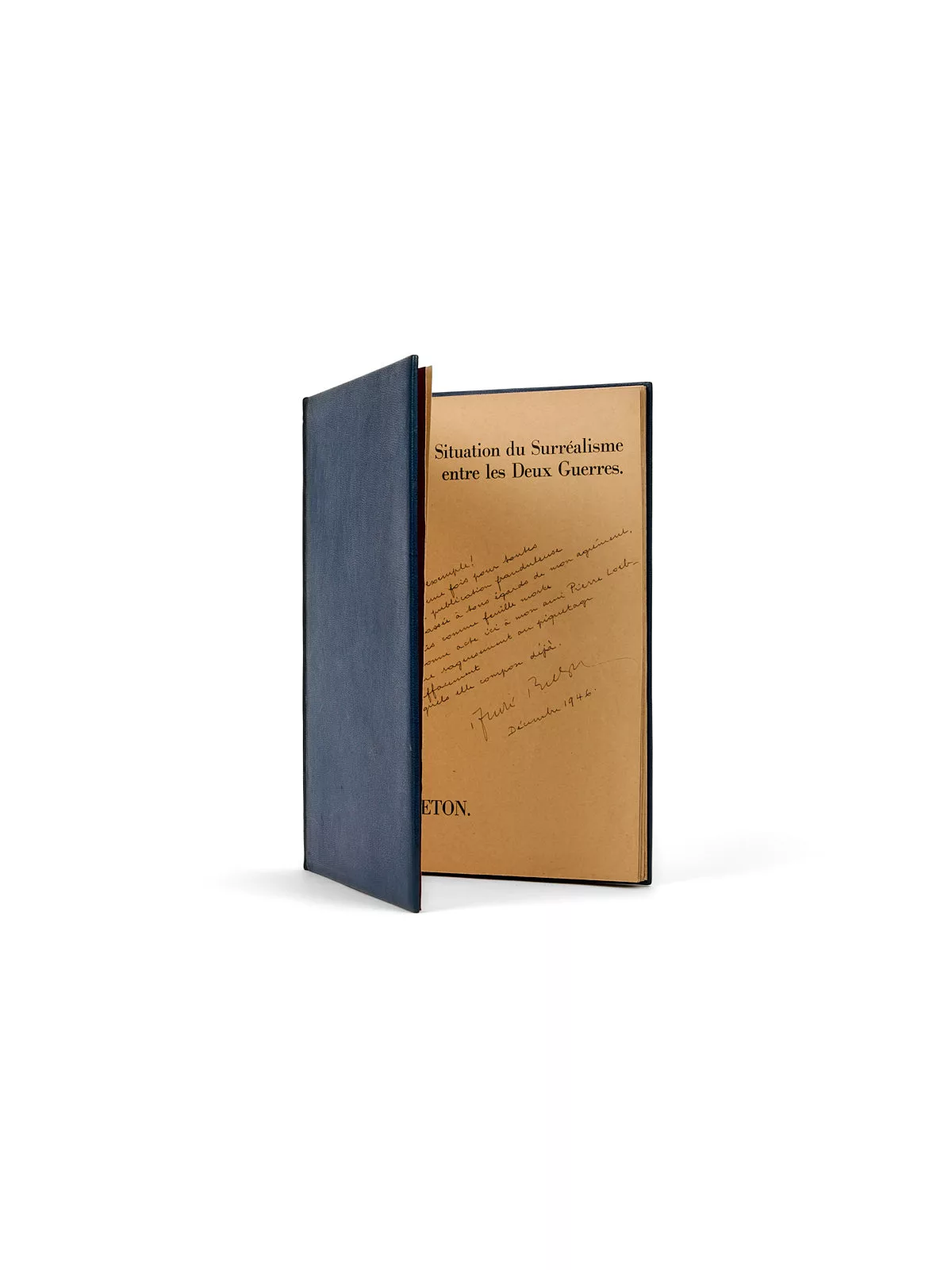
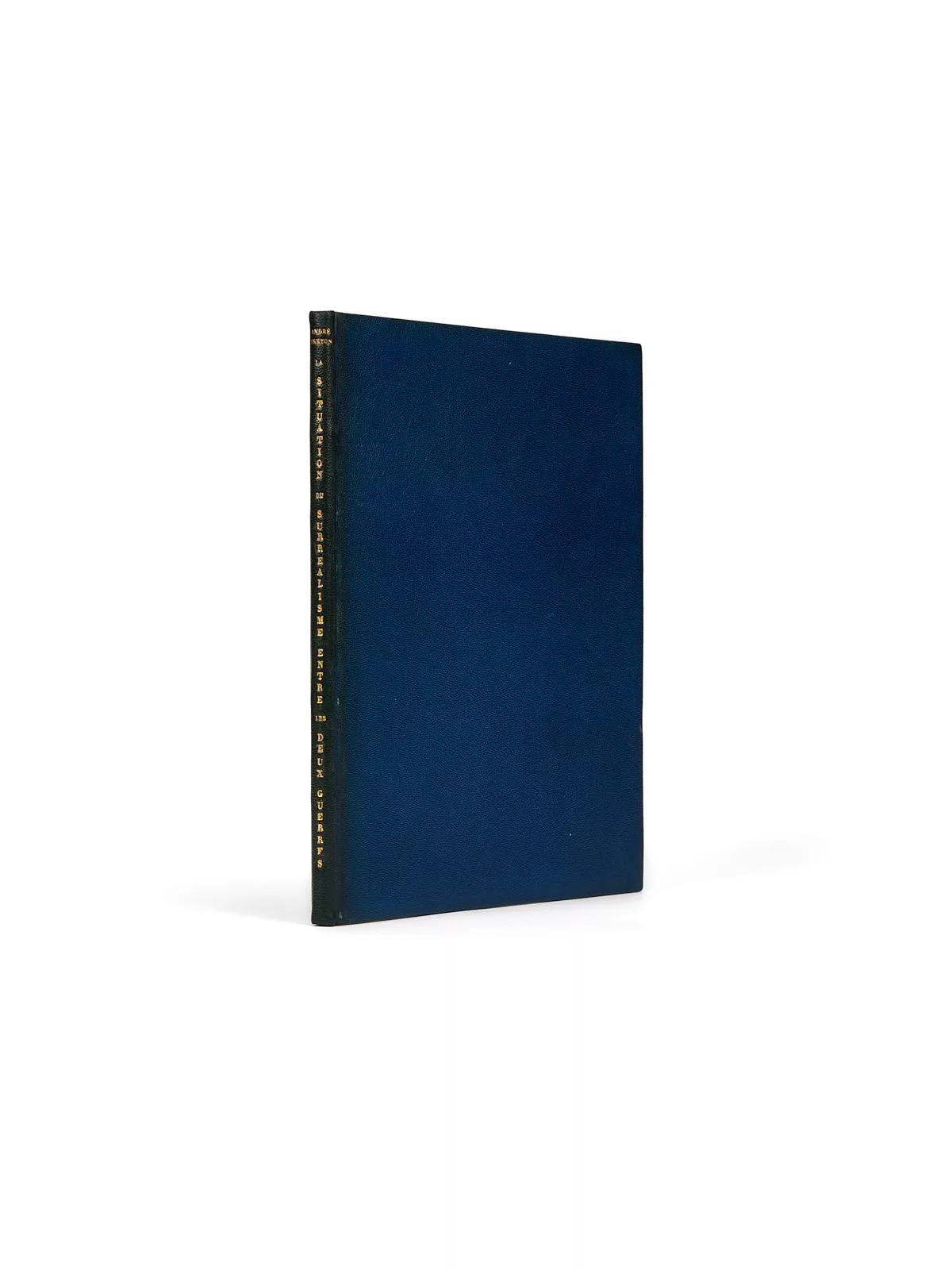
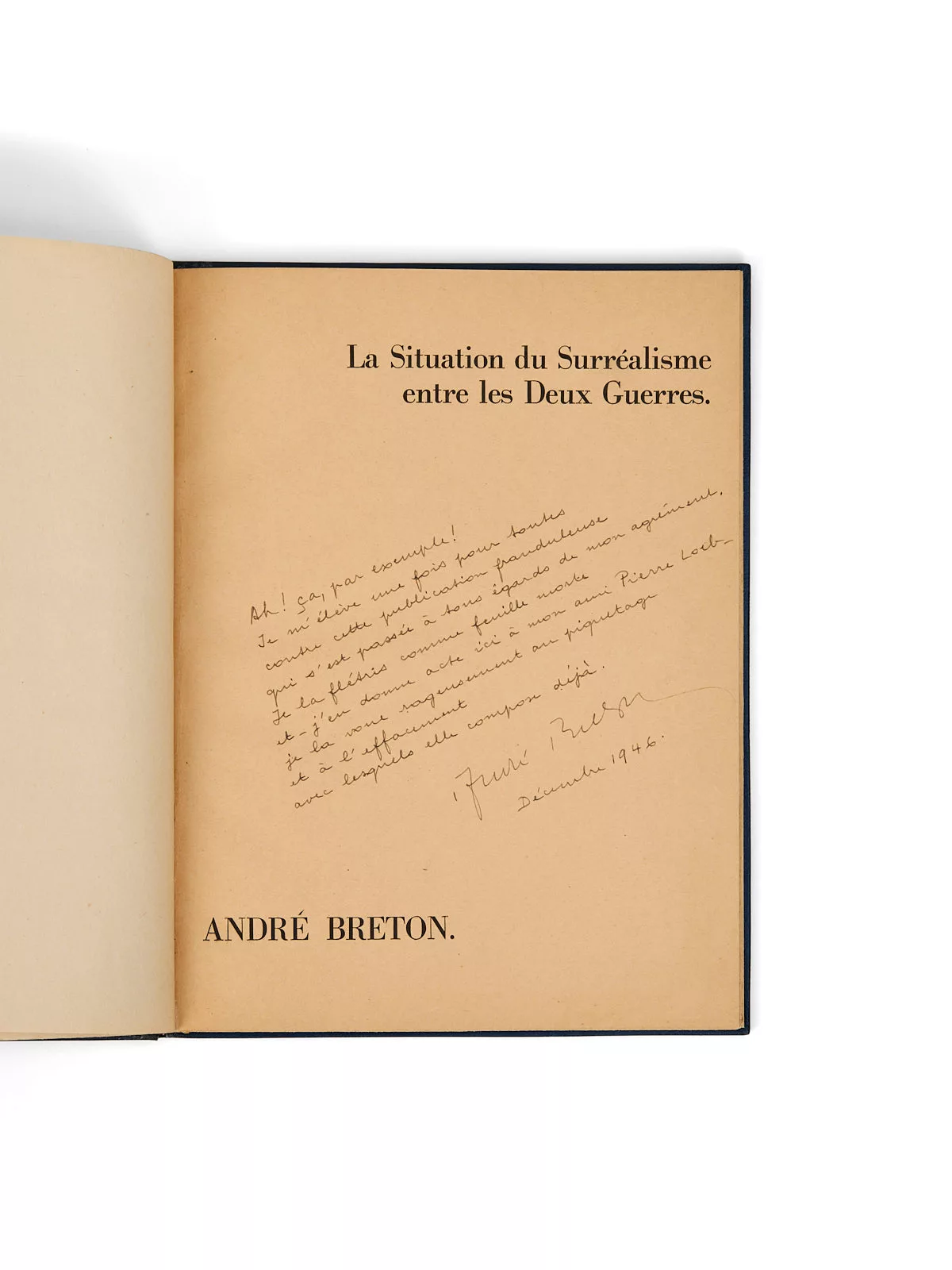
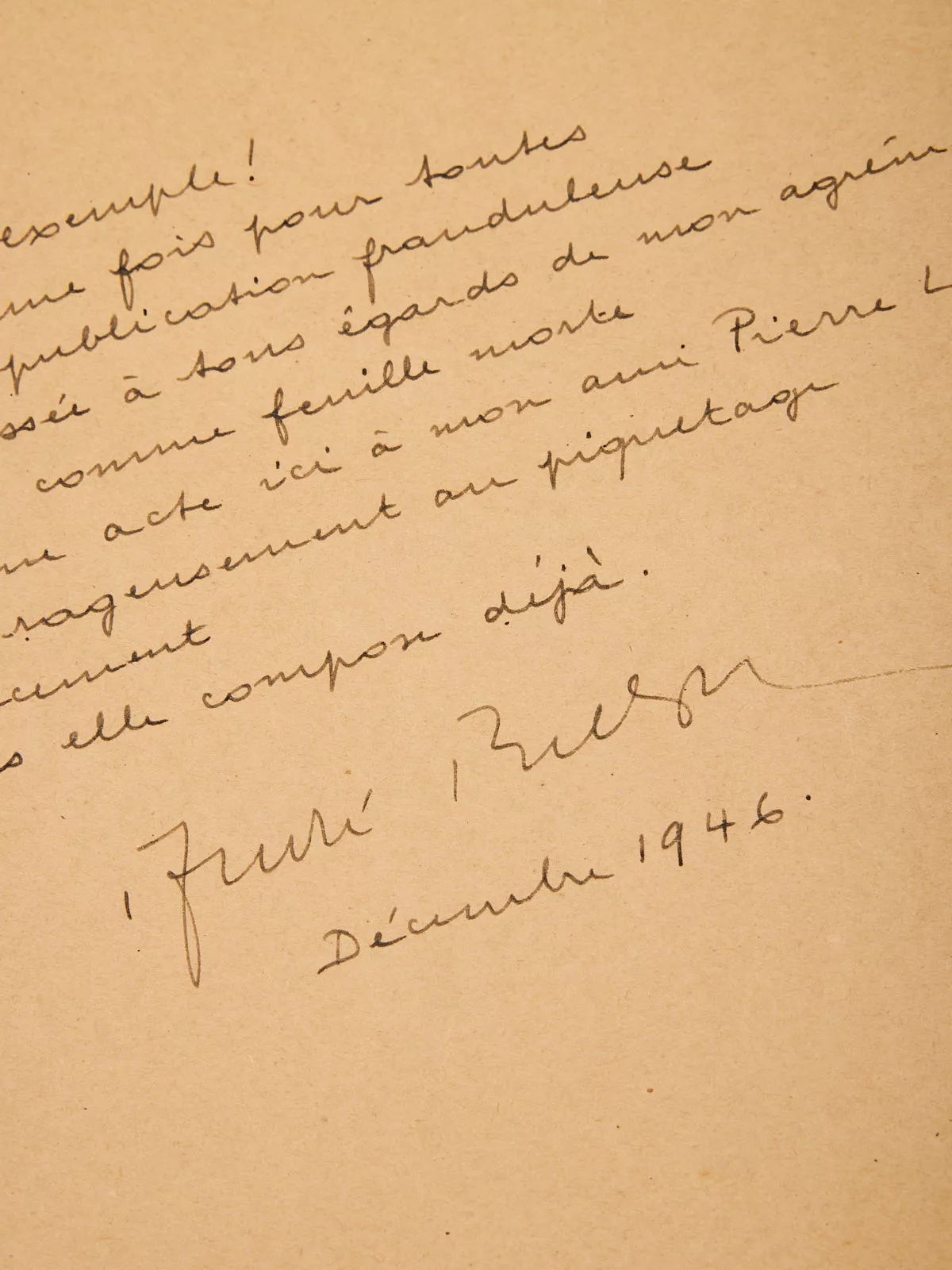
An exceptional copy from the Loeb library, bearing two important autograph inscriptions: a long disavowal signed by André Breton, dated December 1946, and a signed statement by the man who claims to have clandestinely produced the printing, specifying for the first time the material circumstances of its production.
On the cover, Breton wrote:
“Ah ! ça, par exemple ! Je m’élève une fois pour toutes contre cette publication frauduleuse qui s’est passée à tous égards de mon agrément. Je la flétris comme feuille morte et – j’en donne acte ici à mon ami Pierre Loeb – je la voue soigneusement au piquetage et à l’effacement avec lesquels elle compose déjà. André Breton. Décembre 1946.”
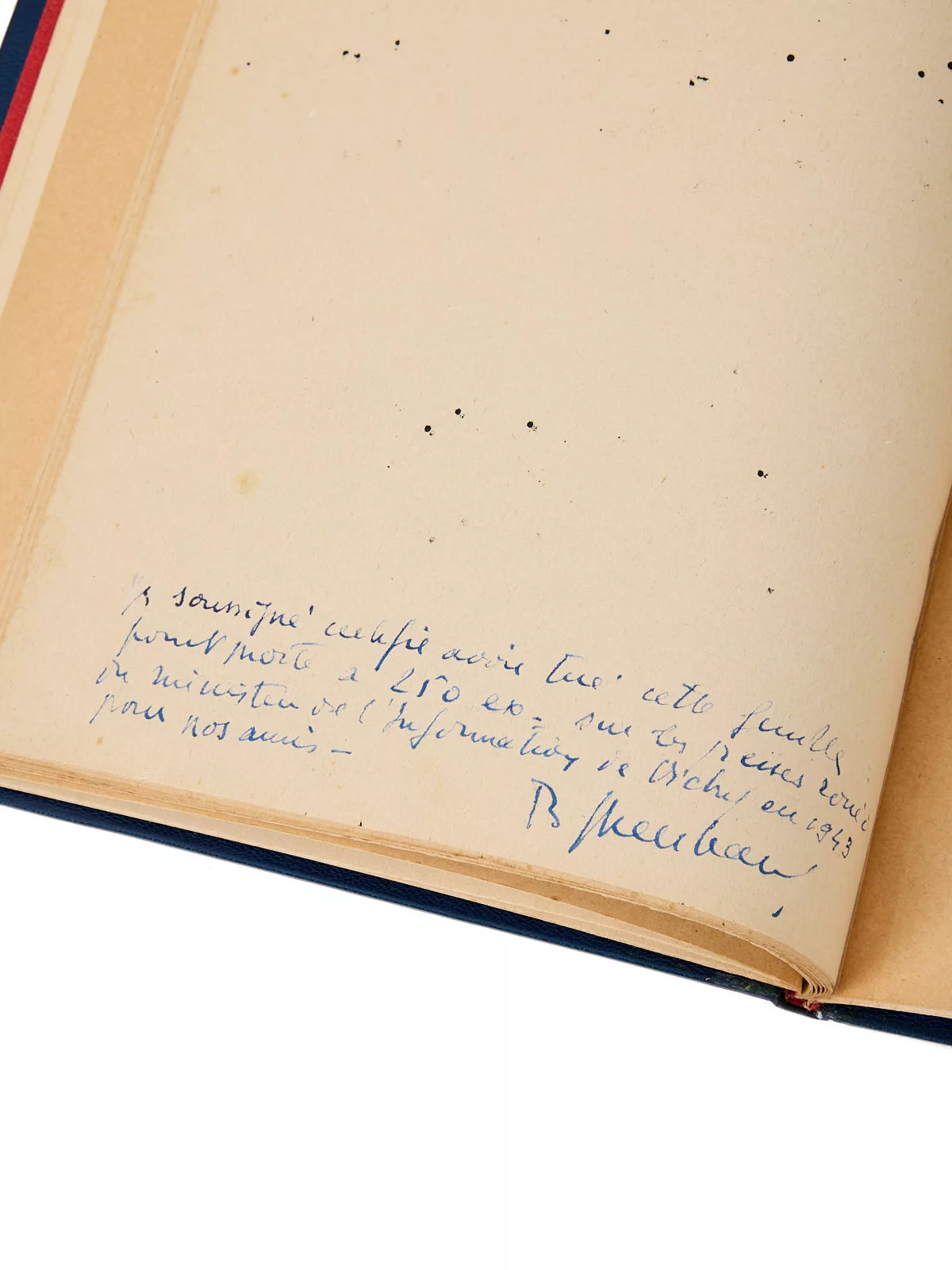
On the last leaf, a second inscription, signed B. Meuleau, answers this condemnation:
“Je soussigné certifie avoir tiré cette feuille morte à 250 ex. sur les presses ronéo du Ministère de l’Information de Vichy en 1943 pour nos amis. B. Meuleau.”
These two testimonies give this copy a special place in the editorial history of the text. The first unambiguously establishes that Breton had neither authorized nor approved this printing. The second claims responsibility for it, specifying the place, date, process, print run and intended recipients, all of which had previously remained uncertain.
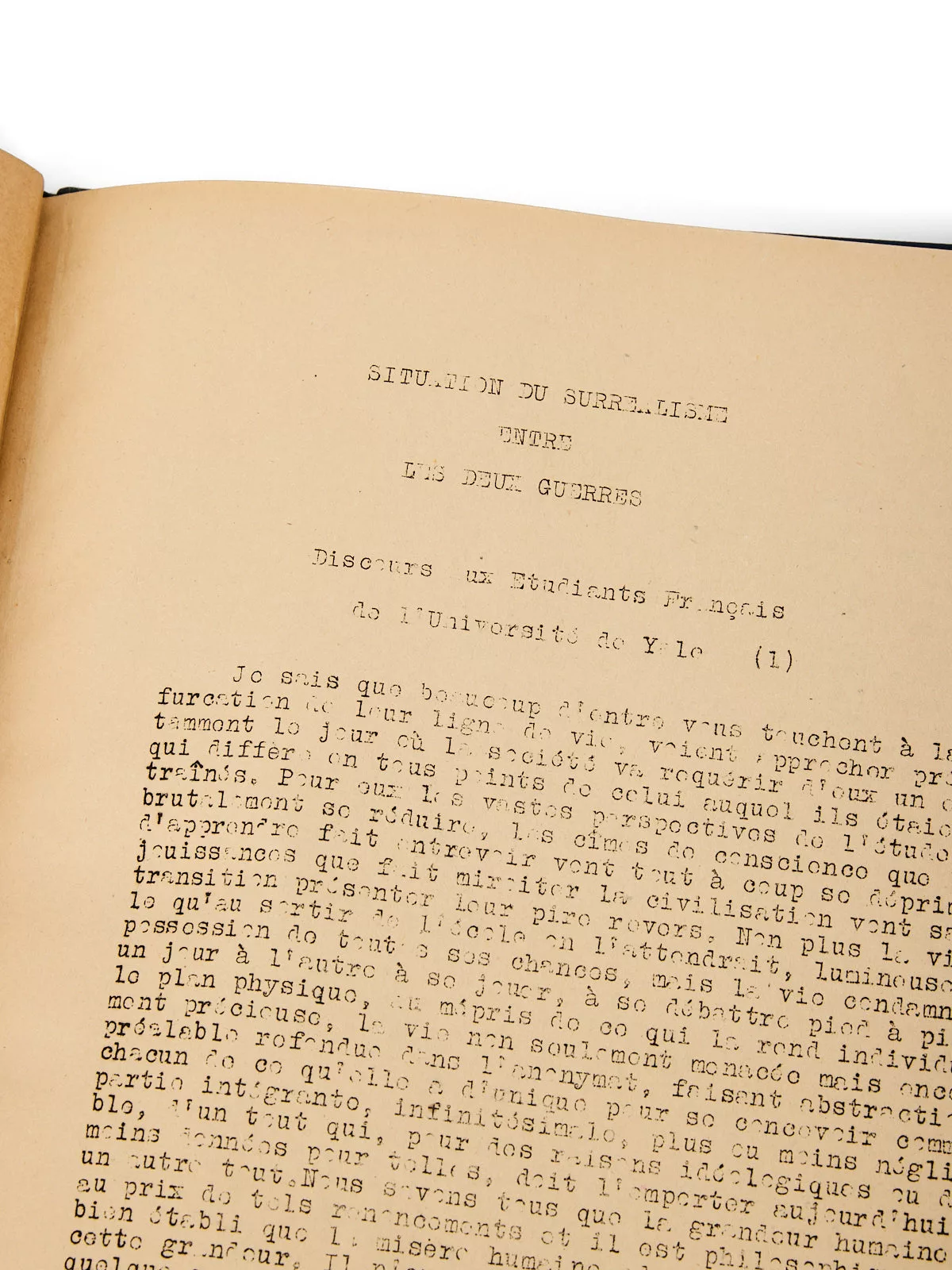
The text is that of the lecture delivered by André Breton on 10 December 1942 before French students at Yale University, at the invitation of Professor Henri Peyre. In exile in the United States since 1941, Breton here takes stock of Surrealism between the two wars and reasserts the scope of its poetic and revolutionary ambitions in a world upended by the conflict.
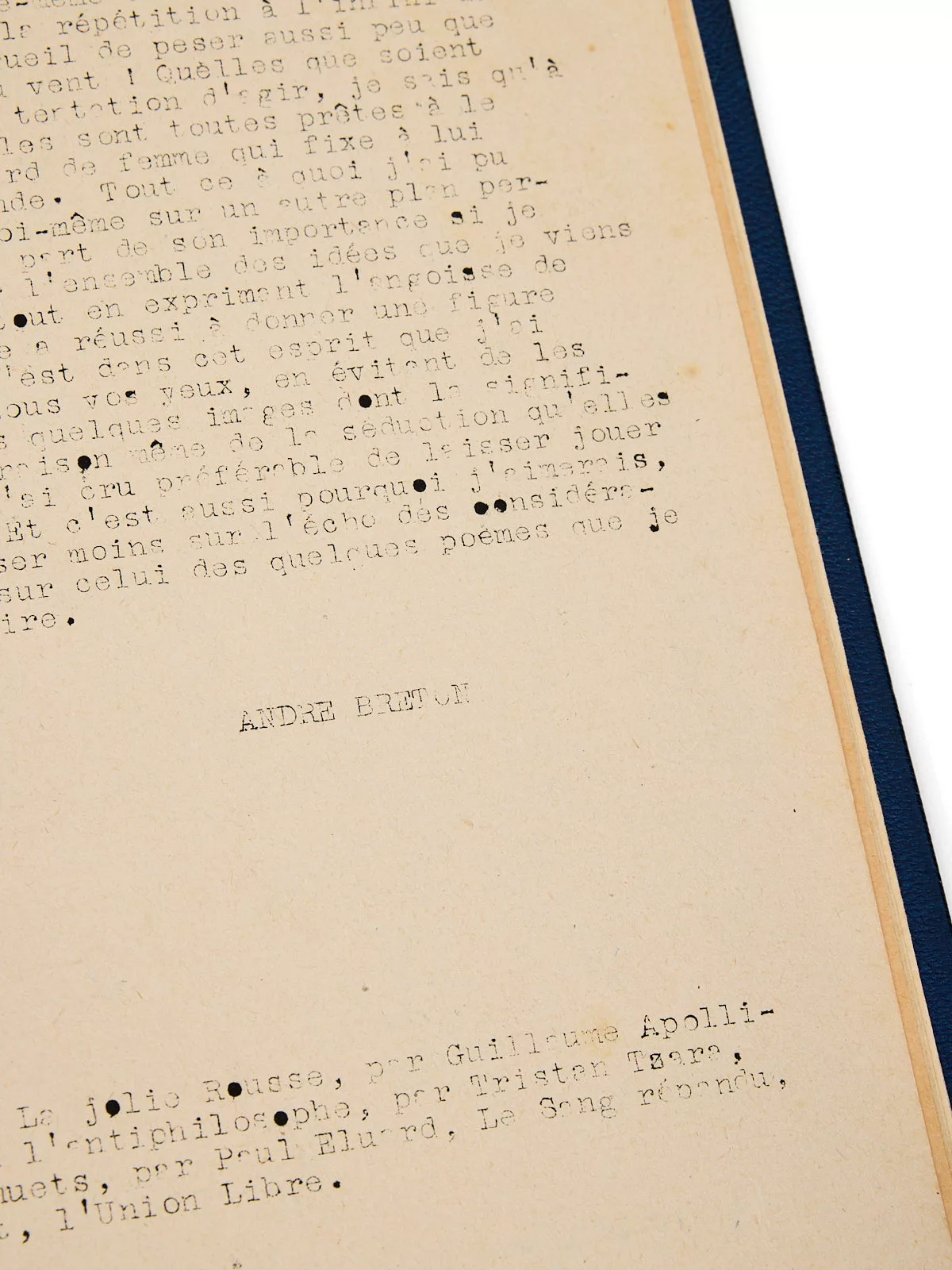
The lecture appeared in the New York review VVV, no. 2–3, in March 1943, accompanied by drawings by Max Ernst, then as a pamphlet from the editions of the review Fontaine in September 1945. It was later reprinted in La Clé des champs in 1953. The mimeographed version notably preserves the final paragraph in which Breton announced to his audience projections and a reading of several poems, a passage removed from later editions.
The typist Meuleau’s statement allows the origin of this singular printing to be established: Vichy, in 1943, on the reproduction equipment of the Ministry of Information. In Occupied France, the circulation of a text by Breton, then exiled in the United States, was a remarkable undertaking: the choice of these administrative presses, and even more their use to reproduce a Surrealist text coming from America, gives the enterprise a paradoxical character. Breton, having returned to France after the war, discovered this edition, which he judged fraudulent. His indignation was not directed at the text itself, but at its unauthorized reproduction. Beyond its bibliographical rarity, it provides direct testimony on the circulation of Surrealist texts between American exile and occupied France.
Only two other inscribed copies of this edition are known: one addressed to Robert Valançay, bearing an equally forceful inscription from Breton, who “absolutely disavows this wretched ‘edition’ (less clandestine than fraudulent) and upon which I call down, more than upon any other of my books, the teeth of rats” (Geneviève and Jean-Paul Kahn, Mille nuits de rêve III, PBA, 18 June 2021, no. 102). The second inscribed copy is held in the Julien Gracq collection at the Bibliothèque universitaire d’Angers, inscribed to Nora Mitrani.
Neither of these two copies is recorded with a comparable statement from the printer. It should also be noted that the claim of a printing of 250 copies signed by André Breton is false. Besides the fanciful mentions found here and there, this claim appears in the notes to the Pléiade edition (OC Pléiade, p. 1355), which however states that it had not examined a copy directly but cites it from a mention in the catalogue of the Librairie Valette (1989).
Having examined it, this copy, as well as a second one recently encountered, are indeed justified, but by a simple mention of the print run (250 copies), in a hand that is not Breton’s. Apart from the fact that he would have refused such a thing — as he confirms in the Loeb copy — he was in the United States at the time of printing. Nor could he, after the fact, have justified or signed anything connected with a publication he so thoroughly denounced.
Provenance: Florence and Édouard Loeb collection (Paris, Sotheby’s, 2012, no. 10).
Centre Pompidou, Breton, p. 352; Sawin, Martica, Surrealism in Exile and the Beginning of the New York School (Cambridge, MIT Press, 1995), pp. 244 and following; André Breton, “Situation du Surréalisme entre les deux guerres,” VVV 2–3, March 1943, New York; Surrealism and Anti-fascism: Anthology, Munich, Hatje Cantz Verlag, 2024, ill. 1, 4–14, 17, reproduced pp. 178–190.