

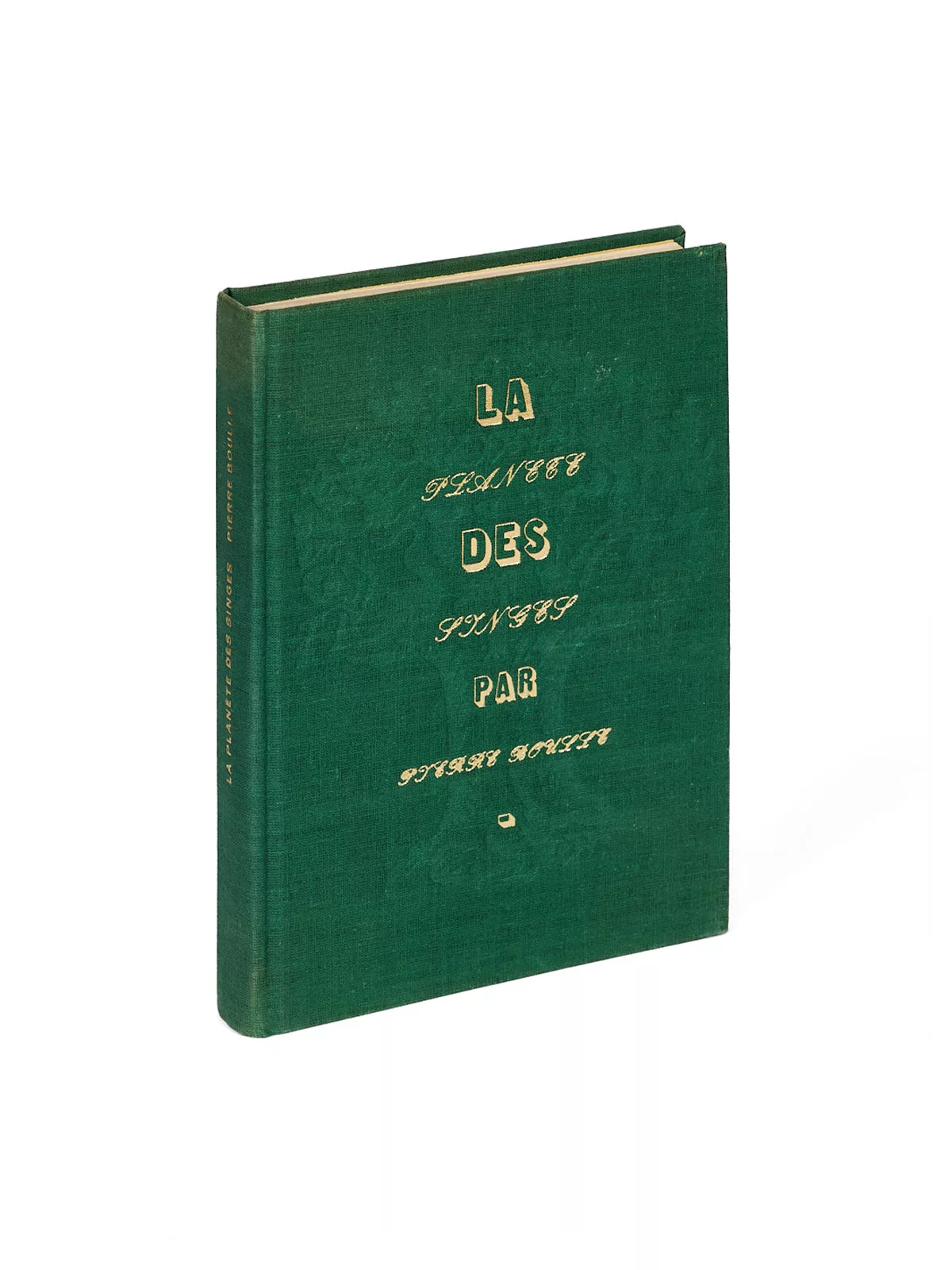
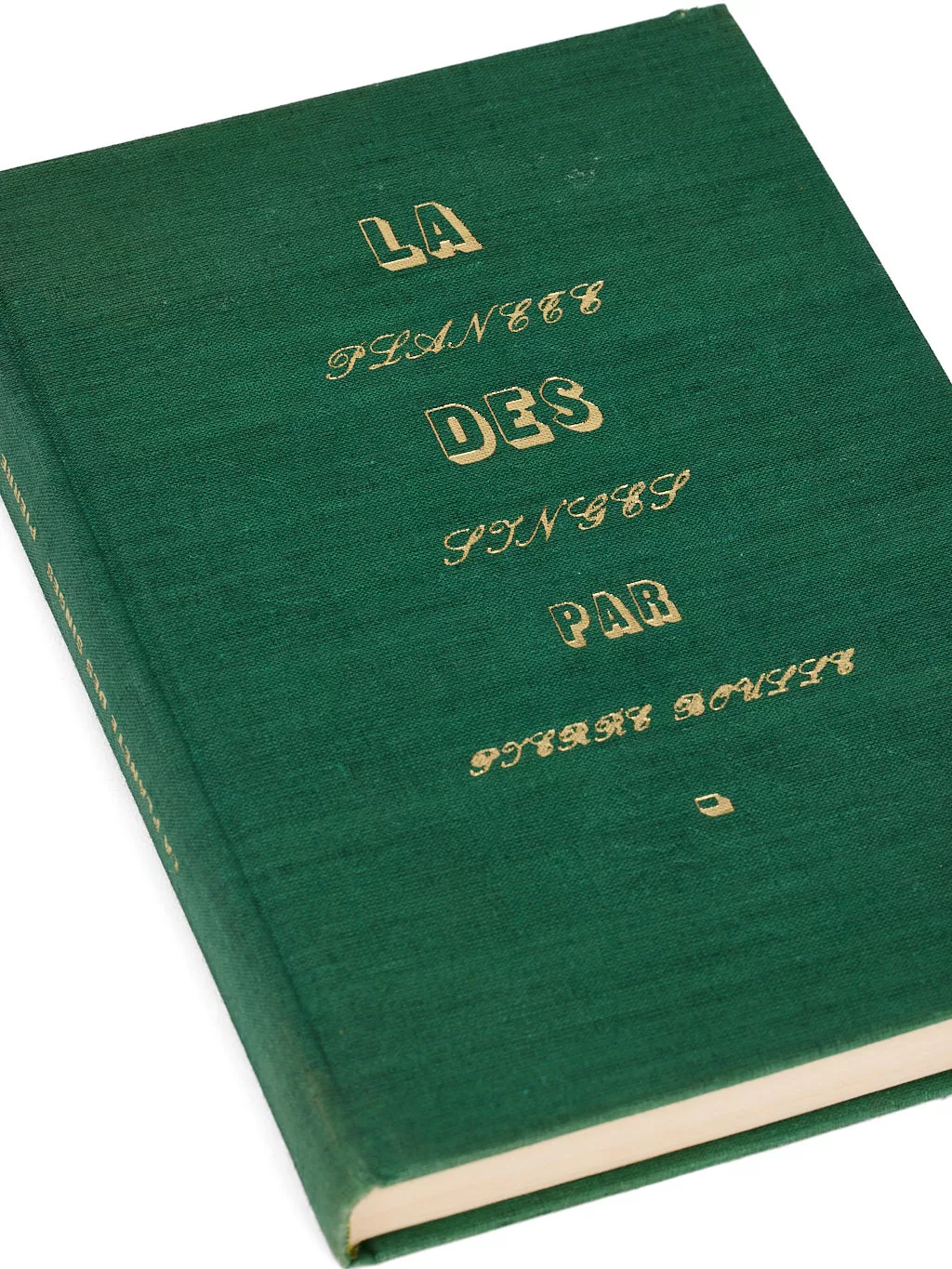
La Planète des singes
The Planet of the Apes is directly inspired by the work of Charles Darwin and by two earlier novels: Sprague de Camp’s Genus Homo (1941) and Vercors’ Les Animaux dénaturés (1952). Boulle also draws on Einstein’s theory of special relativity, using time dilation to bring his hero back to Earth in the distant future. Evolutionary theory is set out in chapter II of the second part: “We know that they [the species] probably all had a common ancestor. […] Apes and men are different branches, which evolved, from a certain point, in divergent directions, the former gradually rising to consciousness, the latter stagnating in their animality.” The artificial evolution of the apes and the decline of man are revealed in chapter 8 of the third part: “He [an ape] had been with me for years and served me faithfully. Little by little, he changed. He began going out in the evenings, attending meetings. He learned to speak. He refused to do any work. A month ago, he ordered me to cook and do the dishes. […] A mental laziness has taken hold of us [men]. No more books; even detective novels have become too great an intellectual effort. […] Meanwhile, the apes meditate in silence. Their brains develop through solitary reflection… and they speak.”
In his narrative, Boulle imagines natural evolution stripping man of his preeminence over other living species in favor of the apes. The idea came to him during a visit to a zoo, while observing gorillas. He said of this: “I was struck by their almost human expressions. This led me to imagine what a man/ape relationship might look like. Some believe I had King Kong in mind when I wrote my book, but that is entirely false.” In the novel, the hero bears the ordinary, even ridiculous name of Ulysse Mérou, far removed from the American film adaptation, in which the majestic Charlton Heston plays Captain George Taylor. Gone too is the film’s famous twist ending with the devastated Statue of Liberty: the novel ends at Orly, with a view of the Eiffel Tower. And the planet of the apes, if it does indeed exist, is not the planet Earth. None of this appears here, but the ending imagined by Pierre Boulle is every bit as effective and surprising!
Marginal stains on pages 123, 125 and 127.