

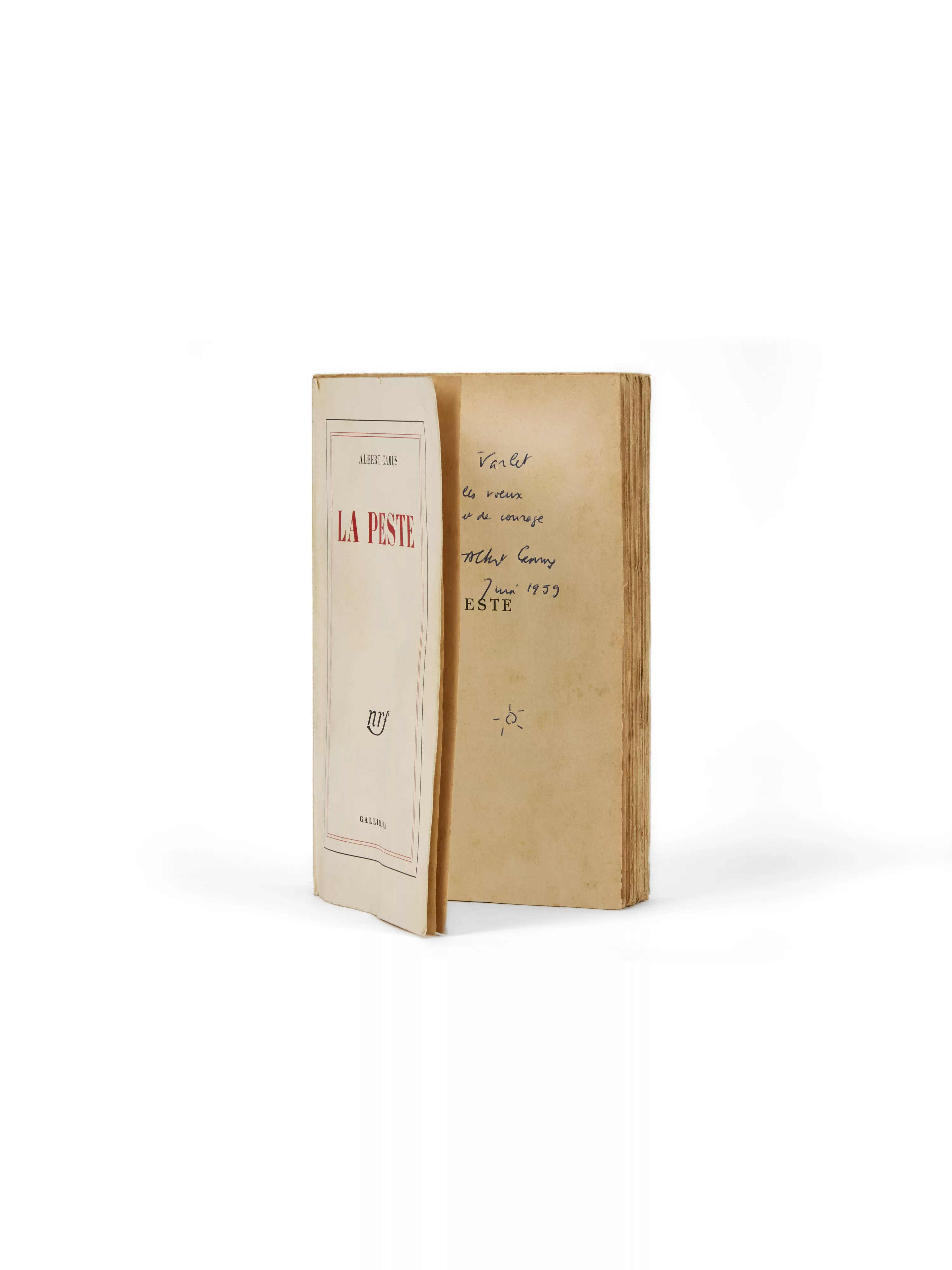
La Peste
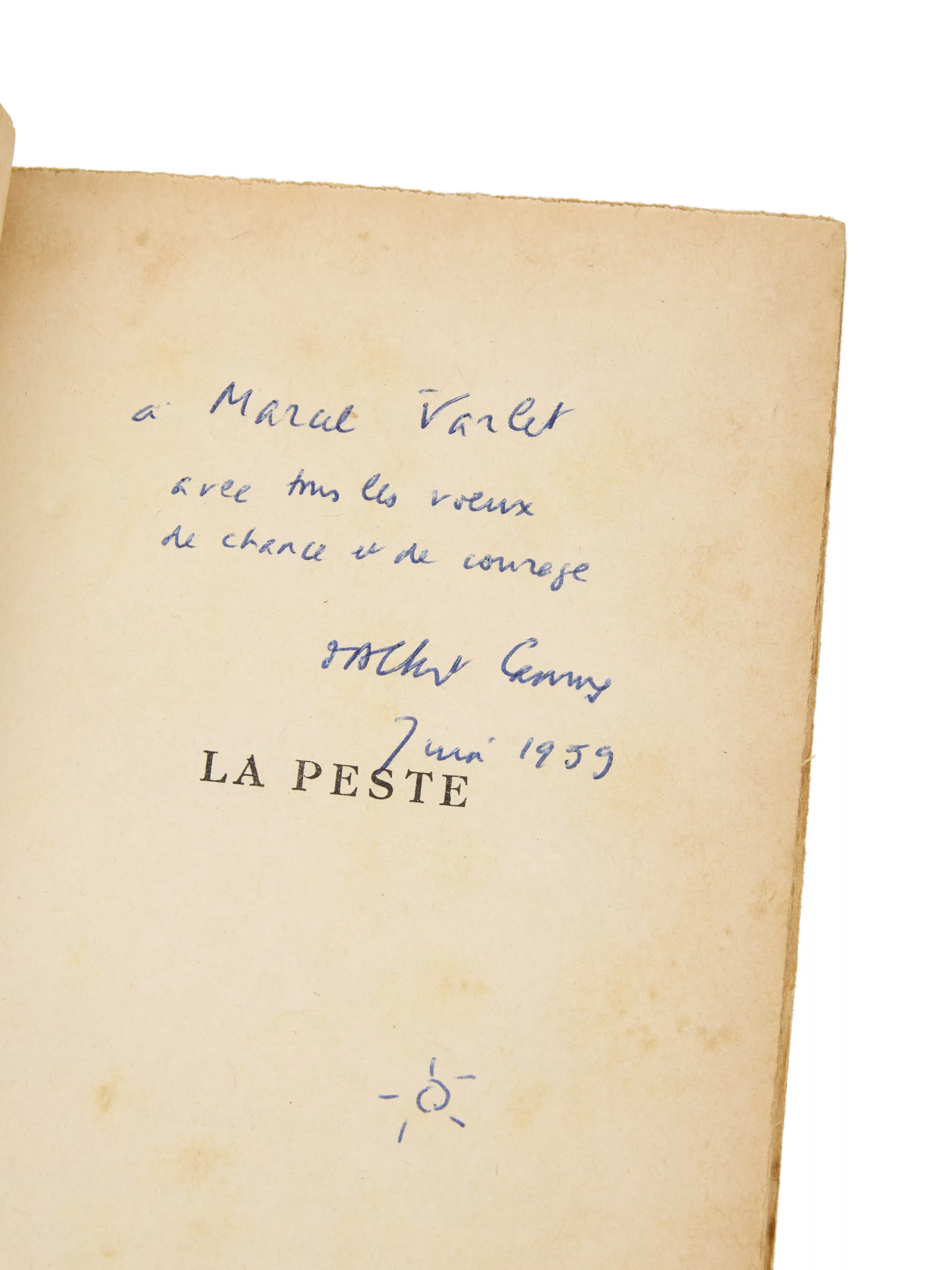
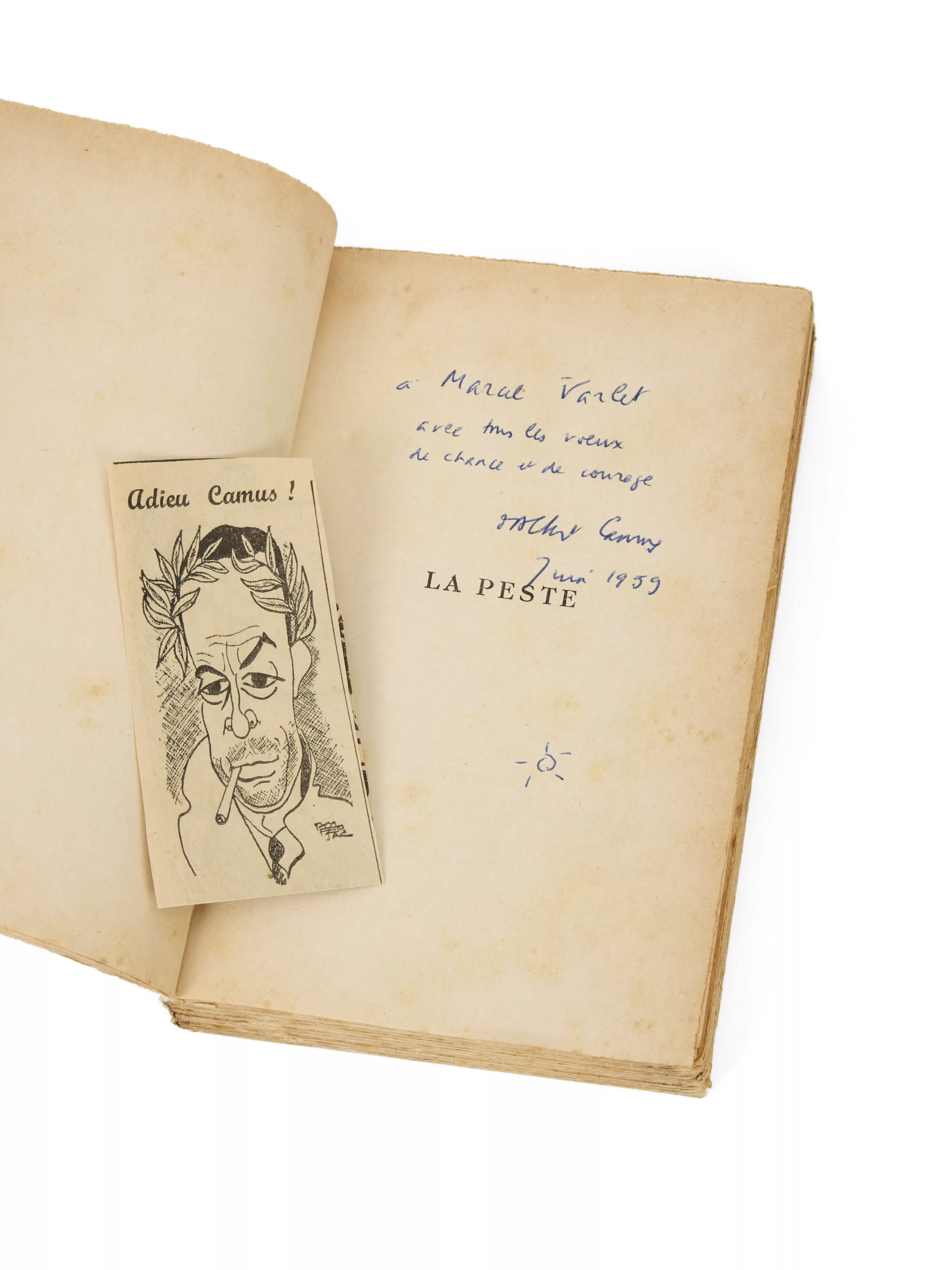
Signed presentation inscription: “à Marcel Varlet avec tous les vœux de chance et de courage. Albert Camus Juin 1959,” with a small sun drawn beside it.
In June 1959, Camus had just left Lourmarin, where he had stayed from 28 April to 28 May and made progress on the first part of Le Premier Homme. Back in Paris, he was wholly absorbed by theater. His adaptation of Dostoevsky’s Les Possédés, which had opened at the Théâtre Antoine on 30 January, was enjoying considerable success and remained on the bill until the summer break; as late as 30 May, Camus took part in a meeting with the audience after a performance. The production was about to go on tour in France and Europe. At the same time, Camus was negotiating with Malraux: he hoped to take over the direction of the Théâtre Récamier and was already working on assembling a future company. He had already met with Malraux on the matter, the subsidy order had just been signed, and the writer believed his appointment imminent. So much so that, on 25 June, he sent the Ministry of Cultural Affairs “theoretical proposals for a New Theater” and, a few days later, attended the Conservatoire’s competition as a spectator in search of young actors.
It was in this Parisian context that Camus, in June 1959, offered his wishes of “luck and courage” to Marcel Varlet. Was he a candidate for the stage of the Théâtre Récamier, the venue designated for his forthcoming appointment?
Twelve years after the novel’s publication, the June 1959 inscription takes on particular resonance, as Camus was engaged in new projects in which theater occupied a central place. A few months later, on 4 January 1960, Camus died in the accident at Villeblevin, leaving in his bag the unfinished manuscript of Le Premier Homme.
Published in 1947, La Peste immediately became one of the great postwar books: a critical and popular success, it established the Camusian grammar of honor and measure. Begun as early as 1941 in Oran — as a terrible typhus epidemic was spreading across Algeria — the novel transposes into a fable of plague the experience of historical evil and of “an evil that spreads terror”: a chronicle kept at human scale, in which lucid, united struggle answers the contagion of murderous ideologies. Underlying it, La Peste nourished the reflection Camus would pursue on stage (Caligula, revived and reworked, L’État de siège, Les Justes) and in adaptation (Larivey, Calderón, Lope de Vega).
The final text of La Peste, whose first lines were written as early as 1942, was completed in the course of December 1946. The final full stop was set down without joy: “I have the idea that this book is a complete failure, that I have sinned through ambition, and this failure is very painful to me. I keep it in my drawer, like something rather disgusting.” Camus was far from imagining that it would become a bestseller and a popular classic, the third best-selling title of Éditions Gallimard, after Le Petit Prince and L’Étranger. Translated into dozens of languages, the “Revolt” cycle would weigh in his favor in the award of the Nobel Prize in Literature ten years later. “What we learn in the midst of plagues is that there is more in men to admire than to despise,” he writes in La Peste. While showing humanity’s capacity for solidarity and struggle, Camus warns that the lessons of such trials must never be forgotten: “The plague bacillus never dies or disappears entirely.”
A fine copy, in which the recipient kept a press clipping on Camus’s death.
Some light foxing.