

La Chartreuse de Parme
“La Chartreuse de Parme is, in our era, and to my mind so far, the masterpiece of the literature of ideas […]. M. Beyle has written a book in which the sublime bursts forth from chapter to chapter. At an age when men rarely find grand subjects, and after writing some twenty extremely witty volumes, he has produced a work that can only be appreciated by truly superior minds and souls.”
— Balzac, Revue parisienne, 25 September 1839.
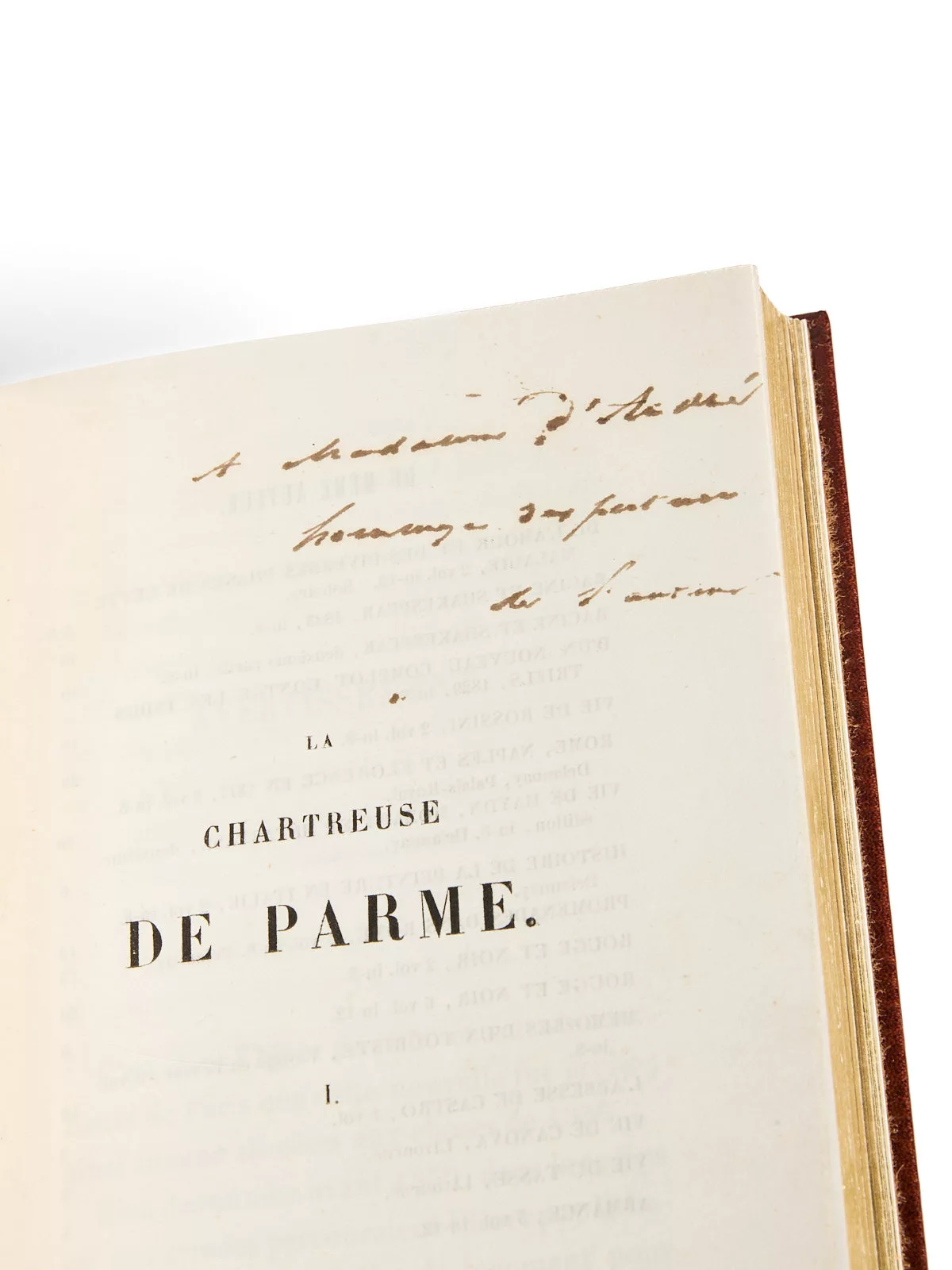
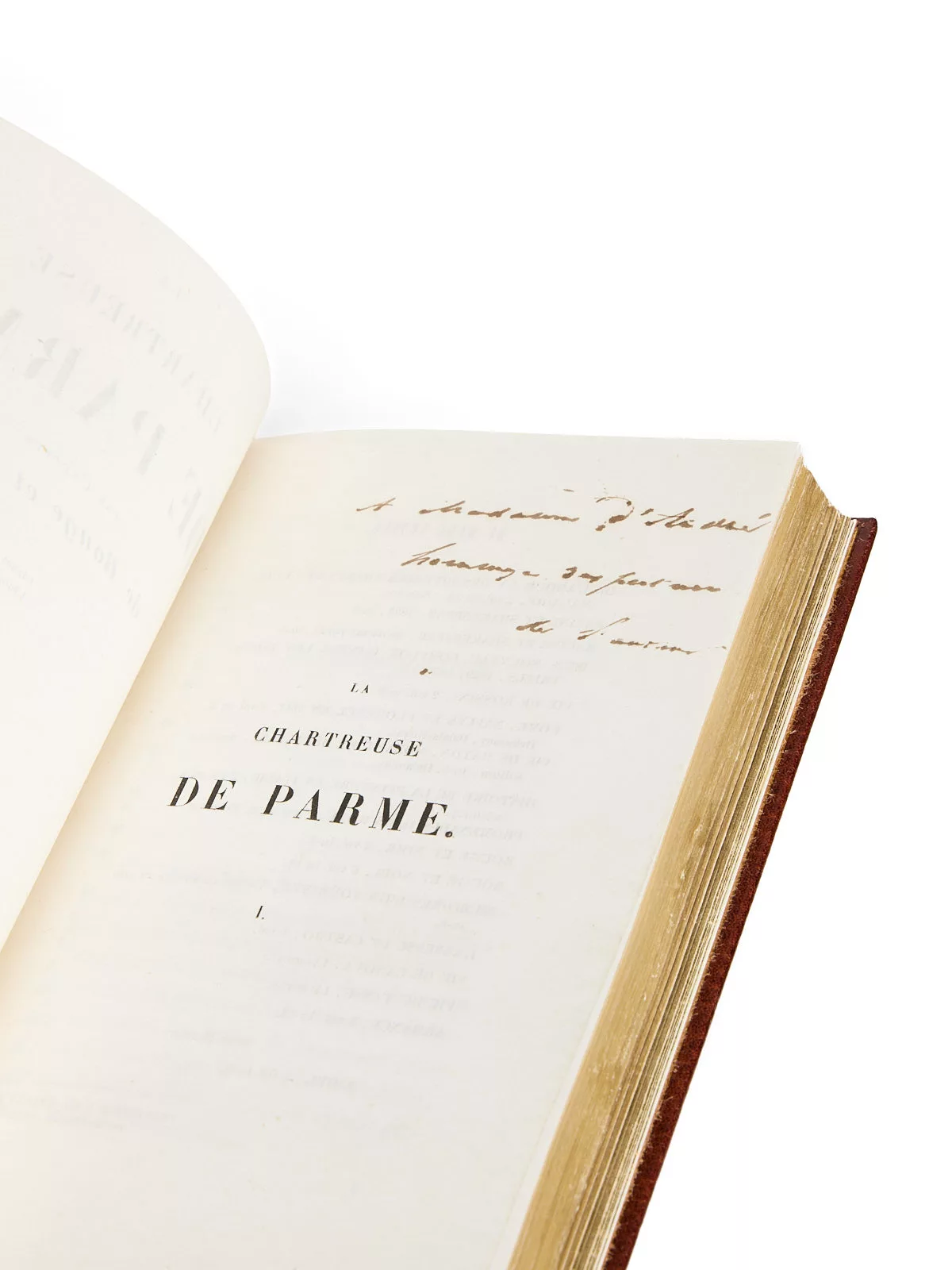
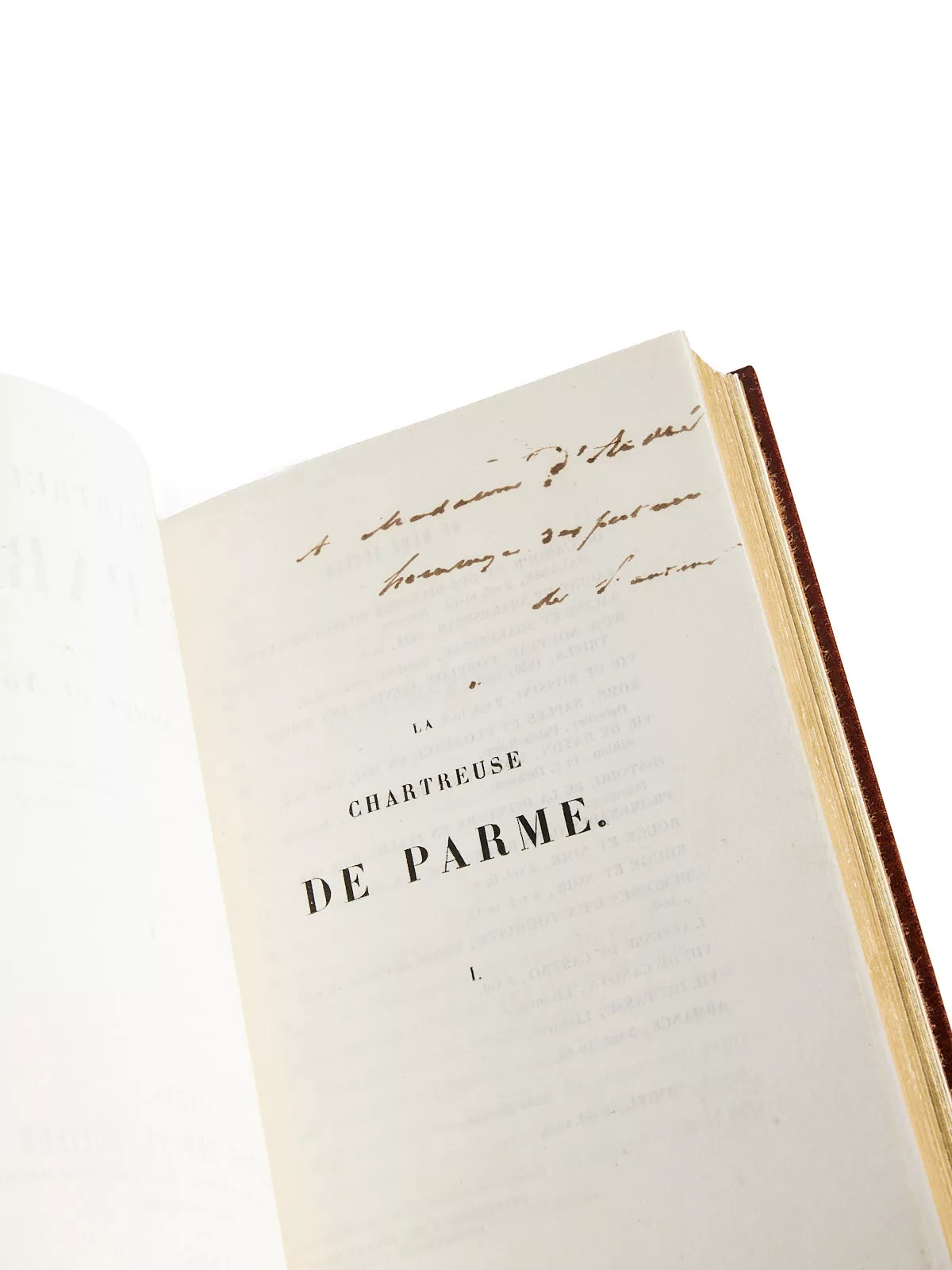
A precious copy inscribed to Madame Claire d’André, wife of Count Antoine d’André (1788–1860), governor of Rome and Strasbourg, baron of the Empire and prefect of the Paris gendarmerie. An officer cadet at the Vienna military academy and later a lieutenant in the Emperor of Austria’s light cavalry, he was recalled to French service in 1809 and campaigned in Russia. Promoted lieutenant adjutant-major in 1813, he took part in the Spanish, Russian and German campaigns. Under the Restoration he returned to the gendarmerie, helping to reorganize it and suppressing unrest in Paris; under Louis-Philippe he became inspector general of the gendarmerie, succeeding Lieutenant-General Latour-Maubourg.
No other copy of La Chartreuse de Parme is known to have been inscribed to a woman, making this the first copy with such a provenance.
The same is true of Le Rouge et le Noir, for which the only certain copy with a female provenance is that of the Baroness Charles de Rothschild — the sole example naming a woman — since the six other known inscribed copies bear only the formula “hommage de l’auteur,” of which only two recipients, Félix Faure and Baron Adolphe de Mareste, are identified.
Only seven copies bearing an autograph inscription by Stendhal have been recorded for La Chartreuse de Parme (the same number as for Le Rouge et le Noir):
– Inscribed to Frédéric Soulié (Destailleur copy [1891], then Montgermont [1912], cited by Vicaire and Carteret — the only inscribed copy cited in both bibliographies)
– Inscribed to Romain Colomb (Bibliothèque de Grenoble)
– Inscribed to Albert Stapfer (sale, 1931, then Drouot Rive Gauche, Bibliothèque Sacha Guitry, March 1976, no. 222)
– Inscribed to Paul-Émile Daurand Forgues (Christie’s, May 2013, no. 208; €38,000, modern binding by Devauchelle)
– Inscribed to Count Amédée de Pastoret (Pierre Bergé & Associés, Bibliothèque Michel Audiard, May 2016, no. 76, modern binding)
– Inscribed to Doctor Jean-Louis Prévost (Paul Voûte and Robert Fleury copies, then the Ribes collection, Sotheby’s, II, no. 187, modern binding)
– Inscribed to Joseph Lingay (volume 1 only, returned to the author, who made autograph corrections to it; Bibliothèque historique de la ville de Paris, Rés. 739841)
There also exists a 117-page autograph manuscript accompanied by a copy of the first edition annotated by Stendhal, originally catalogued in the sixth Bérès sale (20 June 2006, no. 91); this copy was ultimately transferred by private agreement to the Bibliothèque nationale de France. A second annotated copy, once owned by Eugène Chaper (without inscription), is now preserved at the Pierpont Morgan Library in New York [H.572].
The text: barely back from his travels as a “tourist,” Beyle began, in August 1838, to draft a short story, L’Origine de la grandeur des Farnèse, then broke off and decided to turn it into a “romanzetto,” which by 3 September he had decided to set in the nineteenth century — the true birth of La Chartreuse de Parme. Two months later, taking leave from his consular post, he set to work: on 4 November he shut himself up in his Paris apartment on the rue Caumartin.
Some fifty days later, on 26 December, the work was finished, and Stendhal sent his notebooks to his cousin and trusted agent Romain Colomb, asking him to negotiate the publication without disclosing his name, since he could not, “on pain of losing his position, expose his name to public notoriety” (Vittorio Del Litto). Colomb turned, as he had just done for the Mémoires d’un touriste a few months earlier, to the publisher Ambroise Dupont — successfully: the bookseller purchased the publishing rights for 2,500 francs, under a contract dated 24 January 1839 recording the sale of “the entire and exclusive property, for five consecutive years, of a manuscript entitled: La Chartreuse de Parme, by the author of Rouge et Noir.”
The book appeared in the first week of April 1839; the edition was not exhausted until the end of the following year. Its success was sluggish, and the press paid it little attention. Stendhal had dedicated the book “to the happy few,” and the public obliged him: elitist, difficult and richly documented, the novel failed to find its readership. But one figure in the literary world did not miss it: Honoré de Balzac, in his Revue parisienne of 25 September 1839, published an Étude sur M. Beyle, a genuine tribute to La Chartreuse de Parme running to more than seventy pages: “He has written The Modern Prince, the novel Machiavelli would write if he lived exiled in nineteenth-century Italy. The greatest obstacle to M. Beyle’s deserved fame is that La Chartreuse de Parme can only find readers capable of appreciating it among diplomats, ministers, observers, the most eminent men of the world, the most distinguished artists — in short, among the twelve or fifteen hundred people who stand at the head of Europe. Do not be surprised, then, that in the ten months since this astonishing work appeared, not a single journalist has read it, understood it, studied it, announced it, analyzed it, praised it, or even noticed it. As for myself, who believe I know something of these matters, I have just read it for the third time these past few days: I found the work even more beautiful, and felt in my soul the kind of happiness a good deed brings.”
“Never, perhaps, had a living author been praised so splendidly,” notes Paupe (p. 123). And the praise endured: La Chartreuse de Parme, a “unique” and “complete” book, became a legendary work as early as the nineteenth century, thanks to Gobineau, Barbey d’Aurevilly and Henry James, for whom Stendhal’s novel “ranks among the finest that exist.”
Called “the finest novel in the world” by André Gide, La Chartreuse de Parme was considered by Marcel Proust to be “the finest French novel that ever existed.” Julien Gracq expanded on this in En lisant en écrivant: “Fortunate are those books which, behind whatever frenzy may inhabit them, seem to have been written from beginning to end as though in golden dust […]. La Chartreuse de Parme is written entirely, and stands out for me from start to finish against that halo of ripening sunlight […]. The allegro of La Chartreuse is that of travelers without baggage, who do not even burden themselves with Balzac’s voluminous wagons. Reading La Chartreuse, I sometimes imagine I am listening to a haunting yet singular musical theme, a Vinteuil-like ‘little phrase,’ endlessly repeated, but each time in a different timbre by successive groups of instruments, sufficient in itself for my pleasure. Let us admit it: reading this marvelous novel requires a certain state of grace not always available at will […] for it is the climate of love that sustains the book — not so much that of the Sanseverina for Fabrice, or of Fabrice for Clélia Conti, but the novelist’s own manifest love for his novel, as for an Eden revisited in a dream.” The playful Italo Calvino concluded that “the finest novel in the world can only be this one,” all the more so since, for him, it was above all “The Great Italian Novel,” the title of an article he wrote in 1983 for Le Magazine littéraire.
A remarkable modern consensus around a work written and dictated in fifty-three days! To compose so complex and profound a fresco in under two months is surely a mark of genius. From Napoleon’s armies to the intrigues of the court of Parma, this novel of formation traces the spiritual journey of Fabrice del Dongo, “a hero who is hardly a hero,” a sublime reflection of a soul both frustrated and exalted by the Mal du siècle — that malady of a generation of young Frenchmen who, like him, had rallied to Napoleon. With his fall and the return of reactionary power, these young men grew melancholic. Fabrice del Dongo embodies this rupture between man and his age, spending the novel in pursuit of happiness. But how can one be happy in a world that does not understand us? This is the novel’s central question, drawing its charm from the “sublime landscapes” of Lombardy.
The total print run of the edition was 1,200 copies, issued in two batches: the first, on vélin paper, without any special designation; the second, whose copies bear the words “deuxième édition,” printed on laid paper. The collation of the volumes is identical for both printings. When the first edition appeared, in March 1839, Stendhal was still in Paris; he did not return to his consular residence at Civita Vecchia until 10 August.
Stendhal had served since 1831 as French consul for the Papal States as a whole. This was the most fertile period of his career, during which he wrote Lucien Leuwen, La Vie de Henry Brulard, Lamiel, the Chroniques italiennes, and, in 1839, this swan song, La Chartreuse de Parme, blending his love of Italy with a serene vision infused with the spirit of Correggio, Cimarosa and Mozart.
“Very rare and highly sought after. Often foxed,” according to Clouzot; “this work is of great rarity in fine condition” (Carteret).
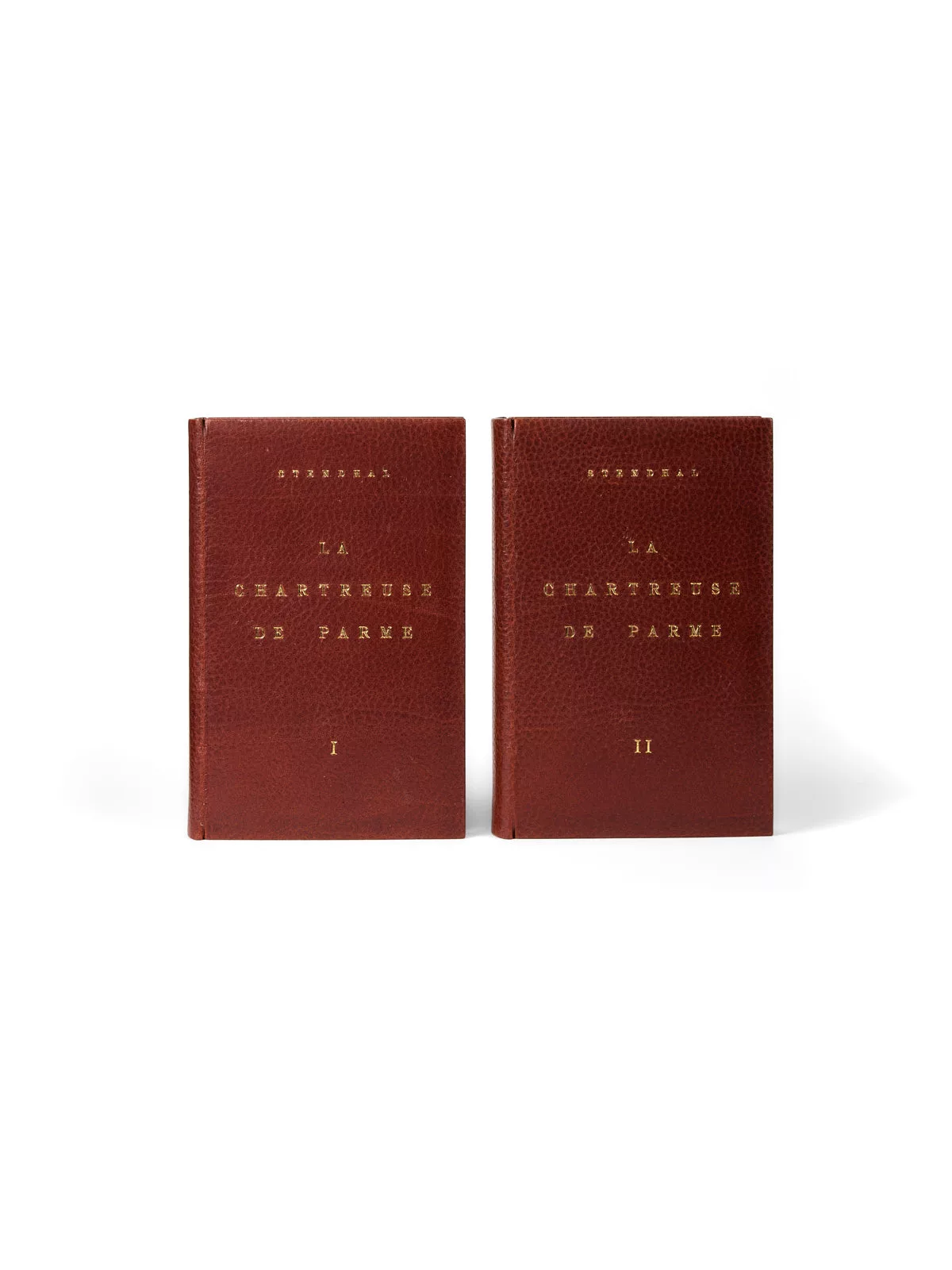
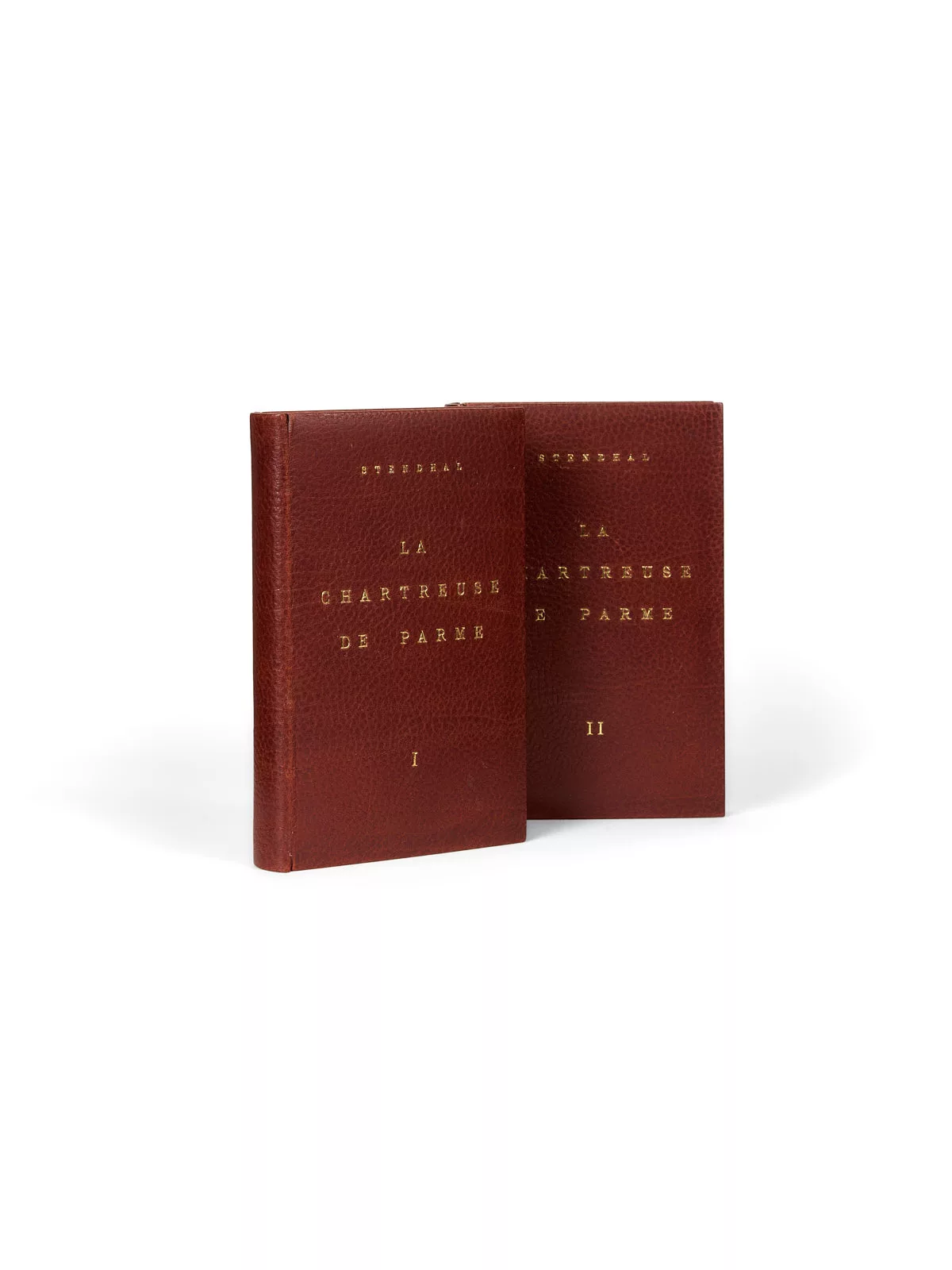
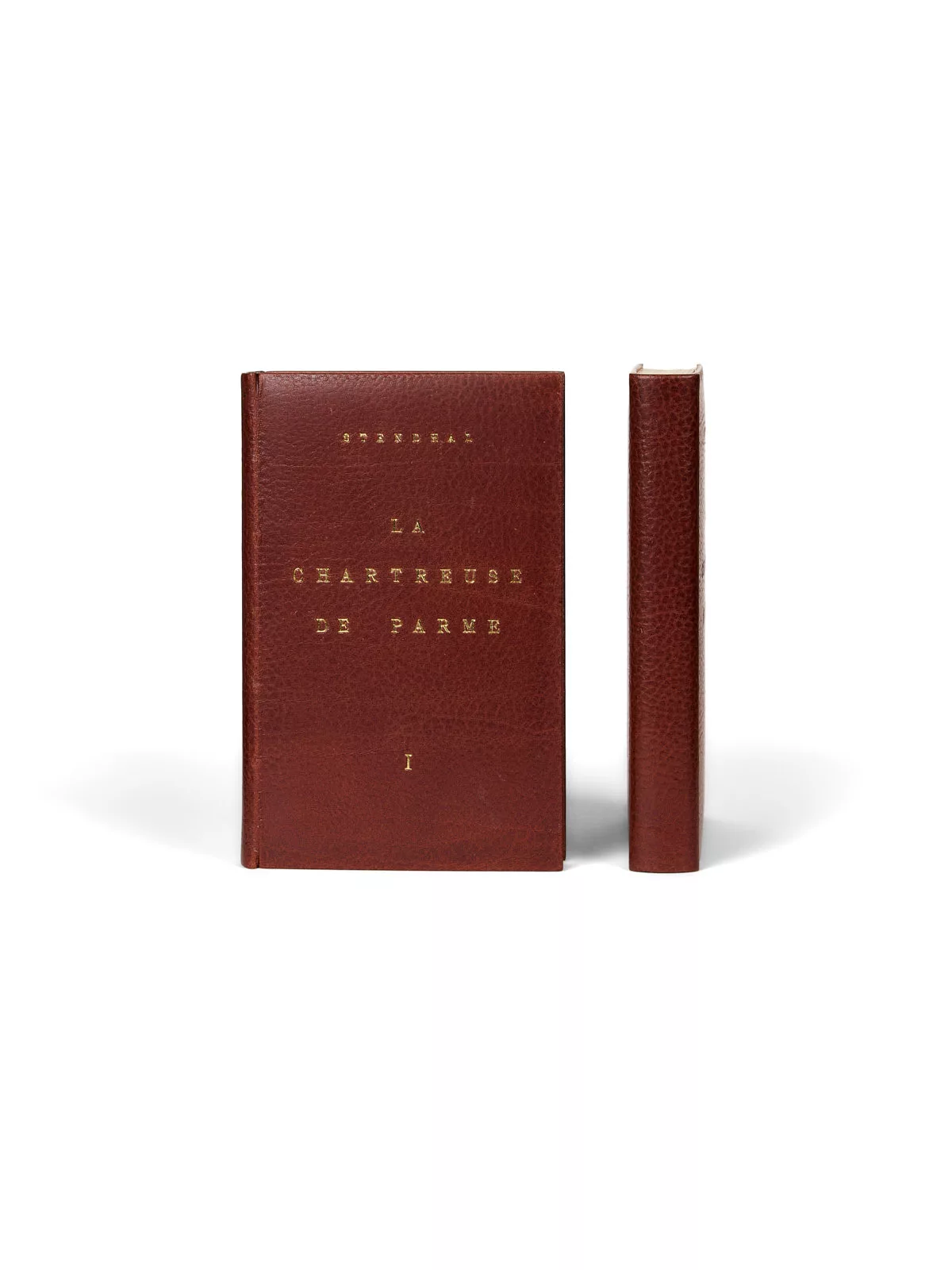
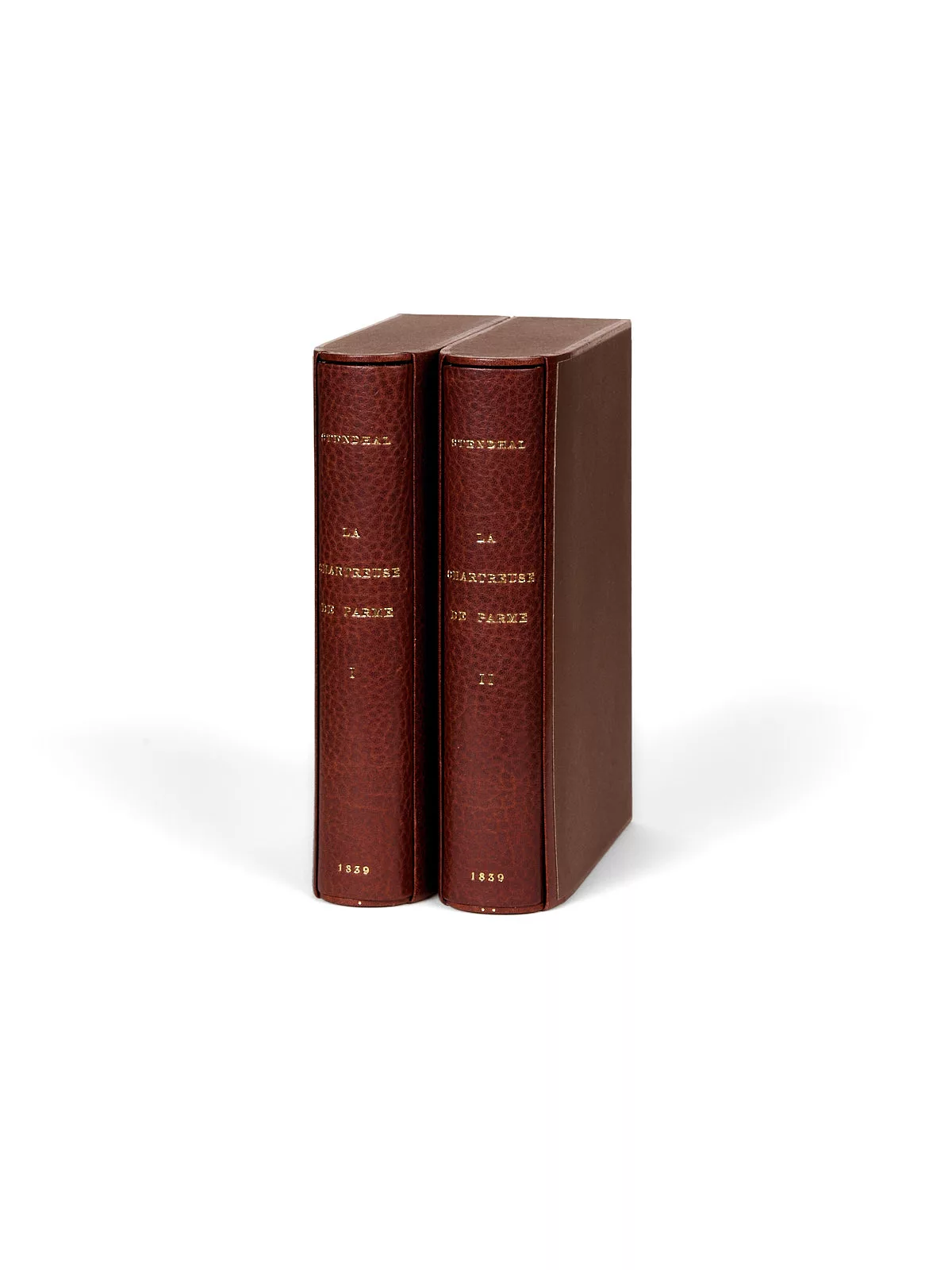
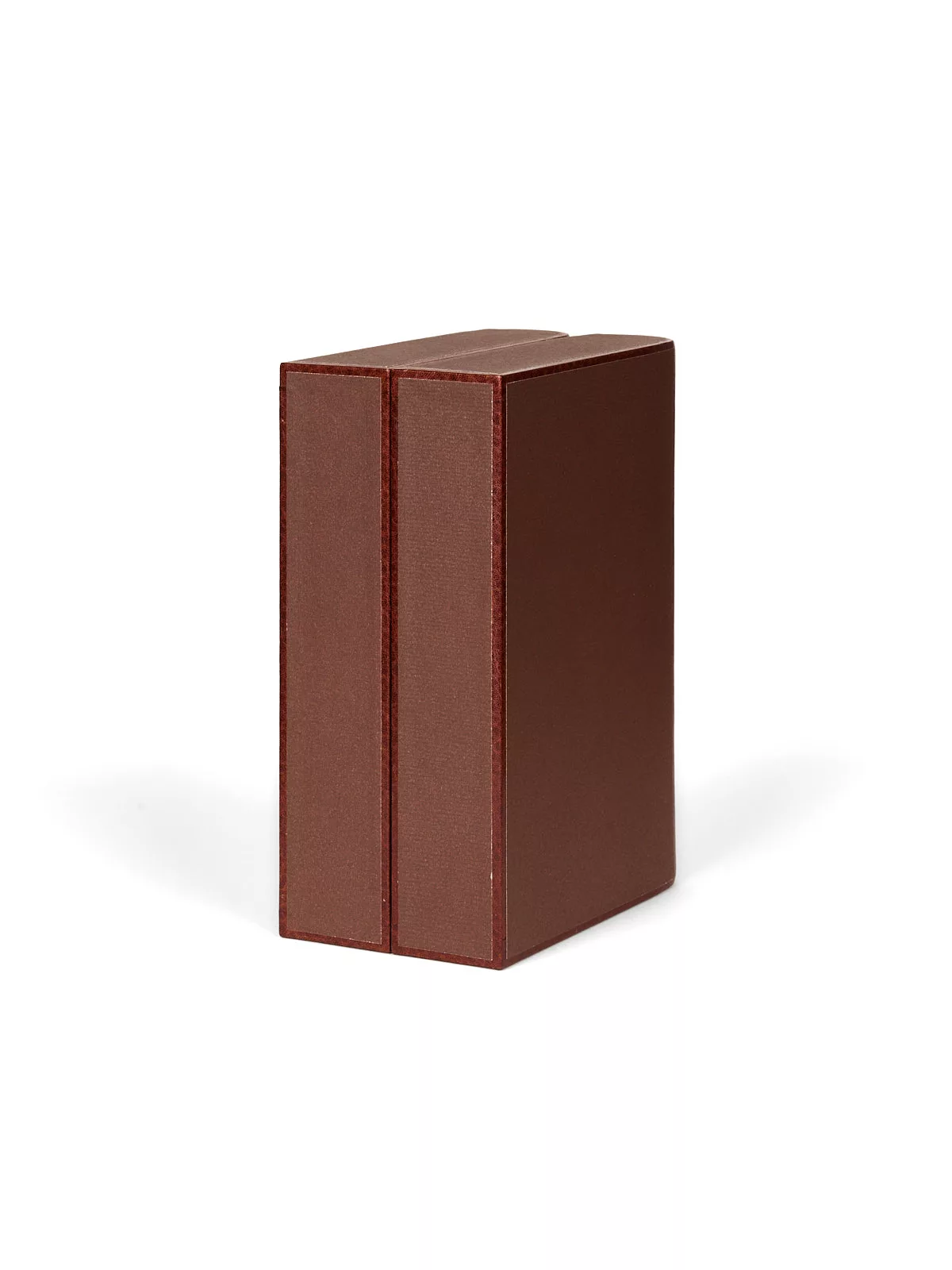
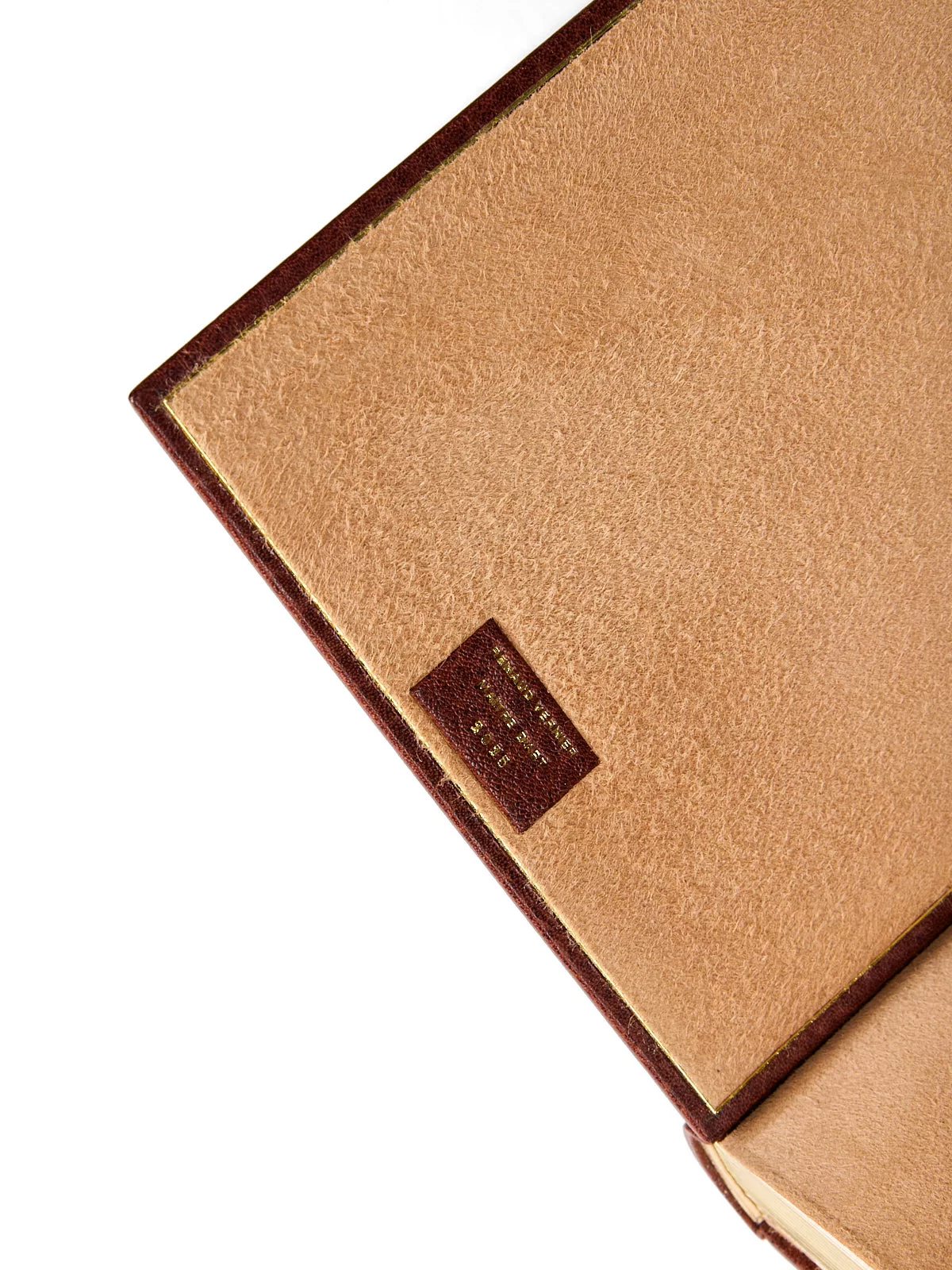
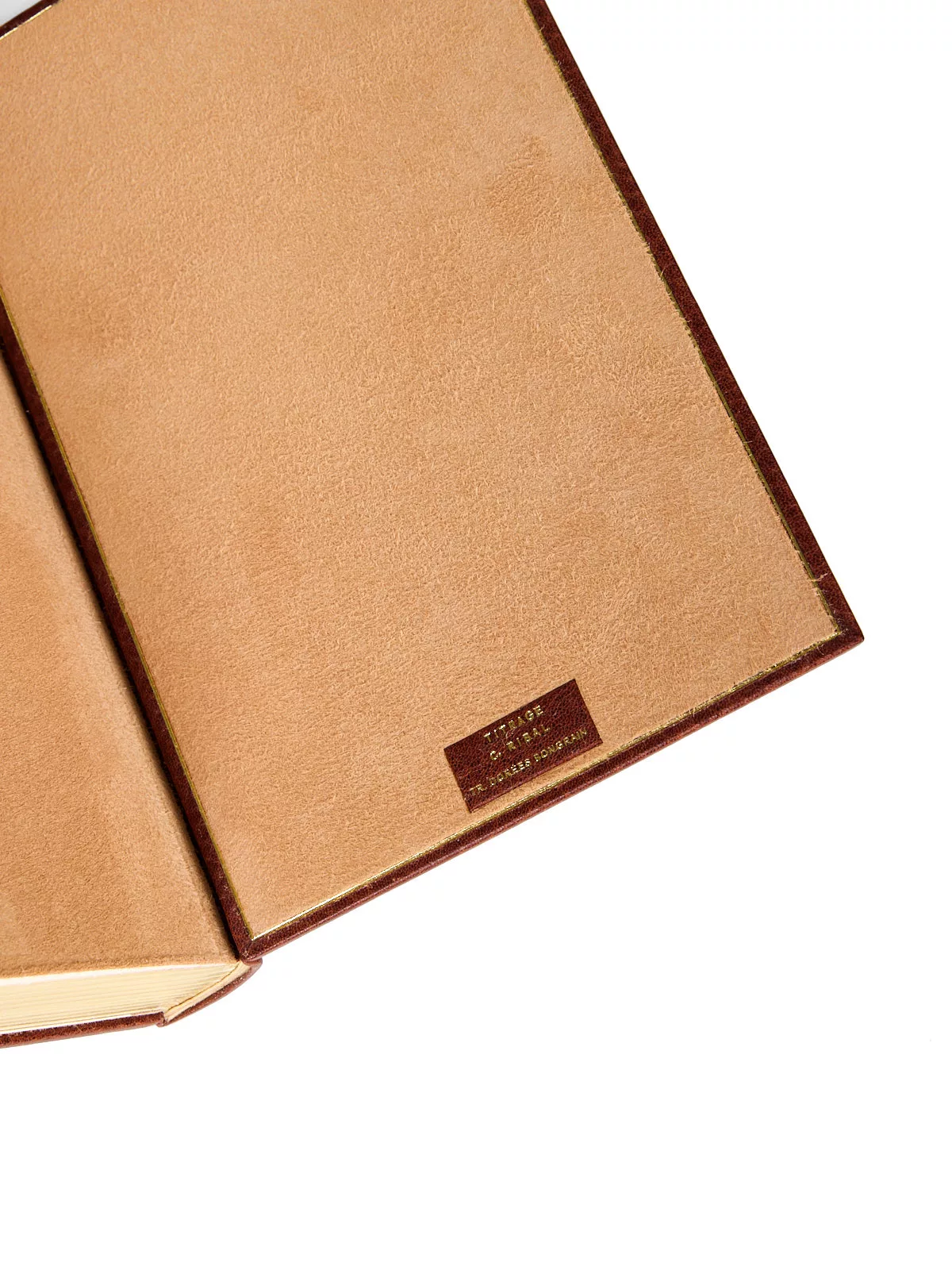
A precious copy, magnificently and expertly bound by Renaud Vernier.
Volume 1 lacks two leaves (pp. 72–74), which were already missing in the original contemporary binding, unfortunately too damaged to be preserved. Once the copy had been cleaned, we chose not to supply leaves from another copy or to replace them in facsimile, in order to preserve the volume’s original condition, even though this defect was probably the binder’s fault.
Cordier 125; Vicaire, 458; Carteret, II, 358; Cordier, Bibliographie stendhalienne, no. 87; Cordier, Comment a vécu Stendhal, pp. 188–189; V. Del Litto, E. Williamson and J. Houbert (eds.), Correspondance générale de Stendhal, Paris, Champion, 1997–1999, III; J. Houbert, “Le Contrat d’édition de La Chartreuse de Parme,” in L’Année stendhalienne, no. 5, Paris, Champion, 2006, pp. 325–329; Stendhal, Journal, in Œuvres intimes, Paris, La Pléiade, 1982; Paupe, Histoire des œuvres de Stendhal, p. 120 ff.; Stendhal, La Chartreuse de Parme, ed. Mariella Di Maio, Paris, Gallimard, 2003.