

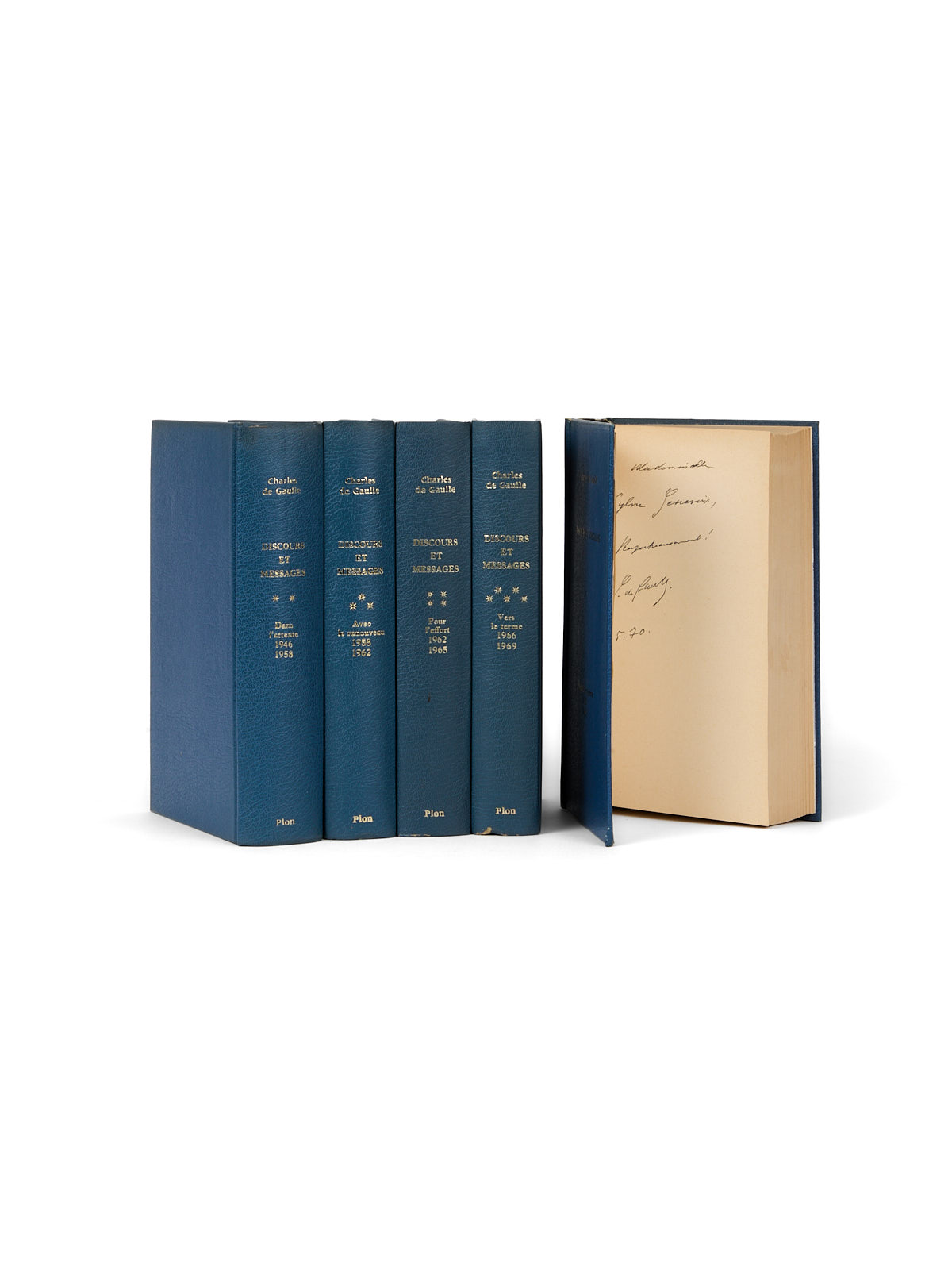
Discours et Messages
Inscribed and signed by de Gaulle to Sylvie Genevoix: “Pour Mademoiselle Sylvie Genevoix, respectueusement ! C. de Gaulle. 12.5.70.”
These five volumes bring together the speeches delivered by General de Gaulle, from the famous appeal of 18 June 1940 to the speech of 28 April 1969. The exact texts survive, either written in his own hand for radio and television addresses, or recorded by official shorthand for his public speeches and addresses to the Assemblies.
The first volume of the Discours appeared in April 1970, and de Gaulle made a point of sending copies to those close to him, whether from political, cultural, literary or family circles. The remaining volumes followed over the course of 1970, during which de Gaulle, already ill, corrected the proofs from La Boisserie, along with those of Mémoires d’espoir, published in October. He died on 9 November 1970 — four days after the publication of the fourth volume, Pour l’effort; the last, Vers le terme, was completed in print on 24 November, posthumously.
This inscription reflects a rare personal bond: a discreet but influential literary figure, Sylvie Genevoix is the daughter of Maurice Genevoix, whom de Gaulle held in very high esteem. In 1960 he entrusted her father with the Mémorial de Verdun project, whose creation was decided on 23 October 1960 at the general meeting of the Comité National du Souvenir de Verdun. The French State, under the presidency of Charles de Gaulle, launched a major national subscription to finance the project.
Born 17 May 1944 in Châteauneuf-sur-Loire, Sylvie Genevoix grew up at Les Vernelles, the family home acquired by her father in 1927. There she developed a deep attachment to the Loire and to family memory, which she later recounted in her book La maison de mon père (2001). After studying classics at the Sorbonne, she began a career in publishing at Plon — Charles de Gaulle’s longtime publisher since the Mémoires de guerre in 1954.
She began there as press attaché at Éditions 10/18, then coordinated the literary departments at Plon-Perrin-Julliard, becoming literary director at Julliard. From 1992 to 2005 she was literary director at Albin Michel, before being appointed to the Conseil supérieur de l’audiovisuel (CSA), where she worked on the development of local television and the accessibility of programs for people with disabilities. She also chaired the Mission langue française et francophonie.
Charles de Gaulle expresses here a touching trust toward this intellectual heir of a writer he deeply admired, and a young collaborator at the publishing house that published him.