

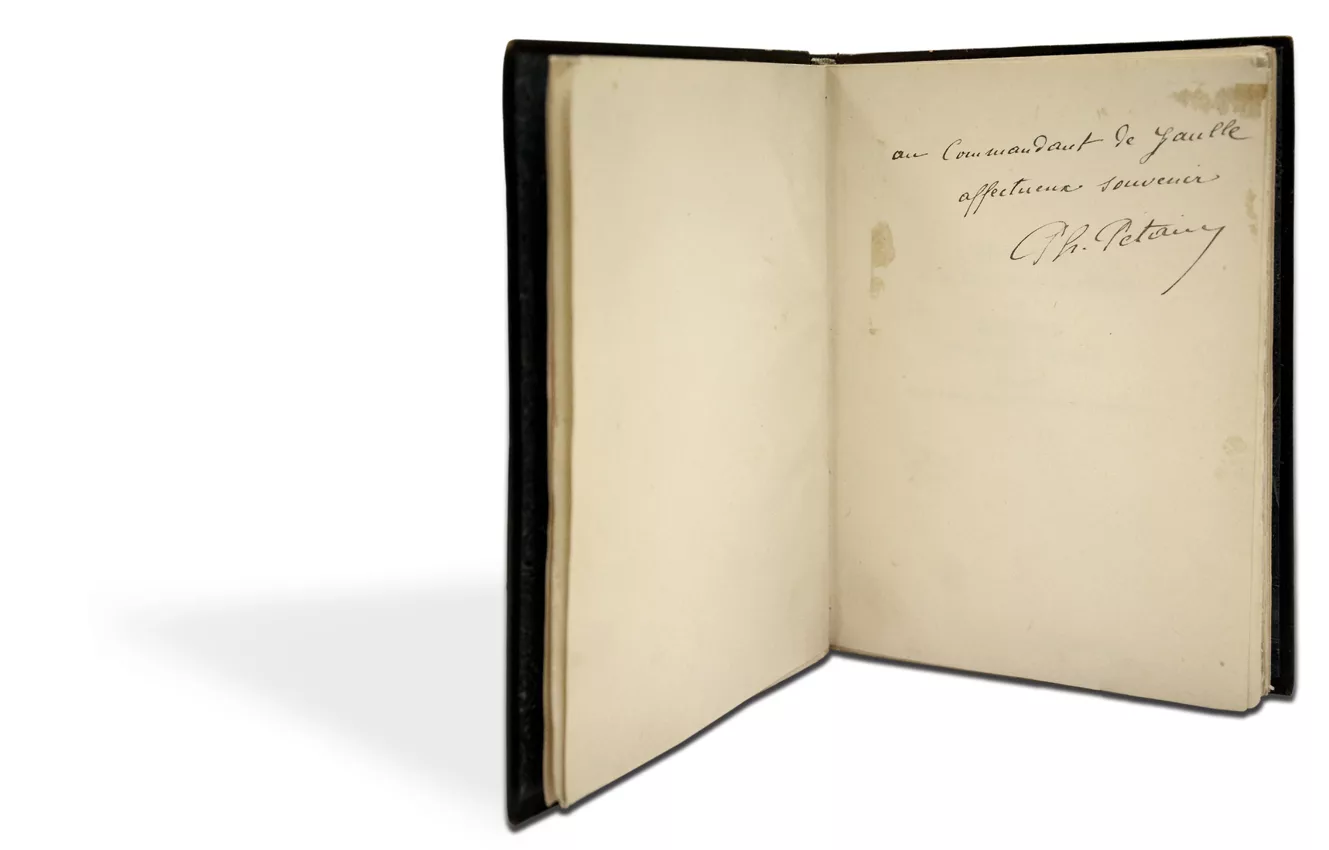
Discours de réception de M. le Maréchal Pétain
A remarkable association copy: General de Gaulle's own copy, with an autograph presentation inscription signed:
“au Commandant de Gaulle, affectueux souvenir, Philippe Pétain.”
Philippe Pétain and Charles de Gaulle first met in 1922.
Colonel Pétain, then two years from retirement, commanded the 33rd Infantry Regiment at Arras and had been sidelined because of his ideas, which clashed with those of the general staff of the day. Lieutenant de Gaulle, fresh out of Saint-Cyr, joined the regiment. Pétain immediately recognized de Gaulle’s exceptional qualities, both intellectual and as a leader, and considered him nothing less than “the most intelligent officer in the French army” (Chantal Morelle, de Gaulle, n. 82).
In the 1920s, seeking election to the Académie française, Pétain brought de Gaulle into his office to draft the book he was planning — to be titled Le Soldat — with de Gaulle as its ghostwriter. De Gaulle complied willingly, but the fate of the manuscript triggered a rift between the two men: Pétain asked a colonel to revise the text.
De Gaulle found this intolerable and wrote to the officer: “[…] a book is a man. That man, until now, was me. If someone else, be it Montesquieu, be it you yourself, Colonel, interferes, then one of two things will happen: either he will make another book, or he will demolish mine, which will then have neither character nor value. If the Marshal wishes you to make another book, I have no objection to raise. I will simply take back what is mine. But if it is a matter of tampering with my ideas, my philosophy, my style, I object, and I will tell the Marshal so […]. I consider this work to belong to me personally and exclusively.” Nothing came of it, and Le Soldat was never published.
On 20 June 1929, Marshal Pétain was elected to the Académie française by unanimous vote. Nearly two years passed before he delivered his Discours de réception under the dome, on 22 January 1931, to the seat left vacant by Marshal Foch. The volume was printed just two days before the speech. Paul Valéry delivered the official Réponse.
Le Fil de l’épée, published a few months later in 1932, was dedicated to the Marshal, who received an augmented copy inscribed beneath the printed dedication with the words “Hommage très respectueux et très profond dévouement.” Two years later came Vers l’armée de métier, dedicated “à l’armée française pour servir à sa foi, à sa force, à sa gloire.” Four years after that, La France et son armée brought the final break between the two men — tensions had been building since 1928 — since the book drew heavily on the Marshal’s own thinking. As de Gaulle had insisted in 1928, the book appeared under his name alone, though he offered Pétain a preface acknowledging the Marshal’s role. Pétain also requested a dedication, whose wording he negotiated — but de Gaulle altered it. Pétain discovered the change, furious, only upon publication. It read: “À monsieur le maréchal Pétain qui a voulu que ce livre fût écrit, qui dirigea de ses conseils la rédaction des cinq premiers chapitres et grâce à qui les deux derniers sont l’histoire de notre victoire.”
The break was final.
To our knowledge, this is the only book ever inscribed by Philippe Pétain to Charles de Gaulle.
By contrast, four copies of books by de Gaulle inscribed to Pétain are known: no. 1 of Le Fil de l’épée, a copy of La France et son armée, an offprint entitled “Métiers militaires” published in 1933, and — the earliest — an offprint from the Revue Militaire Française entitled “L’Action du chef de guerre,” a lecture that served as the model for the opening, eponymous chapter of Le Fil de l’épée.