

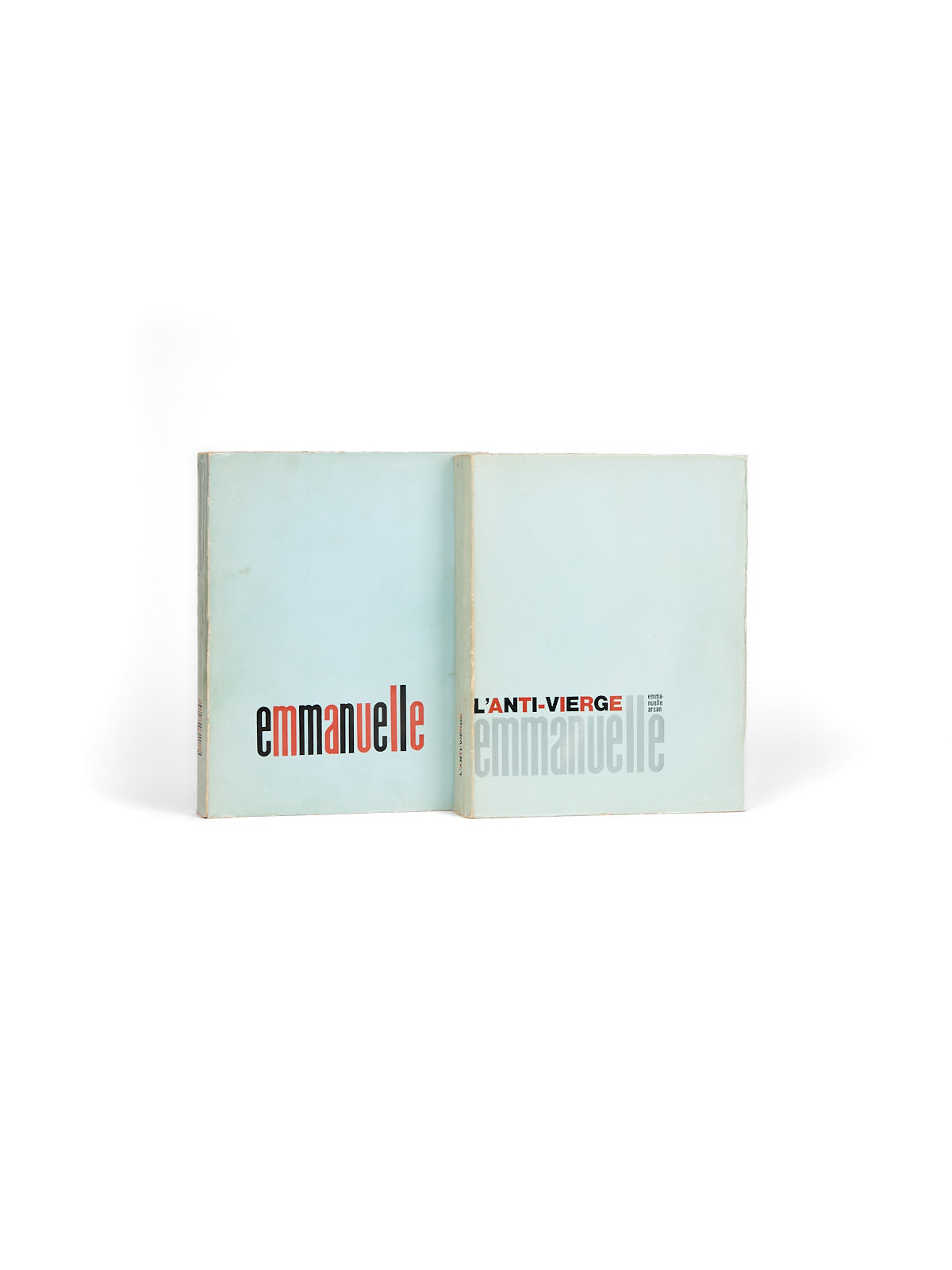
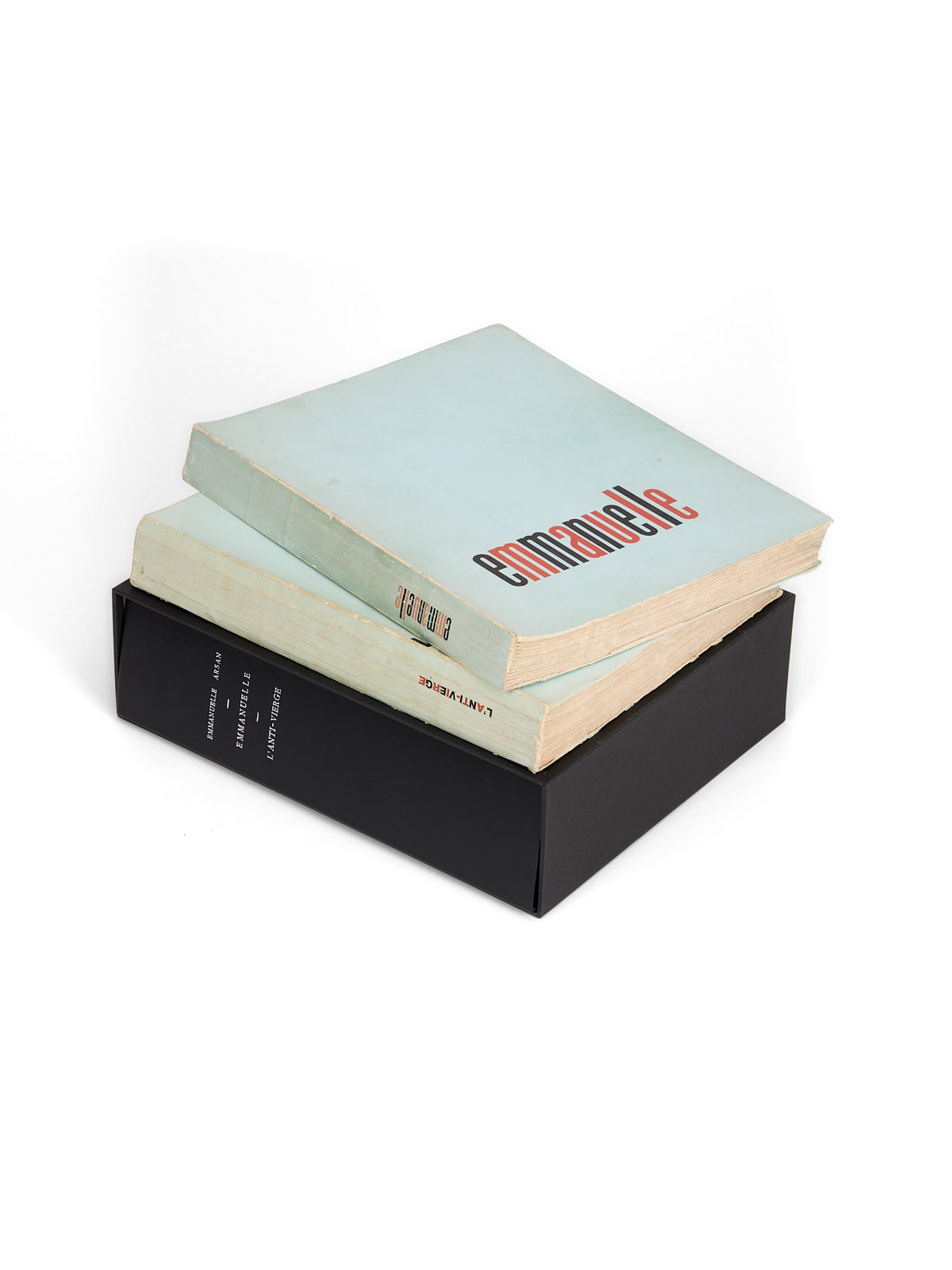
One of the first 50 copies on vergé d'Arches paper (nos. 7 and 6).
A rare deluxe-paper printing of one of the most celebrated erotic texts of the twentieth century, first published clandestinely in 1959 (without a deluxe issue). The author’s name appeared for the first time eight years later: Emmanuelle Arsan. This was a pseudonym, that of Louis-Jacques Rollet-Andriane, a French diplomat with the United Nations for SEATO (South-East Asia Treaty Organization), after a posting in Bangkok. The book was written under cover of his wife, Marayat Andriane Bibidh, then aged twenty and of Thai origin, whom he had married when she was sixteen.
The unwieldy novel — a single text, before being split into two volumes by its future publisher — arrived by post in Paris at the end of 1956: a package from Bangkok, carefully typewritten on luxurious rice paper, landing on the desk of Eric Losfeld. A connoisseur of Surrealism and eroticism, and the eclectic publisher of Sade, André Breton, Georges Bataille, Benjamin Péret and Roland Topor, the founder of Éditions Le Terrain Vague found the manuscript “astonishing.” “The first publication of Emmanuelle was done under the counter. The book had a considerable impact. I received — which was very rare for a clandestine book — an enormous number of articles, all favorable. The critics did not play the Parisian game of pretending to be ‘in the know.’ Everyone said: ‘a book with no publisher’s name’ — when in fact it was I who had sent it to them, specifically asking them not to mention my name, since at that time it meant an unequivocal criminal prosecution” (Eric Losfeld, Endetté comme une mule, ou la passion d’éditer, Paris, Belfond, 1979, p. 162).
Even with a ban on advertising, the success was phenomenal. “Losfeld had both the luck and the misfortune of being the publisher of Emmanuelle. Luck, because when a diplomat wished to recount his rather free relations with his Eurasian wife, he had the charming idea of attributing the account to her under the pseudonym Emmanuelle Arsan. This magnificent and deeply unsettling love story was immediately banned, and Losfeld was once again sentenced to prison and a heavy fine. Nevertheless the book sold, under the counter, in the thousands, even tens of thousands of copies. Since its sale was prohibited, it could only be sold illegally and for cash.” (Francis Leroi, 70, années érotiques, La Musardine, 1999).
The book was officially published by Le Terrain Vague in 1967, this time under the author’s name Emmanuelle Arsan. Within a few weeks, 100,000 copies were sold and Emmanuelle ranked thirteenth among the best-selling books of 1968. André Breton devoted the front page of the magazine Arts to the novel, and even Françoise Giroud, editor of L’Express, bowed before the phenomenon: “The better a book of this kind is, the more dangerous it is; and I have just read a very good book by someone I suspect to be highly cultivated,” the co-founder of the weekly wrote with amusement. Losfeld, for his part, could not resist the pleasure of lifting the veil, subtly and only for the initiated. In issue 96 of the film magazine Positif, of which he was the publisher, he printed a photograph of the young woman along with a text meant to reveal her real name, Marayat Andriane: “We love her naked; she is beautiful; she practices the art without a veil — in a word, she is the anti-virgin. Her career is a strange one. Born in Bangkok in 1940, she came very quickly to settle in Europe. At sixteen she married a French diplomat and lived in the various posts to which he was assigned. It is she who bewitches us, more than Candice Bergen in Robert Wise’s The Sand Pebbles, in which she made her screen debut. She did not, alas, write the screenplay, and her role there remains altogether quite innocent.”
Eric Losfeld saw his publication condemned. On 11 January 1968, an order from the Ministry of the Interior banned both advertising and display in bookshops. But the partial ban only fueled curiosity. His general catalogue for winter 1968 carried a note under the heading “Second rayon”: “We remind booksellers that this work, by order of the Ministry of the Interior, has been subject to the following prohibitions: offering or selling to minors under eighteen, display, and advertising by poster.” Losfeld, ever provocative, nonetheless announced, in a box just below, the October 1968 publication of the second volume of Emmanuelle: L’Anti-vierge.
The pairing of both titles in the deluxe-paper issue is rare. This set in this printing is absent from the erotic collections of Emmanuel Pierrat and Gérard Nordmann, and we know of only one other copy, in a private collection. It is also absent from the collections of the Bibliothèque nationale.
Translated worldwide, the novel was adapted for the screen in 1974 by Just Jaeckin, and this film version is undoubtedly better known than the book. It offers a watered-down version of the novel — even though the main episodes of the story are retained — denounced by Emmanuelle Arsan as soon as it was released. This sanitized version has entirely obscured the militant character of the novel and the “revolutionary” scope of the theories it sets forth.
Dutel, Bibliographie des ouvrages érotiques publiés clandestinement en français entre 1920 et 1970, no. 1470; Pia, 415.