

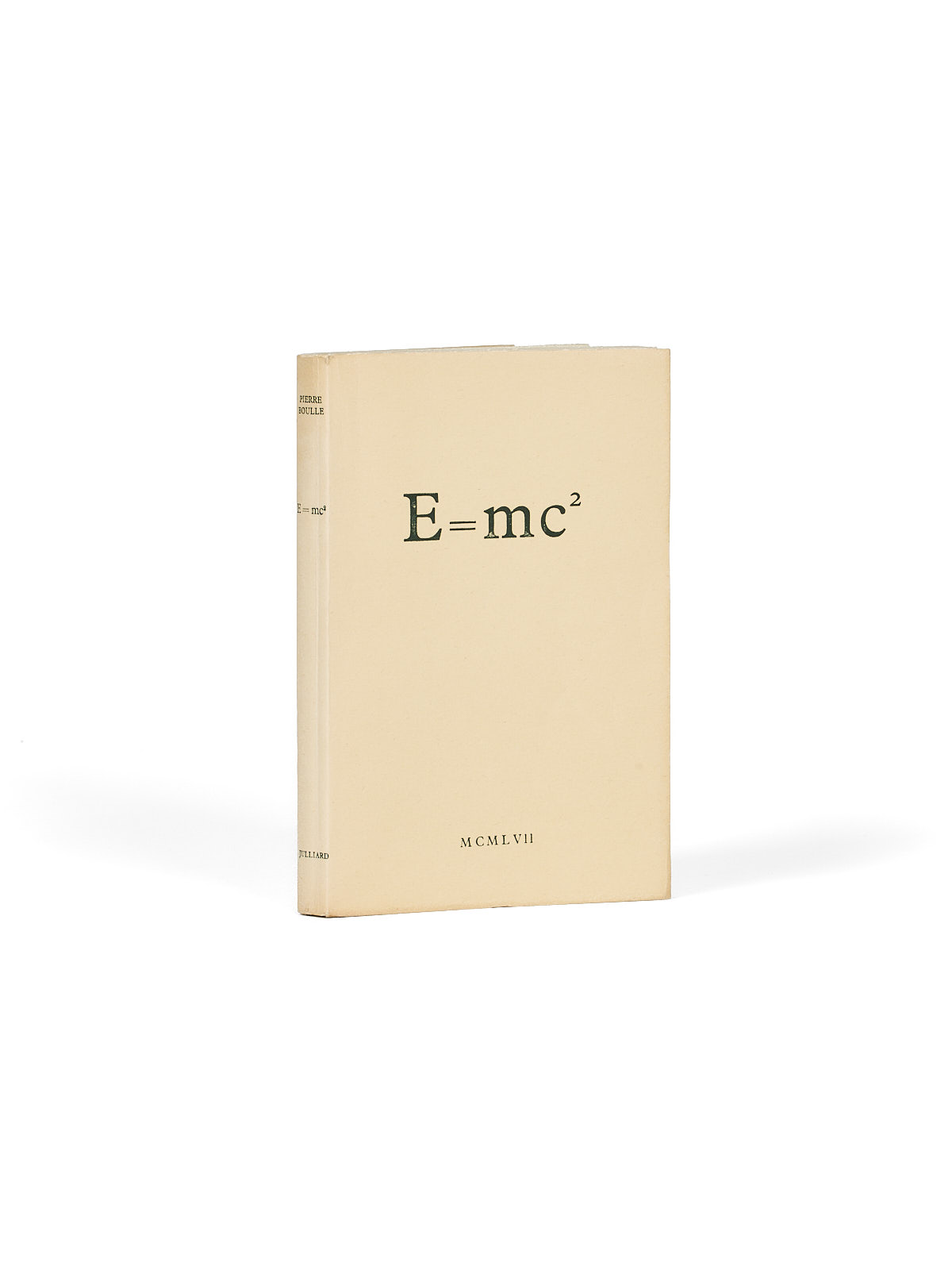
E = mc2
One of 30 copies on Corvol paper (no. 1).
Pierre Boulle first came to prominence with The Bridge over the River Kwai (1952), whose film adaptation, released a few months later, would make him world-famous. At the time E = mc2 appeared, he was still early in his literary career; it was his second collection of short stories, its title borrowed from the long text that closes the volume, “E = mc2, ou Le roman d’une idée.”
In this story, which moves between alternate history and a parallel universe, the protagonists attempt to reverse the destructive applications of the natural disintegration of uranium atoms into an artificial creative synthesis of that same uranium, both operations being made equally possible by the formula E = mc2. Pierre Boulle brings in the figure of Albert Einstein (who had died in 1955) in a world where several other physicists linked to the history of the atom have changed names but fail to change history: “Correct theories allow for experimental verification, but there is no path leading from experiment to theory.” Three other stories precede it: “Les Luniens,” “L’amour et la pesanteur” and “Le miracle.”