


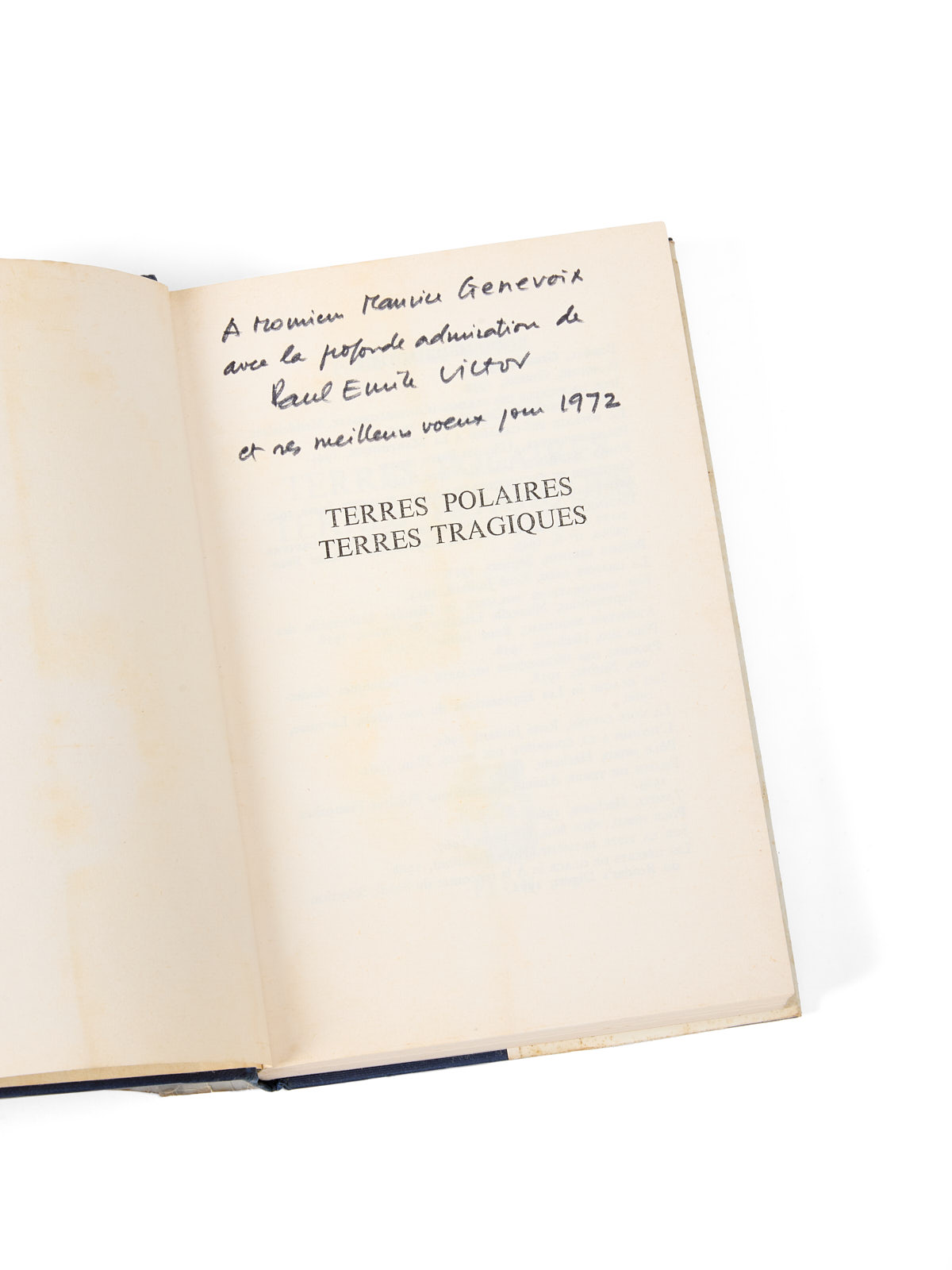
Terres polaires terres tragiques
Inscribed and signed: “À Monsieur Maurice Genevoix avec la profonde admiration de Paul Émile Victor et ses meilleurs vœux pour 1972.”
Born in Switzerland on 28 June 1907, Paul-Émile Victor spent much of his childhood in Saint-Claude, a small village in the Jura, where he took part in scouting, read numerous adventure novels and devoured the ethnological articles published in the weekly L’Illustration, developing a genuine passion for the polar regions. He went on to study engineering at the École Centrale de Lyon and, in January 1934, had a decisive encounter at the Académie des Sciences in Paris: there he approached one of the leading figures of French polar exploration, Commandant Jean-Baptiste Charcot, to whom he presented a plan for an ethnographic expedition. His aim was to study the “Eskimos” of eastern Greenland and bring back to Europe information and objects representing the culture of this population, only recently discovered by Westerners. Charmed by the idea, Charcot supported the venture, and six months later, on 25 August 1934, the young Paul-Émile Victor disembarked from the polar vessel Pourquoi-Pas? at the Danish trading post of Ammassalik. He remained there for a year, quietly absorbing the local culture.
In 1971 Paul-Émile Victor wrote Terres polaires, terres tragiques, a series of eight accounts illustrating the relentless harshness of these regions, from an early exploration in 1819 in search of the Northwest Passage to a final account set during the Second World War, when Greenland served as an essential relay point between the United States and England. At that time, Victor, who had gone into exile in the United States, had become an instructor for the US Air Force and commanded one of its search-and-rescue squadrons for pilots lost in polar regions, a role he held until 1946, when he was granted American citizenship in recognition of his wartime service.
A major figure in polar exploration, Victor spent much of his life traveling between the coldest regions of the world. Founder of the Expéditions Polaires Françaises, he remains, twenty-five years after his death, one of the pioneers of the field in France and one of the world’s earliest environmental activists.
He received the Académie française’s prize in 1973 for his body of work, presented by Maurice Genevoix, then its Permanent Secretary. He was later honored as Commandeur, then Grand Officier and finally Grand-Croix of the Légion d’honneur, the order’s highest distinction.