

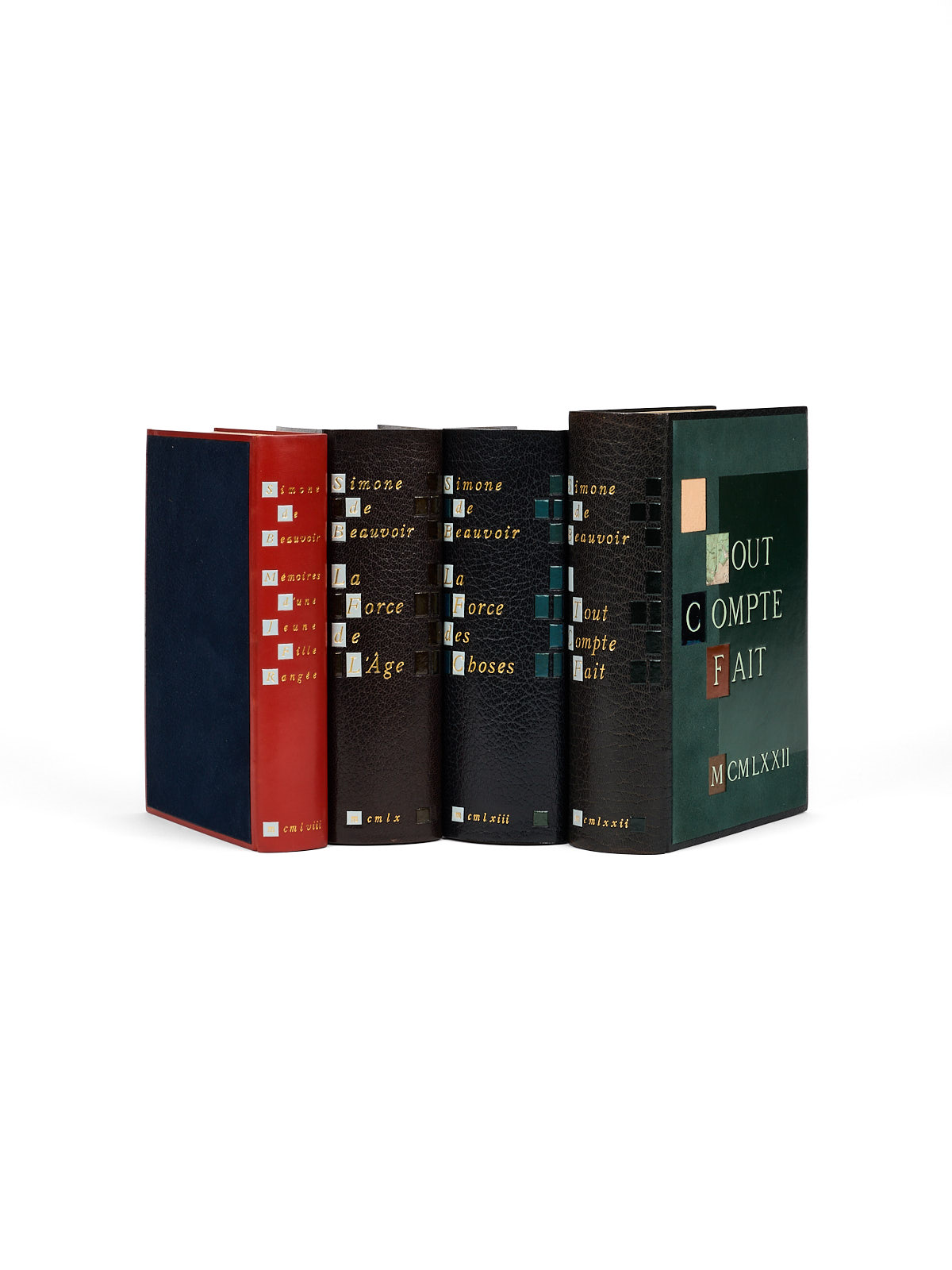
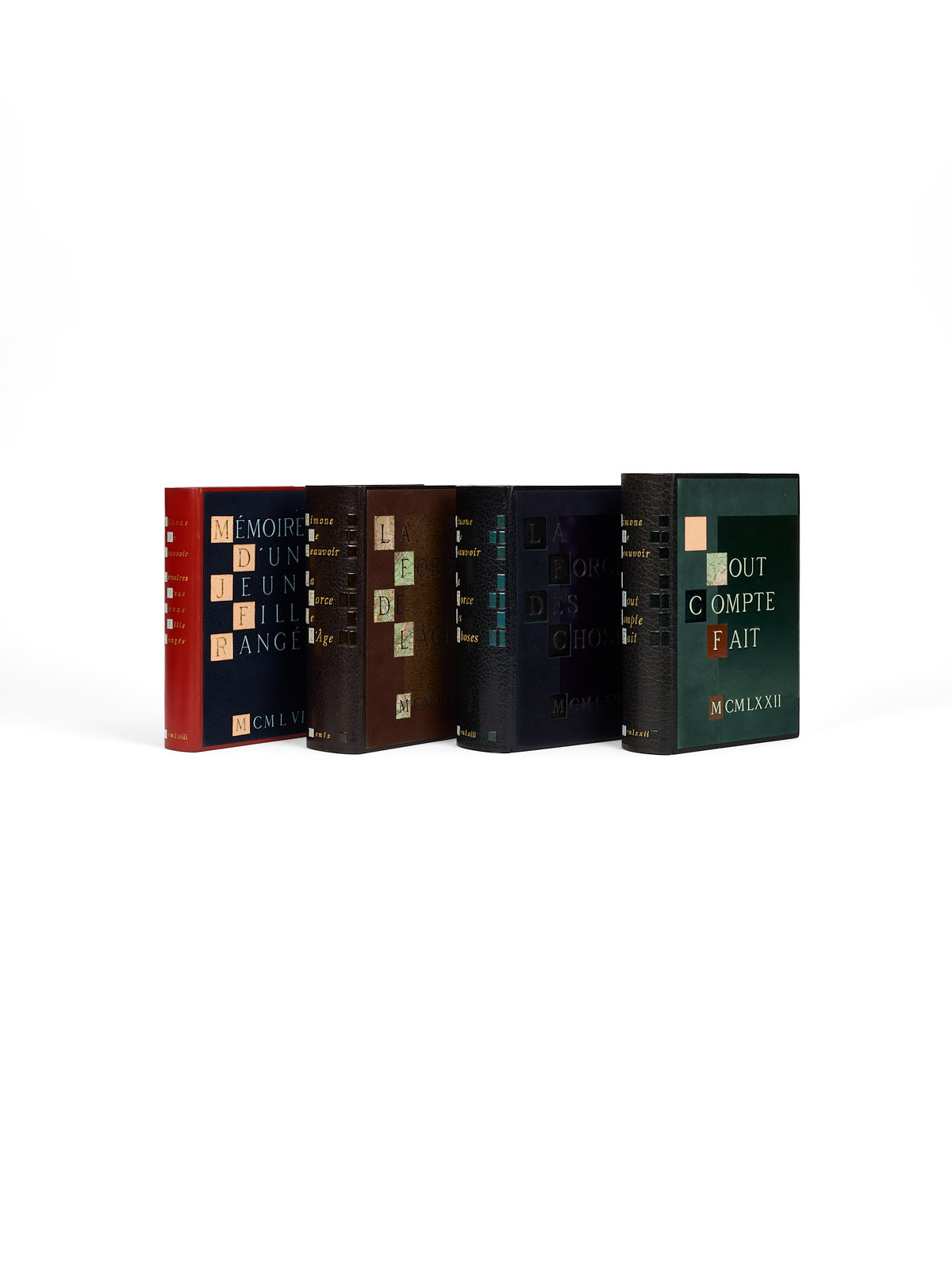

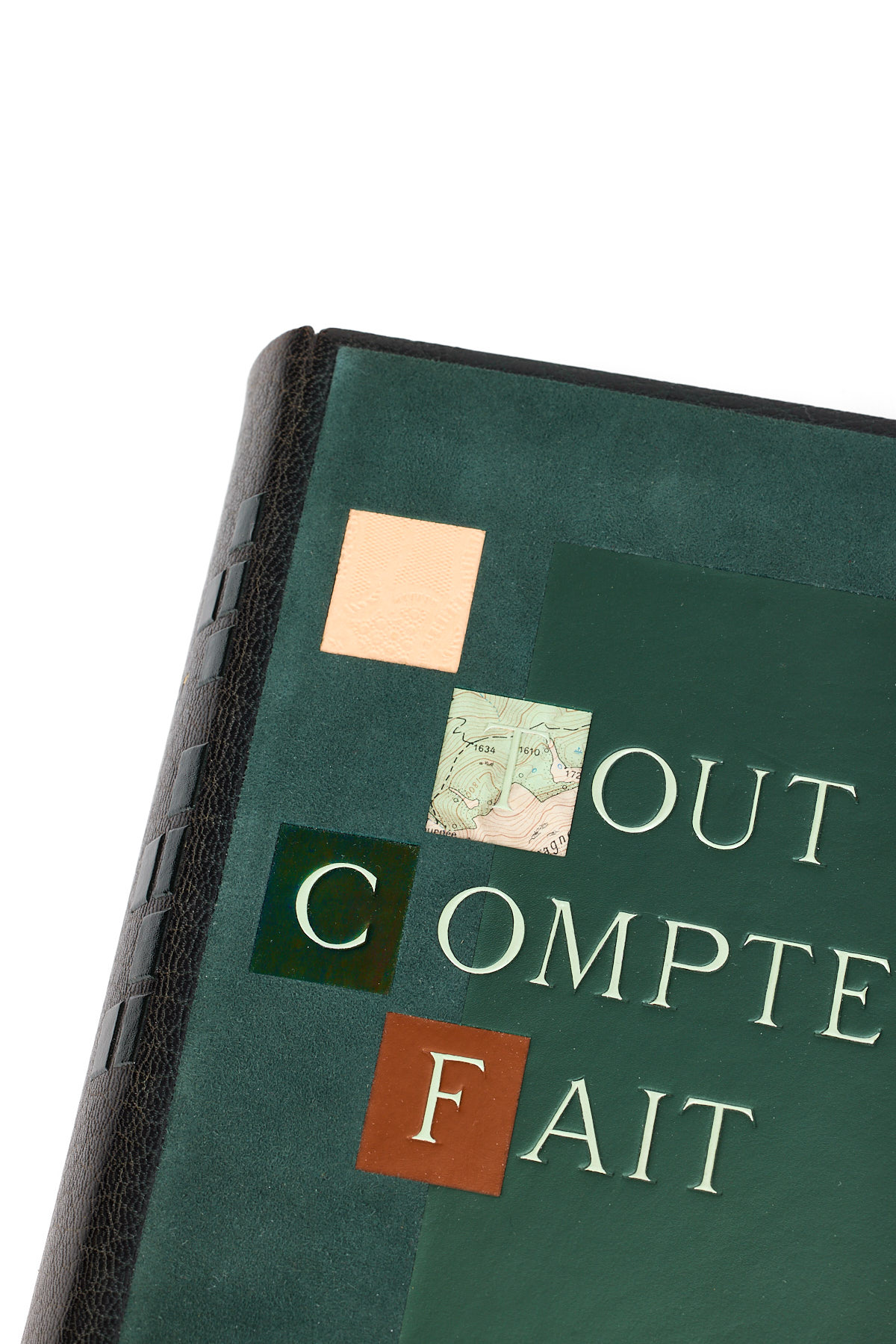
Mémoires d’une jeune fille rangée…
One of 25 copies on vélin de Hollande (no. 13).
One of 30 copies on vélin de Hollande (no. 25).
One of 35 copies on vélin de Hollande (no. 10).
One of 40 copies on white Holland Van Gelder laid paper (no. 21).
Simone de Beauvoir’s monumental autobiography: her major work, a landmark of twentieth-century feminist literature.
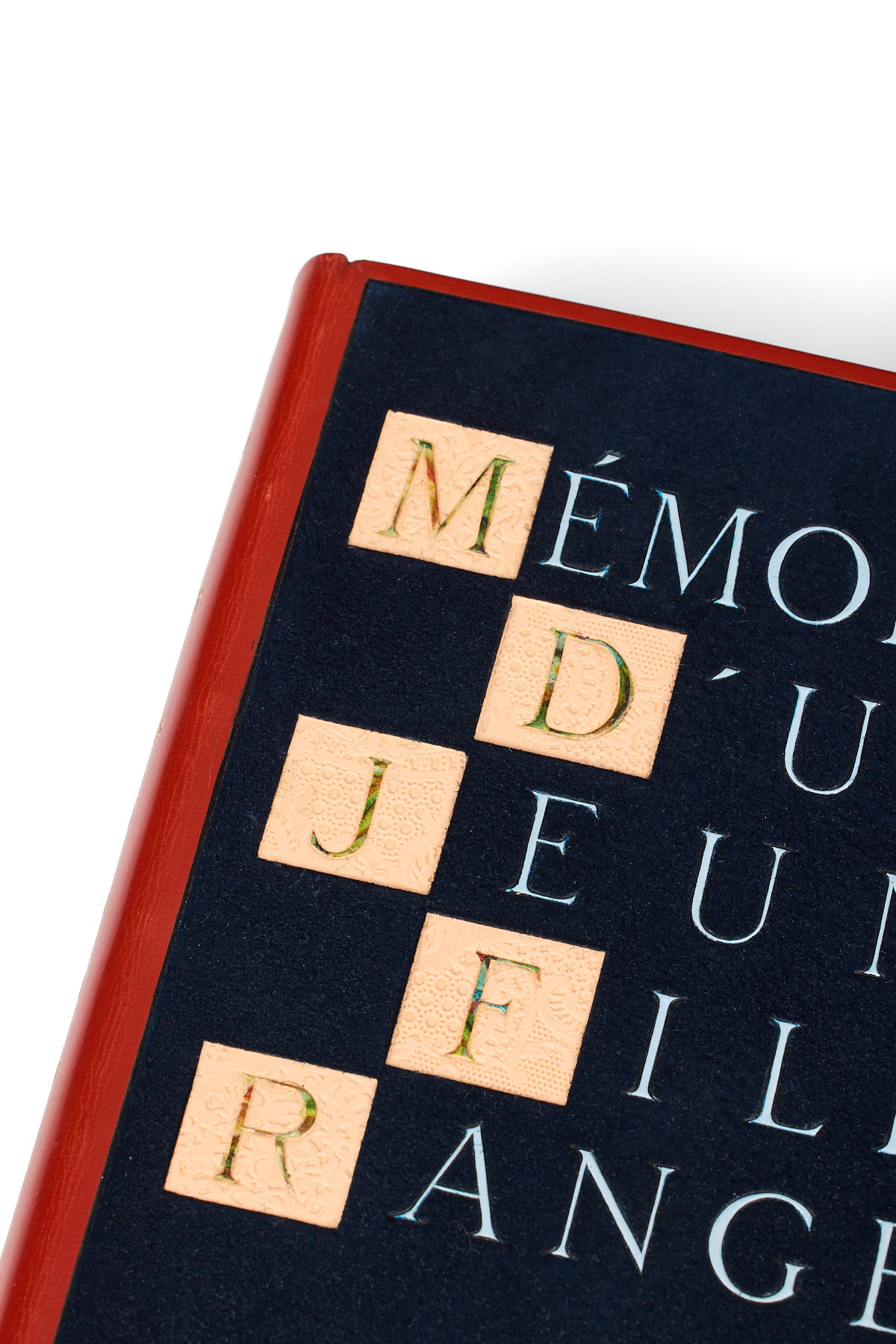
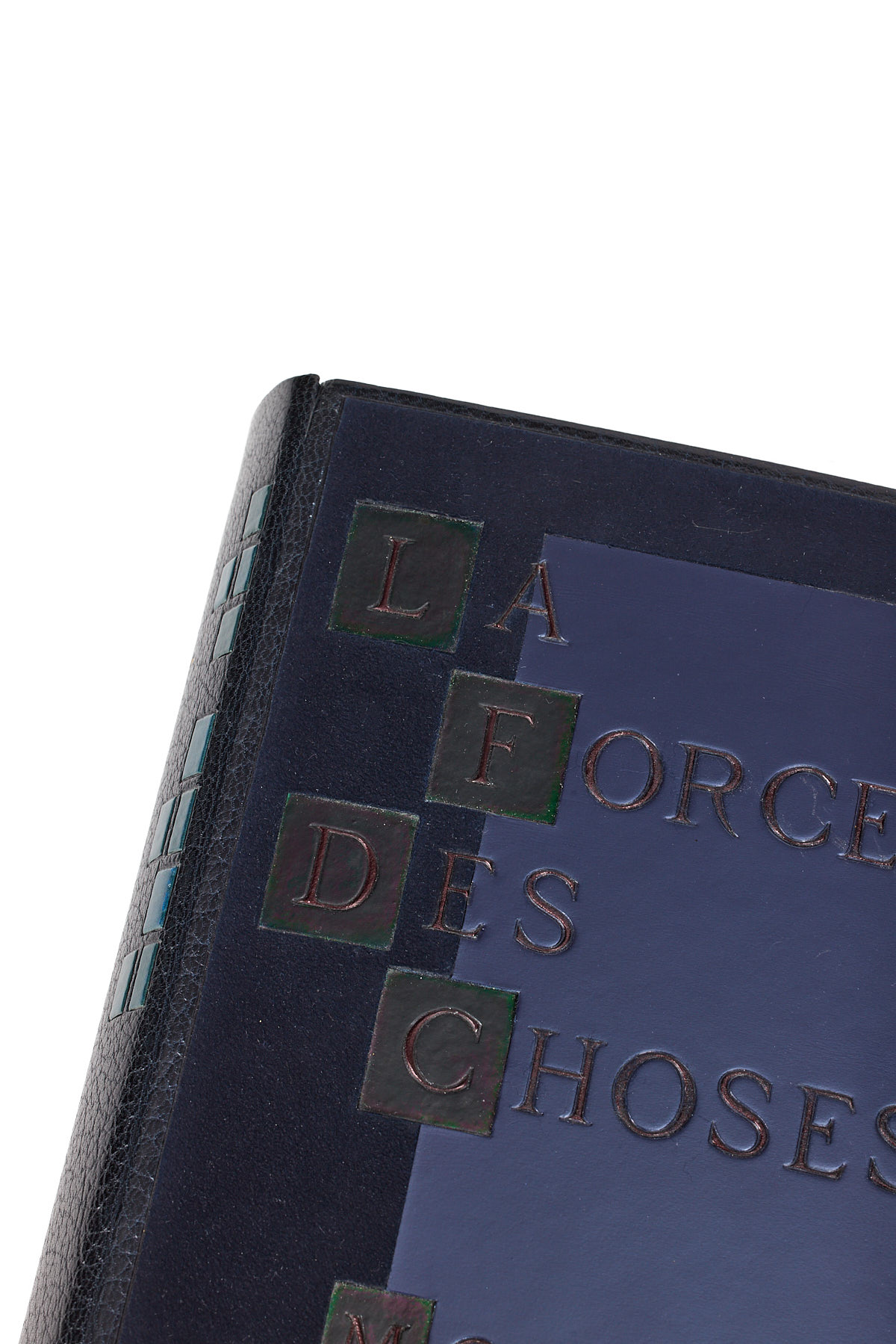
Magnificent bindings by Pierre-Lucien Martin: three of the four were executed for his own collection; only the first has no identified provenance, though it is an exact copy of a binding he had made for himself the previous year (Pierre-Lucien Martin sale, no. 36, copy D). Two other Martin bindings for Mémoires d’une jeune fille rangée are known — one from 1964, for Pierre Consten, and one from 1966, for Jean-Pierre Guillaume — bringing the total to four. This 1960 design was the earliest instance of a decorative scheme that Martin would return to many times afterward.
In all, Pierre-Lucien Martin produced four complete sets of these bindings, each with more or less significant variants: sixteen volumes in total. Several sets have since been dispersed, and the present set is the only complete one known today.
In this first volume of her autobiography, Simone de Beauvoir recounts the first twenty years of her life, from 1908 to 1928, up to her meeting with Jean-Paul Sartre.
“In 1929, Simone de Beauvoir was twenty. She had just placed a brilliant second, behind Sartre who was retaking the exam, in the agrégation in philosophy. Fiercely Cartesian, she made bold plans for herself: she intended to live in order to write and to go her own way unhindered. ‘Free as air,’ she entered into a sacred pact with Sartre: ‘We would never become strangers to one another, neither would ever appeal to the other in vain, and nothing would prevail against this pact.’ A pact accompanied by the vow: ‘We will tell each other everything.’ […] The life of Simone de Beauvoir, as we have discovered it in her four autobiographical books and two novels, provided a genuine education in feminine freedom for several generations of women. Even if no life can serve as a model, the fact remains that by turning her back on millennia of patriarchal norms, by refusing the imposed destiny of wife and mother, and by becoming one of the most famous philosophers of her time, she showed her readers that they too could try to open the cage of prejudice that confined them. Our children may no longer read La Nausée or Le Deuxième Sexe, or any work by either of them, but their names are now inscribed in the history of ideas and in the mythology of love. This may not have been Sartre’s original plan. But it is thanks to the Castor, who built this mythic couple with him against all odds, that Sartre will endure for posterity. Beauvoir’s sweet revenge: it is with her that he will win eternity.” (Élisabeth Badinter, Simone de Beauvoir ou les chemins de la liberté, BnF Conférences, 2002).
A wonderful and unique set.
Unidentified bookplate (red stamp) on the doublure of volume 1;
From the libraries of Pierre-Lucien Martin (bookplate and sale, May 20, 1987, no. 36), then François Ragazzoni (bookplate), for volume 2;
From the libraries of Pierre-Lucien Martin (sale, May 20, 1987, no. 37) and Jean-Pierre Guillaume (sale, May 17–18, 1995, no. 50), for volume 3;
From the libraries of Pierre-Lucien Martin (bookplate and sale, May 20, 1987, no. 38) and François Ragazzoni (bookplate), for the last volume.