

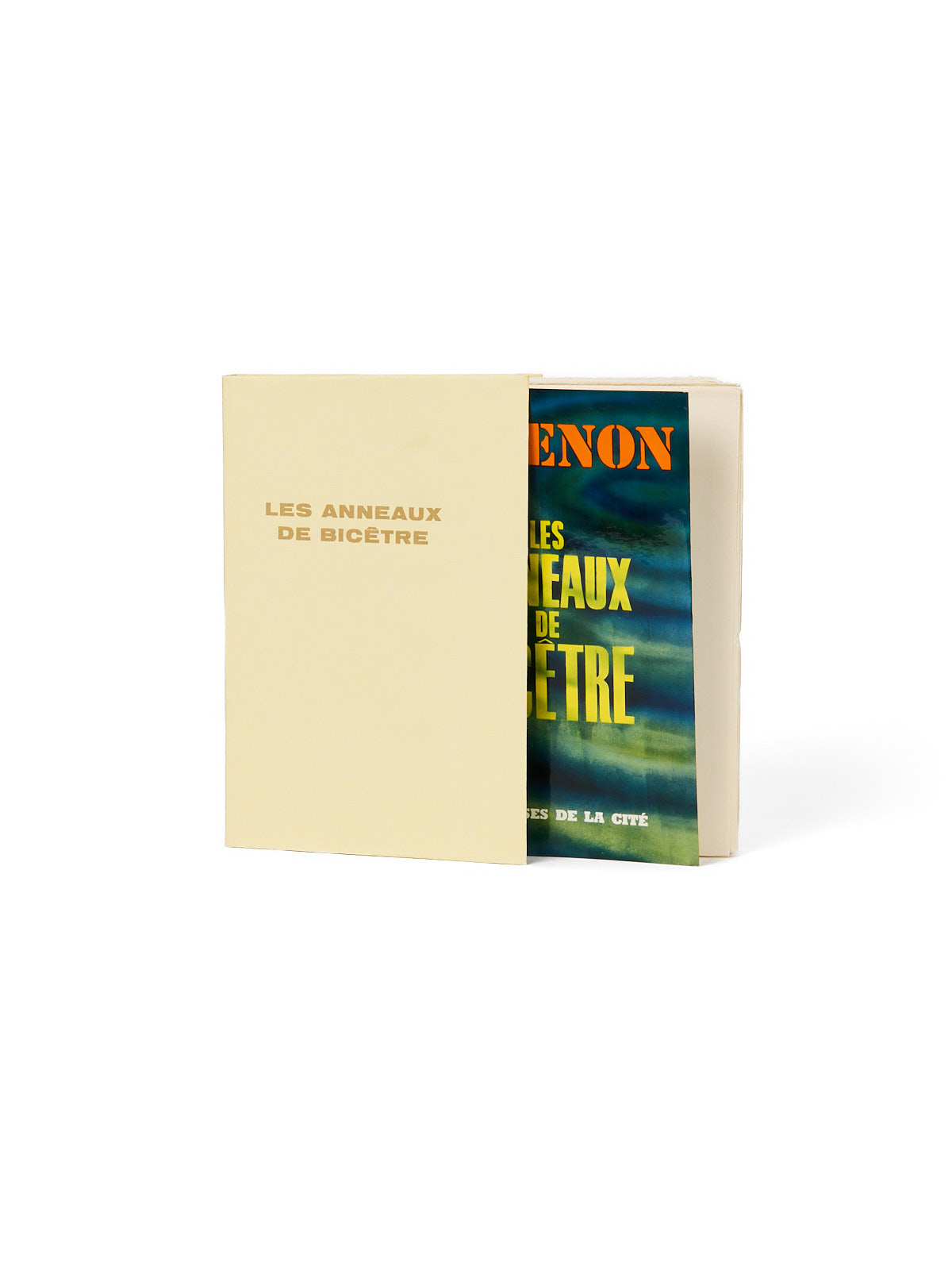
Les Anneaux de Bicêtre
In translations the novel is known as Les Cloches de Bicêtre, but in France the word cloche “has a double meaning, evoking tramps, fools and vagrants: in French editions the cloches are therefore replaced by anneaux, evoking the sound of those same bells spreading out in concentric circles” (Mémoires intimes, p. 472).
With Les Anneaux de Bicêtre, Simenon was determined to write a (his?) great novel. This narrative, quite distinct from his earlier work, tells the story of a man struck down by a stroke who is reborn to life after his stay at the Kremlin-Bicêtre hospital. He began writing it at the end of September 1962, after a brief trip to Paris to gather preliminary information. It took him twenty-three days to write (an exceptionally long time for Simenon, who admitted he had “exceeded a working period normally out of reach”), and the book met with public and critical success: “Simenon, an existentialist novelist! Who would have expected it? (…) I am far from having read them all, but I believe I can say that he has never written one more strikingly true, more bitter, more human than this one” (André Billy, Le Figaro, 8 May 1963).
The novel is among the sixteen “romans durs” of “undisputed renown” selected for Simenon’s entry into the Bibliothèque de la Pléiade in 2003.