

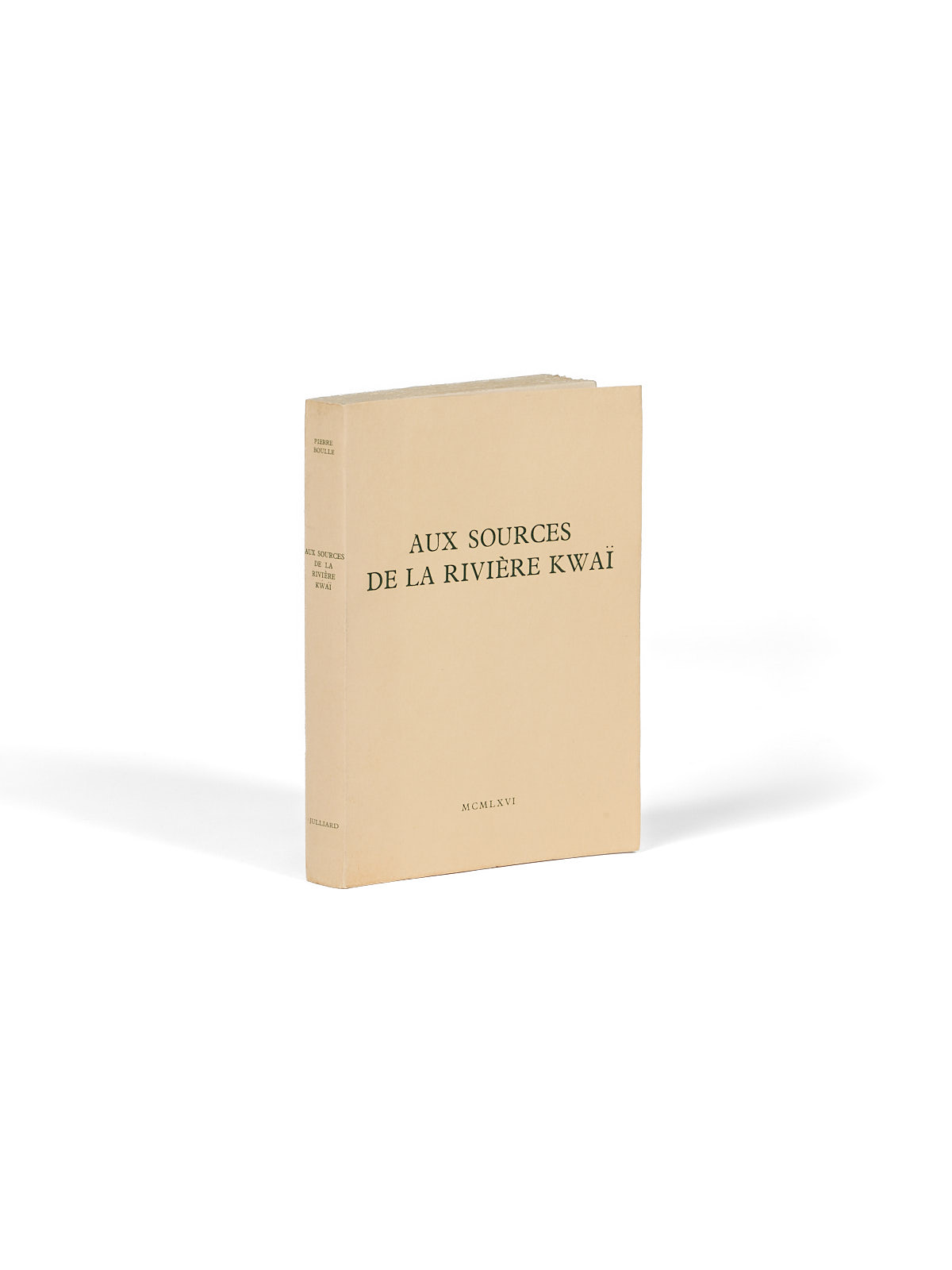
Aux sources de la rivière Kwaï
One of 20 copies on alfa paper, from the deluxe issue, this copy no. 3.
When Le Pont de la rivière Kwaï appeared in 1952, Pierre Boulle was still unknown. A former French planter in Malaya, where he resumed work after the Second World War, he decided in 1947 to abandon “that reasonable path” and settle in Paris to attempt a literary career: his debut, William Conrad, a novel published two years later in a printing of 3,000 copies, followed by Le Sacrilège malais, met with modest success. It was the publication of the Mémoires of Admiral Jean Decoux, Governor-General of Indochina from 1940 until the Japanese coup of 9 March 1945, that gave Boulle the idea and the inspiration for his eventual triumph. He recalled his own experience twenty years earlier: mobilized in Saigon in September 1939, he returned to Malaya upon his demobilization in April 1941 and joined the Free French forces stationed there. Boulle was taken prisoner after fighting the Japanese in Burma, China and Indochina.
His novel, published in 1952, was a success further amplified by David Lean’s remarkable film. But Boulle wished to reclaim the story’s origins, and in response to the “conscientious inquisitors” who had “often asked” him for the key to the tale, he invites the reader to trace with him the sources of the river Kwai, where he “attempted to recount as faithfully as possible a few personal adventures experienced in the Far East during the last war […] I am simply giving here the account after the novel, affirming that the former already contains, in diffuse form, all the material and spiritual substance of the latter.” To support this claim — which he calls “tedious” — he invites a kind of “transposition”: the parallels in situations, attitudes and even phrasing merely confirm his original source of inspiration.
An essential complement to Pierre Boulle’s great novel.