

Maigret et le corps sans tête
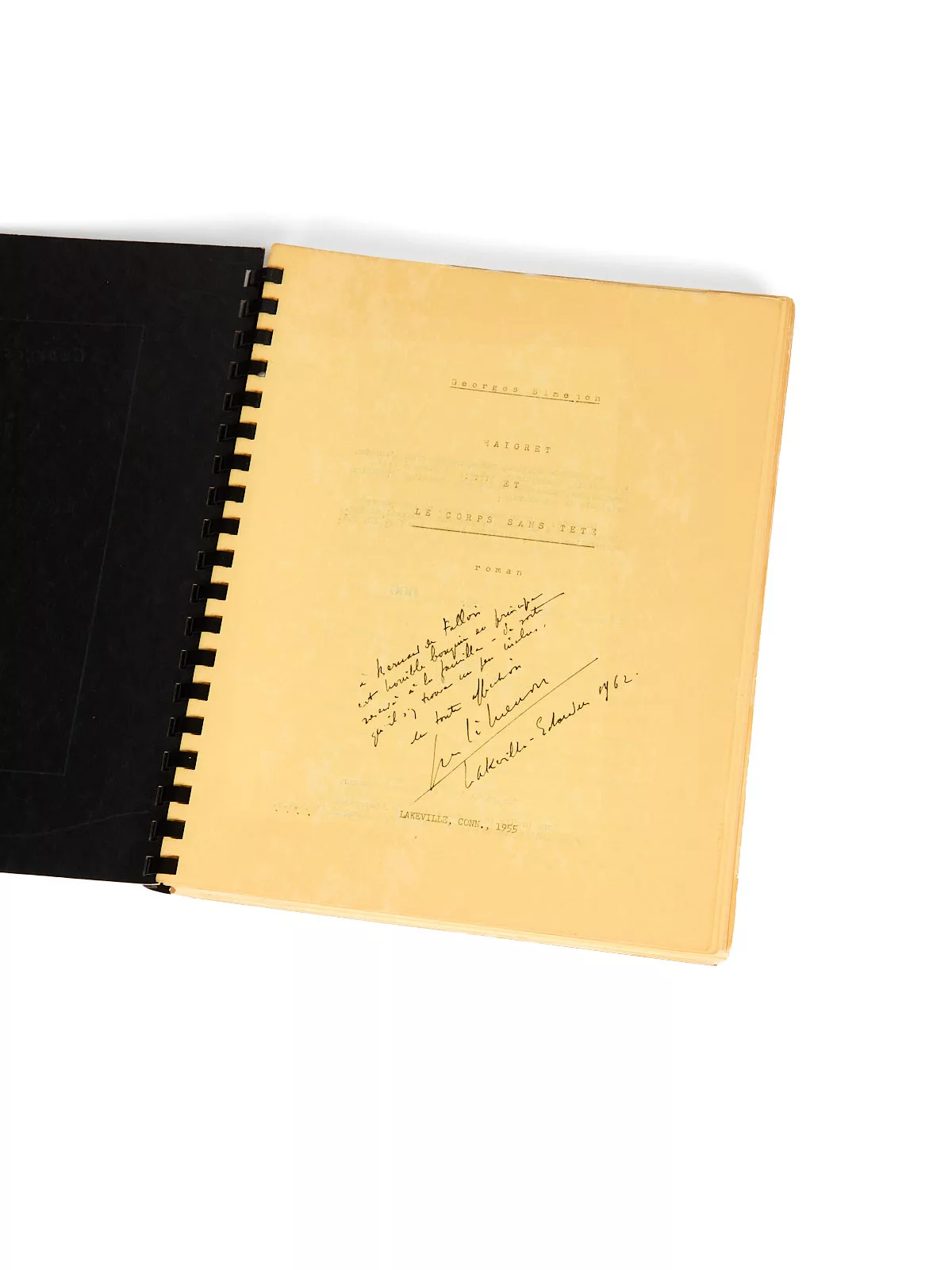
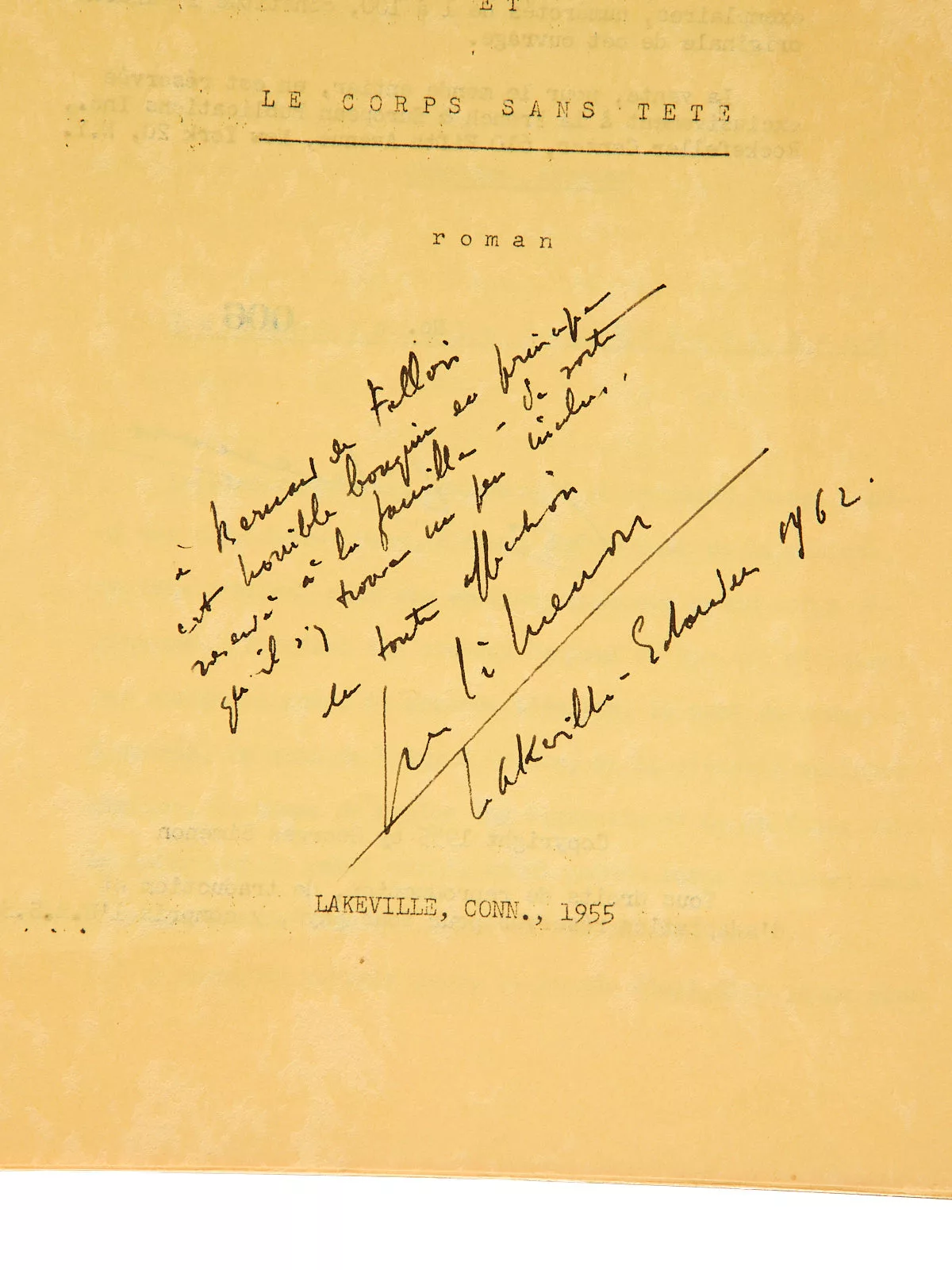
Bernard de Fallois's copy, with this fine inscription: “à Bernard de Fallois, cet horrible bouquin en principe réservé à la famille - de sorte qu'il s'y trouve un peu inclus. En toute affection, Georges Simenon, Lakeville-Echandens, 1962.”
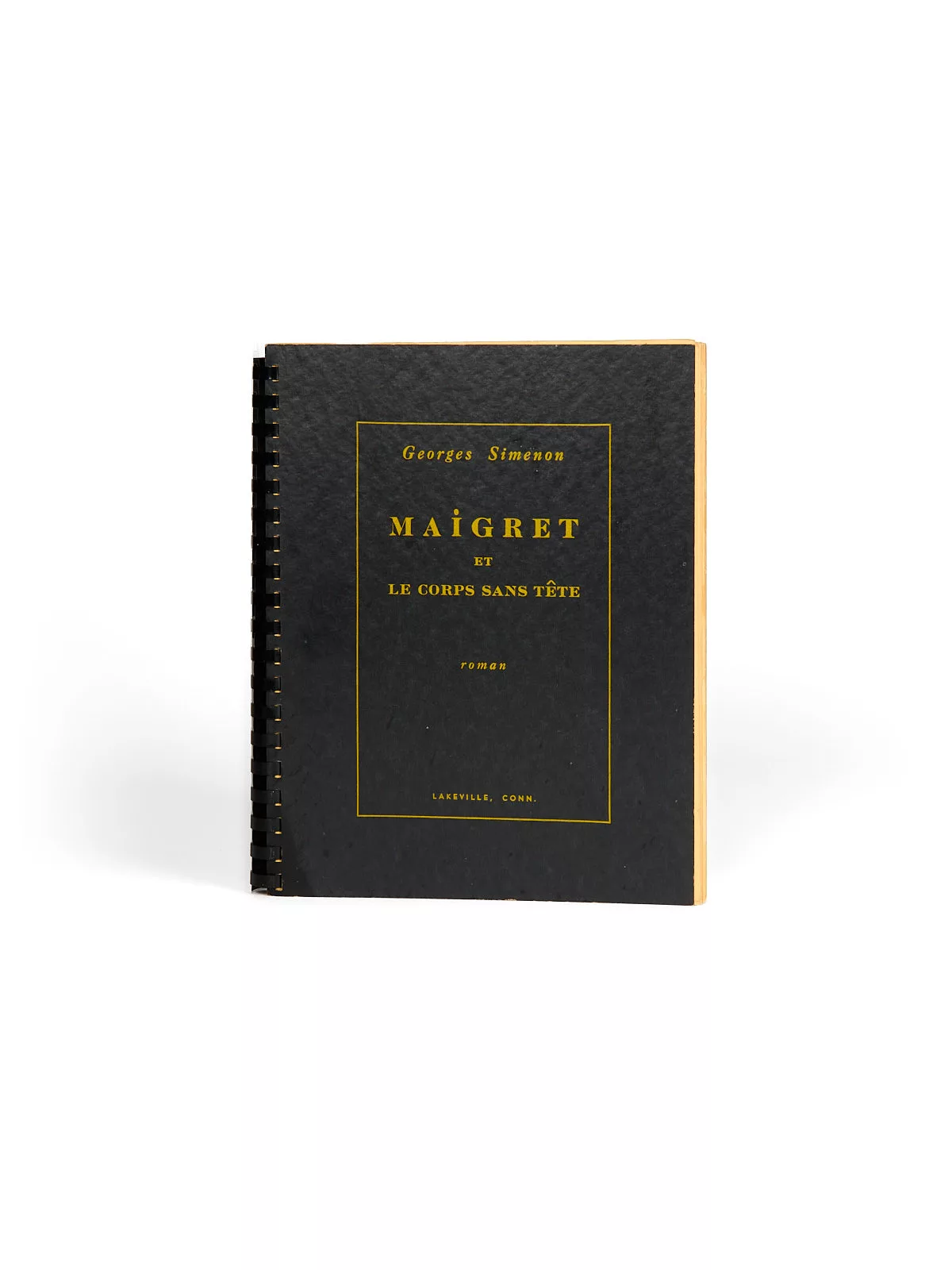
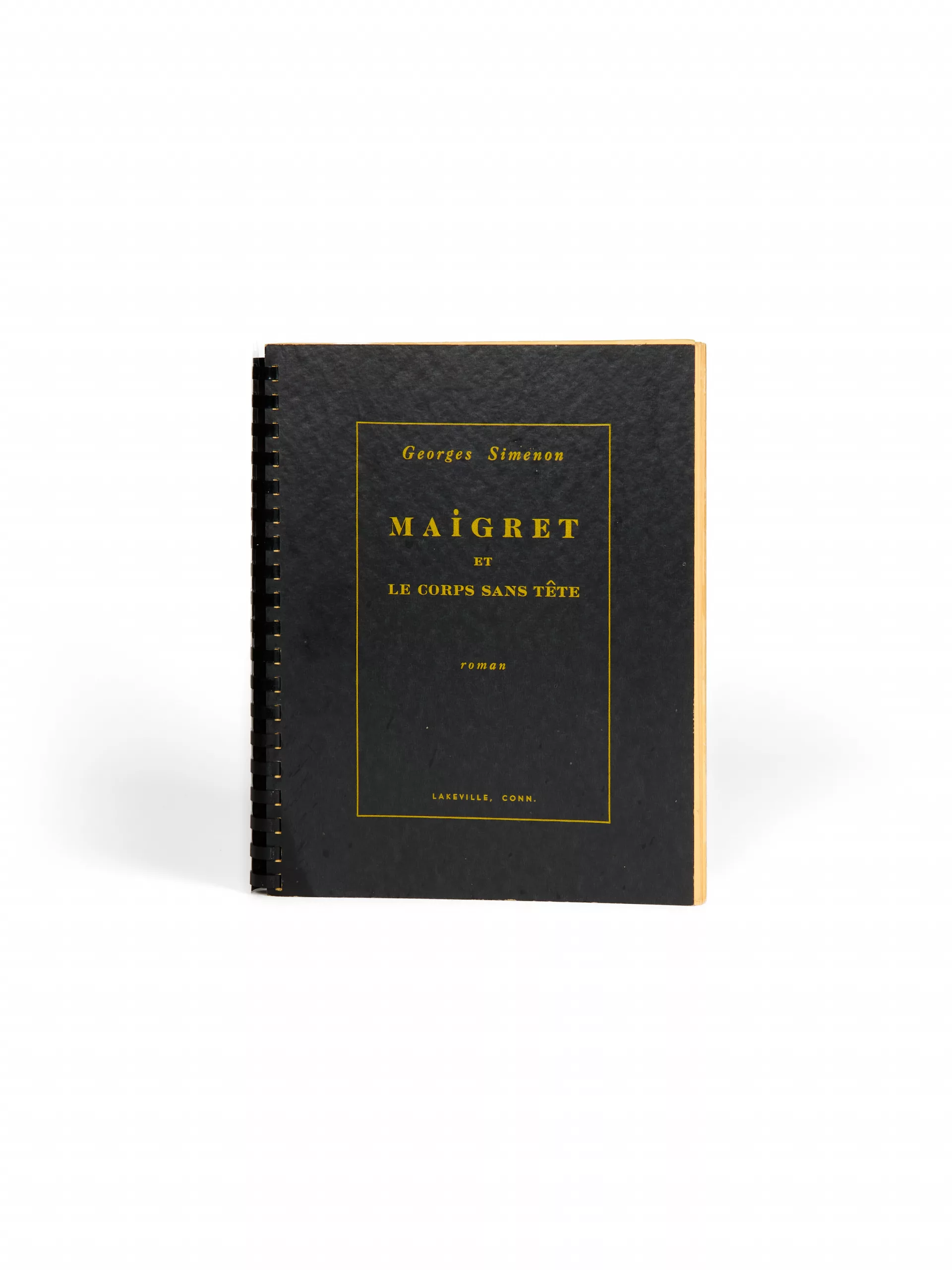
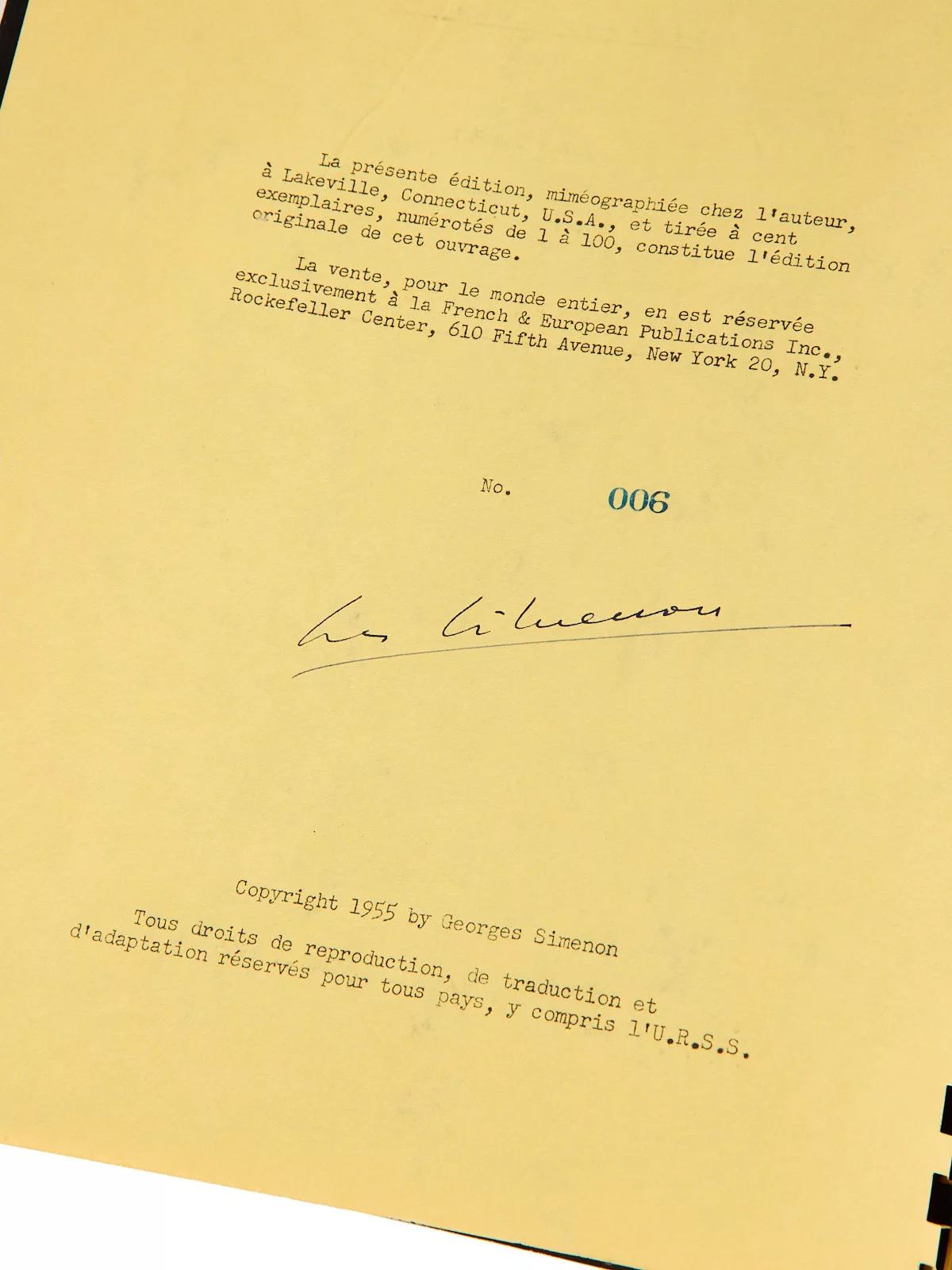
Living at ‘Shadow Rock Farm’ in Lakeville, Simenon wrote his novels for Presses de la Cité at an impressive pace. Three titles were given a local, limited first edition, mimeographed and distributed exclusively through French & European Publications at Rockefeller Center in New York: Maigret chez le ministre, Les Témoins and Maigret et le corps sans tête.
Jean-Baptiste Baronian asks whether, during this voluntary exile, Simenon might have felt nostalgic for his youth, when he used to unearth rare finds and first editions among the secondhand booksellers of Liège — and whether that nostalgia was one of the reasons he decided one day to produce, himself, a small special printing of some of his novels. The question is hard to answer. Legal motives have been suggested, but they cannot be verified. Simenon apparently kept only part of the print run, just enough to distribute a few copies among friends and visitors, which explains why these originals rarely circulate and are extremely rare on the market. Some have even wondered whether the stated print run [100 copies] was fictitious, the real number being closer to twenty, or whether Simenon destroyed a good part of it.
The fragility of the medium itself must also be considered: the stencils used for such mimeographed editions, on very fine paper, allowed only a small number of impressions before wearing out. The variations in inking between copies bear this out, and it seems likely that if the run never exceeded some fifty copies at most, it was for purely technical reasons.
For the three editions produced, the only copies known to date are numbered no higher than 44: nos. 2, 4–7, 9–11, 14–17, 21–22, 24–25, 27, 29, 31, 34–36, 42 and 44. Collectors who own further copies are invited to come forward, as a full census would be of great interest. In this same survey, only five other copies are known to be inscribed: one for Maigret chez le ministre, two for Maigret et le corps sans tête, and two for Les Témoins. This volume confirms that Simenon did indeed bring copies of these mimeographed editions back from the United States, otherwise unobtainable in France, in order to give them away.
Maigret et le corps sans tête is the last of the fifty “American” novels before Simenon’s definitive return to Europe in March 1955. After renting several properties in the south of France, he settled in July 1957 in his first Swiss residence, the Château d’Échandens in the canton of Vaud, 17 km from Lausanne. Twenty-seven novels were written there, until the move to Épalinges in December 1963.
Bernard de Fallois needs little introduction: a close friend of Georges Simenon and a discerning connoisseur of his work, he became passionate about it from the 1950s onward, publishing in 1961 an essay on Simenon with Gallimard, in the “Bibliothèque idéale” series edited by Robert Mallet. He was the first to state plainly what many refused to see: that the Maigret novels should be regarded as novels in their own right, despite French taste’s reluctance to admit a body of fiction belonging neither to a stylist nor to a writer of ideas. Alexandre Vialatte once remarked, somewhat grumpily, “He writes like the man in the street,” to which another critic replied, not without humor, “What is curious, though, is that apart from Simenon, no one knows how to write like the man in the street.”
It was Gaston Gallimard who asked Bernard de Fallois to write the volume for La Bibliothèque idéale: “A few years earlier I had published Jean Santeuil and Contre Sainte-Beuve, and tried to explain the genesis of the Recherche. But by then everyone understood that Proust was the greatest writer of the century. Simenon, on the other hand, was not regarded as a great writer, the equal of Balzac or Dostoevsky. I wanted to write about him plainly, without the usual reservations. I asked to meet him, to find out everything he had written before he first signed his own name. From then on we became close friends, and for more than twenty years I spent a week at his house every year.” As proof of their budding friendship, it was only a few months after the publication of the Bibliothèque idéale volume that Simenon gave him this copy, “reserved for the family — so that he found himself, in a way, included in it.”
A fine copy, complete with spiral binding and covers in immaculate condition.
Jean-Baptiste Baronian, La Bibliophilie, une sanction, Lausanne, L’Âge d’Homme, 2006, p. 23, and Bulletin de l’Académie Royale de Langue et de Littérature Française, vol. LXXXIII, 2010; Menguy, 183, p. 103.