

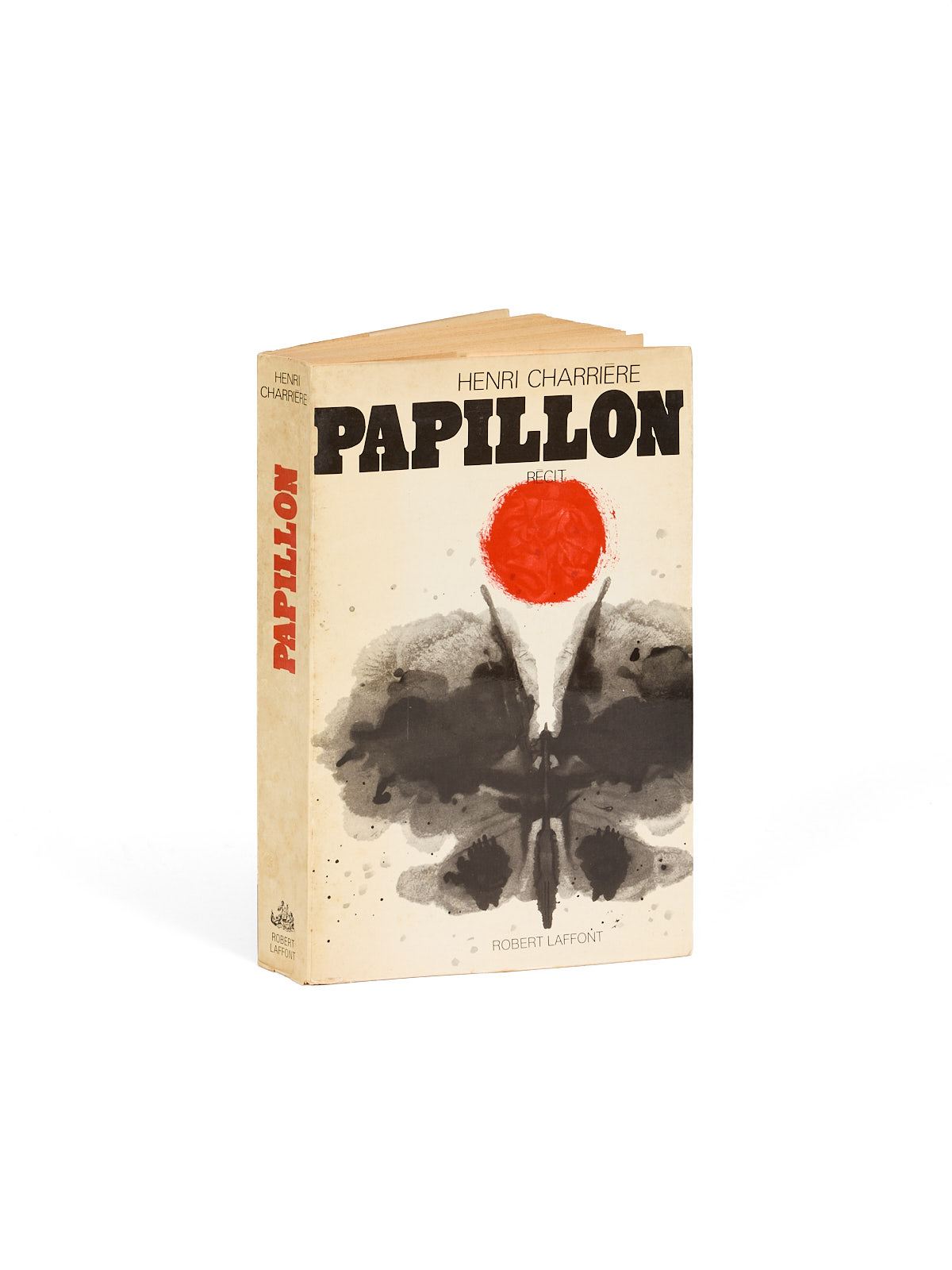
Papillon
Preface by Jean-Pierre Castelnau. Followed by “Papillon ou la littérature orale” by Jean-François Revel.
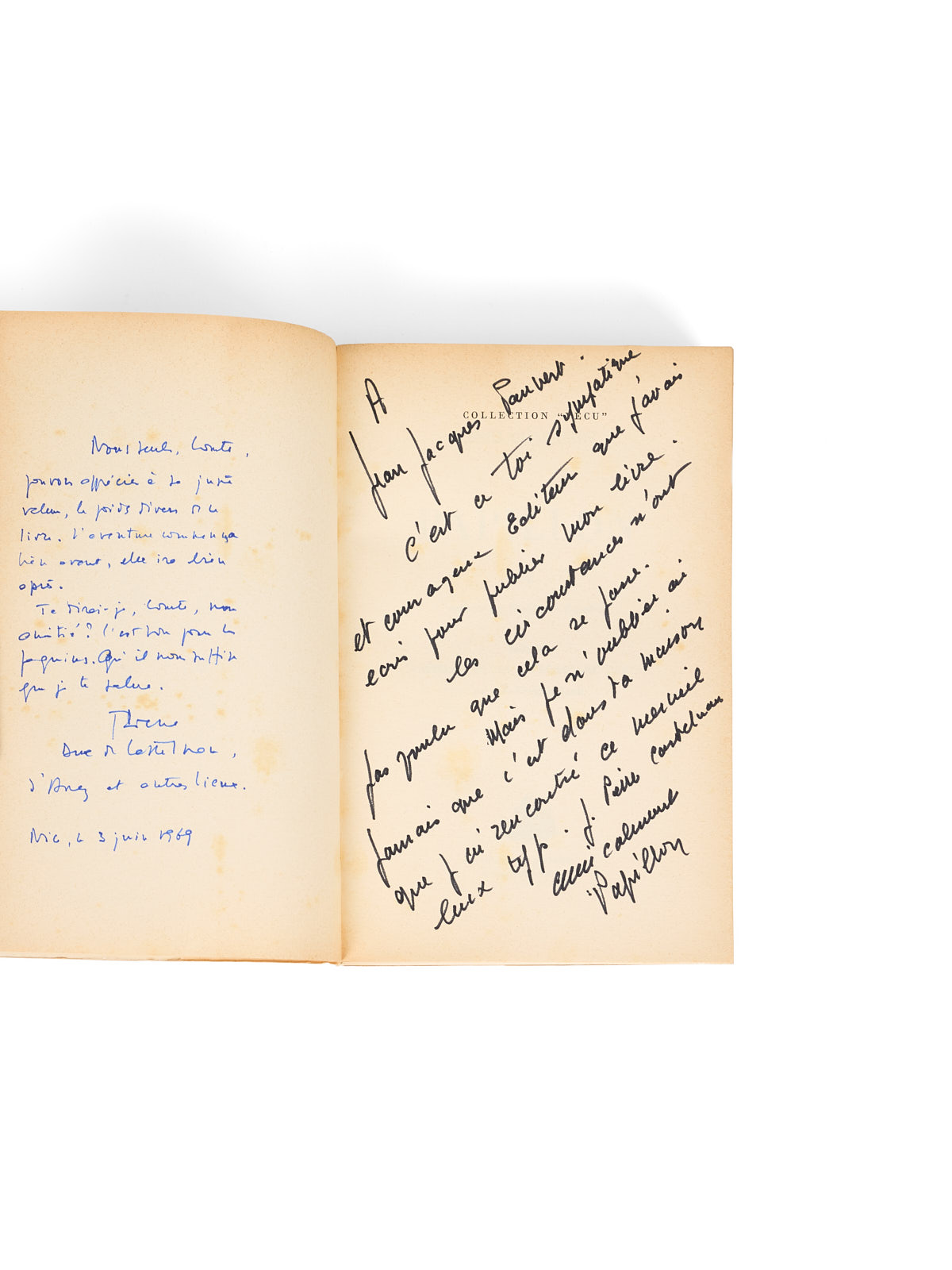
Presentation copy inscribed: “À Jean-Jacques Pauvert, c'est à toi sympathique et courageux éditeur que j'avais écrit pour publier mon livre. Les circonstances n'ont pas voulu que cela se fasse. Mais je n'oublierai jamais que j'ai rencontré ce merveilleux type, J.-Pierre Castelnau. Amicalement, Papillon.”
With a second inscription (from Jean-Pierre Castelnau to Jean-Jacques Pauvert) on the verso of the flyleaf.
To appreciate the significance of the two autograph presentation inscriptions in this copy — which make it an ideal example — one must turn to the memoirs of Jean-François Revel (Le Voleur dans la maison vide, Plon, 1997), who was at Robert Laffont responsible for the publication of Papillon: “In November 1968, Jean-Jacques Pauvert, having been placed under judicial receivership and forced to part with his most talented literary collaborator, Jean-Pierre Castelnau, gave him — unable to pay him severance — a manuscript that had just arrived by post and which the house could no longer afford to publish, along with license to place and negotiate it as best served his interests. This turned Castelnau into a freelance agent. Wanting my opinion, he asked to meet me, which took place on a bleak, freezing December late afternoon at the dismal Café de la Mairie, place Saint-Sulpice, next to Éditions Laffont. ‘I no longer have a salary, not even social security,’ he told me; ‘all I have left is a family to feed and this manuscript by an unknown writer,’ he added, hauling from under the table a box containing two or three terrifying kilos of typewritten pages. ‘I’d like you to do me the favor of telling me what you think of it, whether you believe something can be made of it, how, and whether I have any reason to hope it will restore my finances.’ Already overwhelmed by manuscripts, most of them shapeless and inept, and by the desolation of that winter night, I set the monster aside somewhere in my home and cowardly left it untouched for several days, while notes piled up on my desk repeating like a litany: ‘Monsieur Castelnau called, Monsieur Castelnau called.’ Finally, one Sunday morning, I plunged into the thick bundle; and I felt myself immediately swept away, tamed as I had been at age ten reading my first Jules Verne or my first Jack London. It was Papillon, the fictionalized autobiography of Henri Charrière, the escaped convict who had settled in Caracas since the war, from where he had sent his manuscript to Jean-Jacques Pauvert. In Charrière’s somewhat unsophisticated mind, Jean-Jacques Pauvert was the publisher who specialized in escaped convicts’ confessions, having successfully published Albertine Sarrazin’s L’Astragale. […] If Albertine had sold a hundred thousand copies telling of a shabby escape from the Compiègne or Arras prison, Charrière reasoned in his mind, at once crude and cunning, how much more will I sell with the far more extraordinary adventures of my escape from Cayenne! Indeed, he sold more than a million copies in France and nearly twenty million in various translations around the world, making, in passing, the fortune of Castelnau, who was associated with the venture…” (pp. 331–332).