

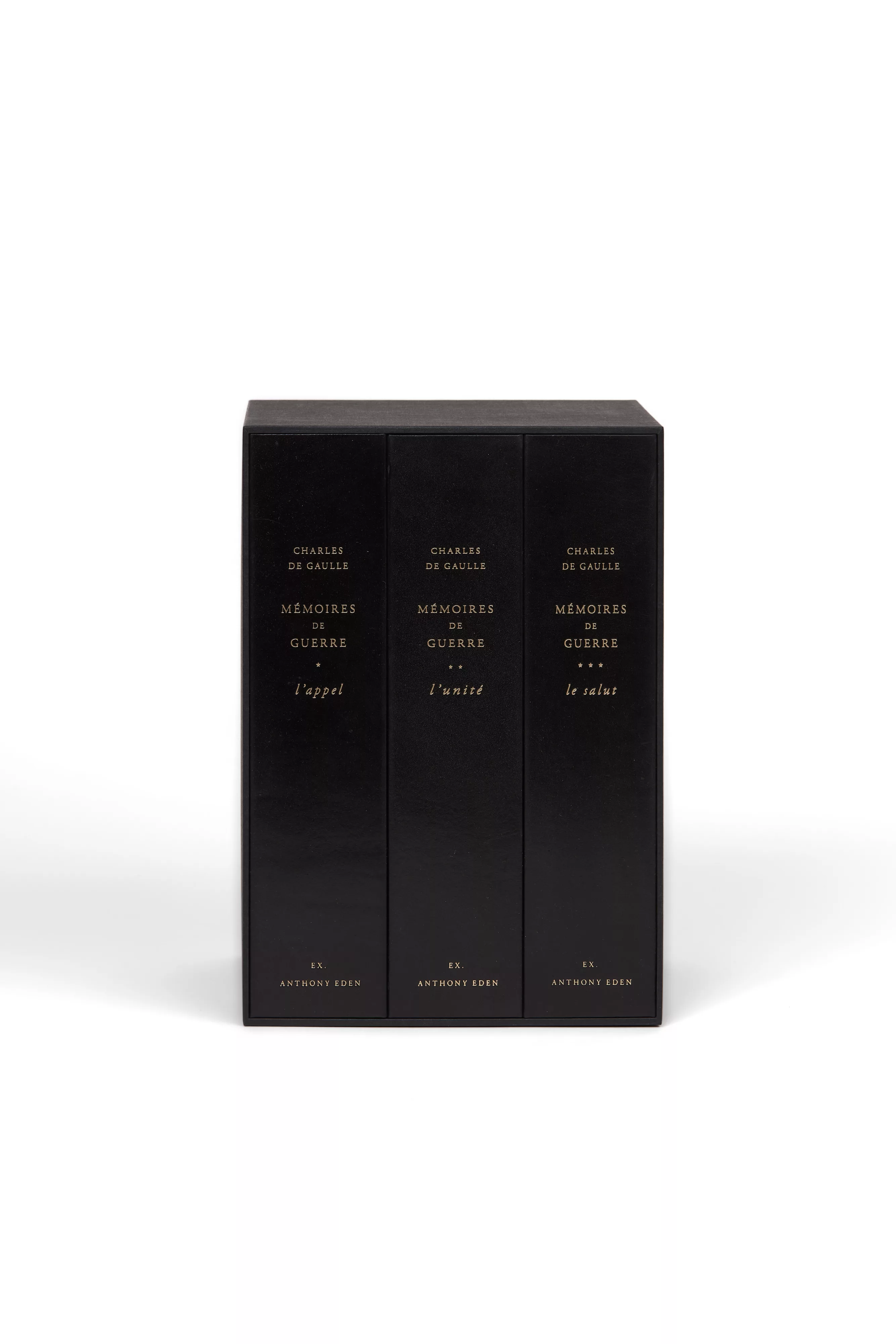
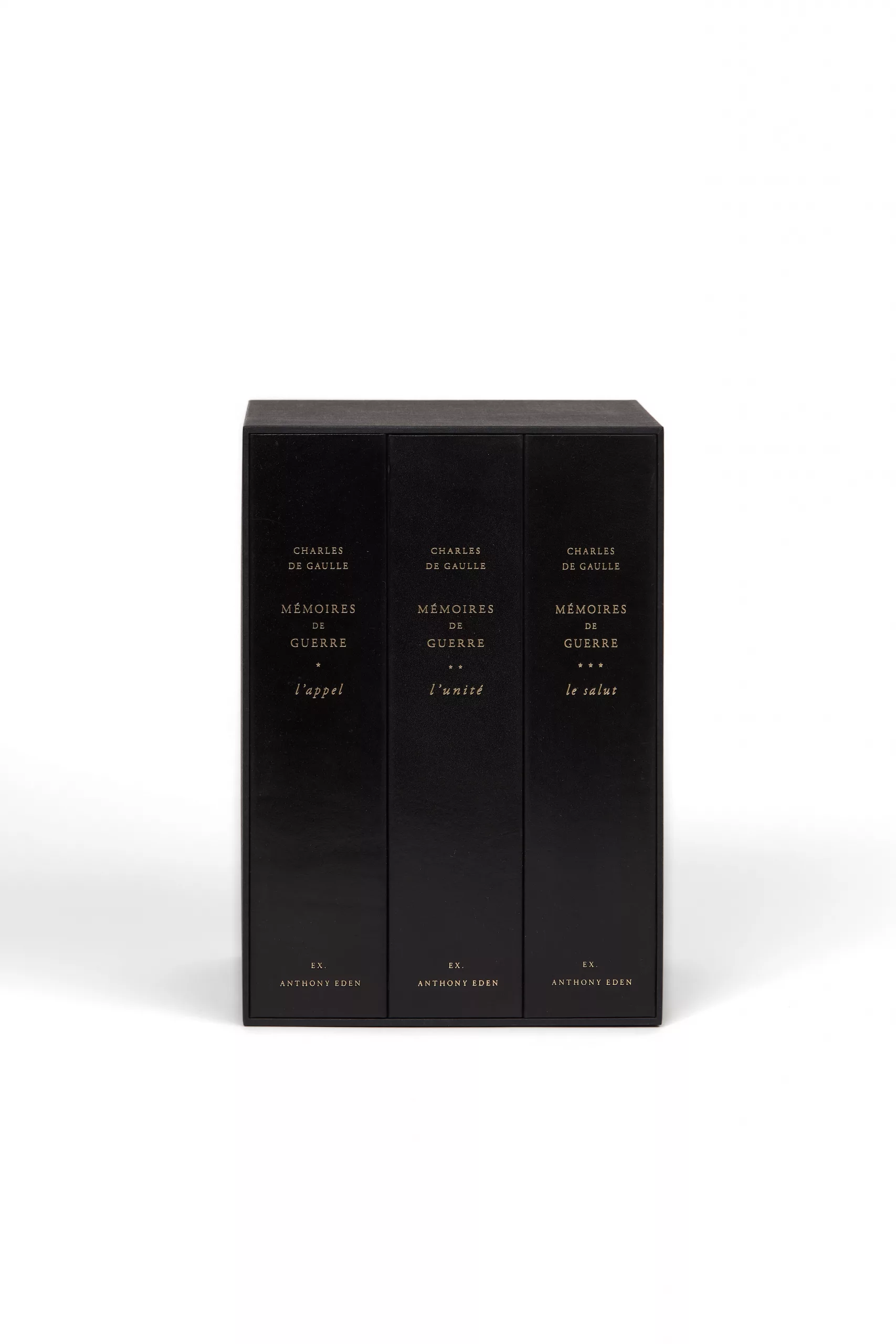
Mémoires de guerre : L’Appel. L’Unité. Le Salut
One of the numbered copies on Alfa Cellunaf paper, reserved “aux anciens de la France Libre et aux membres des associations combattantes et résistantes de la guerre 1939–1945.”
An exceptional copy, presented by Charles de Gaulle to Anthony Eden, inscribed as each volume appeared:
Volume 1: “À M. Anthony Eden, en souvenir de notre combat. Amicalement, son compagnon de guerre, C. de Gaulle, 19 octobre 1954.”
Volume 2: “Pour Sir Anthony Eden, bien amicalement C. de Gaulle, 18.6.56.”
Volume 3: “Pour Sir Anthony Eden, en témoignage de ma très haute et amicale considération. C. de Gaulle, 7.11.59.”
The date of the second inscription — 18 June — can hardly be a coincidence.
A remarkable association between two men who each led their respective countries and played essential roles during the Second World War.
As Churchill’s Secretary of State for War, and later Foreign Secretary, Eden did much to bolster de Gaulle’s position as head of the French government in exile, and was consistently regarded with favor by the General, unlike Roosevelt.
Eden played a central role in wartime diplomacy between the great powers and the governments in exile, and did much to preserve the often difficult relationship between Churchill, de Gaulle and the Free French Forces.
This approach repeatedly put Eden at odds with Churchill and Roosevelt: further disagreements with Churchill concerned Anglo-French relations, particularly the question of de Gaulle’s National Committee of Free France, which Eden had recognized as early as September 1941, at a time when Churchill and Roosevelt still distrusted de Gaulle, who was not officially recognized by London until June 1943, when the newly formed French Committee of National Liberation was recognized as a provisional government.
Eden’s support for France — he was a francophile and fluent French speaker — was not forgotten by de Gaulle after the war; Eden was regarded as “the only British statesman for whom France ever felt affection” (Merry Bromberger and Serge Bromberger, Secrets de Suez, p. 160).
An attentive reader and privileged witness, Eden annotated all three volumes of the war memoirs, drawing attention to his own role in the narrative and offering valuable insights into his experience of the war, with references to Pétain, Roosevelt and others. His annotations often challenge the text, with remarks such as “is this true?” or “this is absurd.” He also annotated and underlined various passages, and filled the final leaves of the second and third volumes with references and page cross-references.