

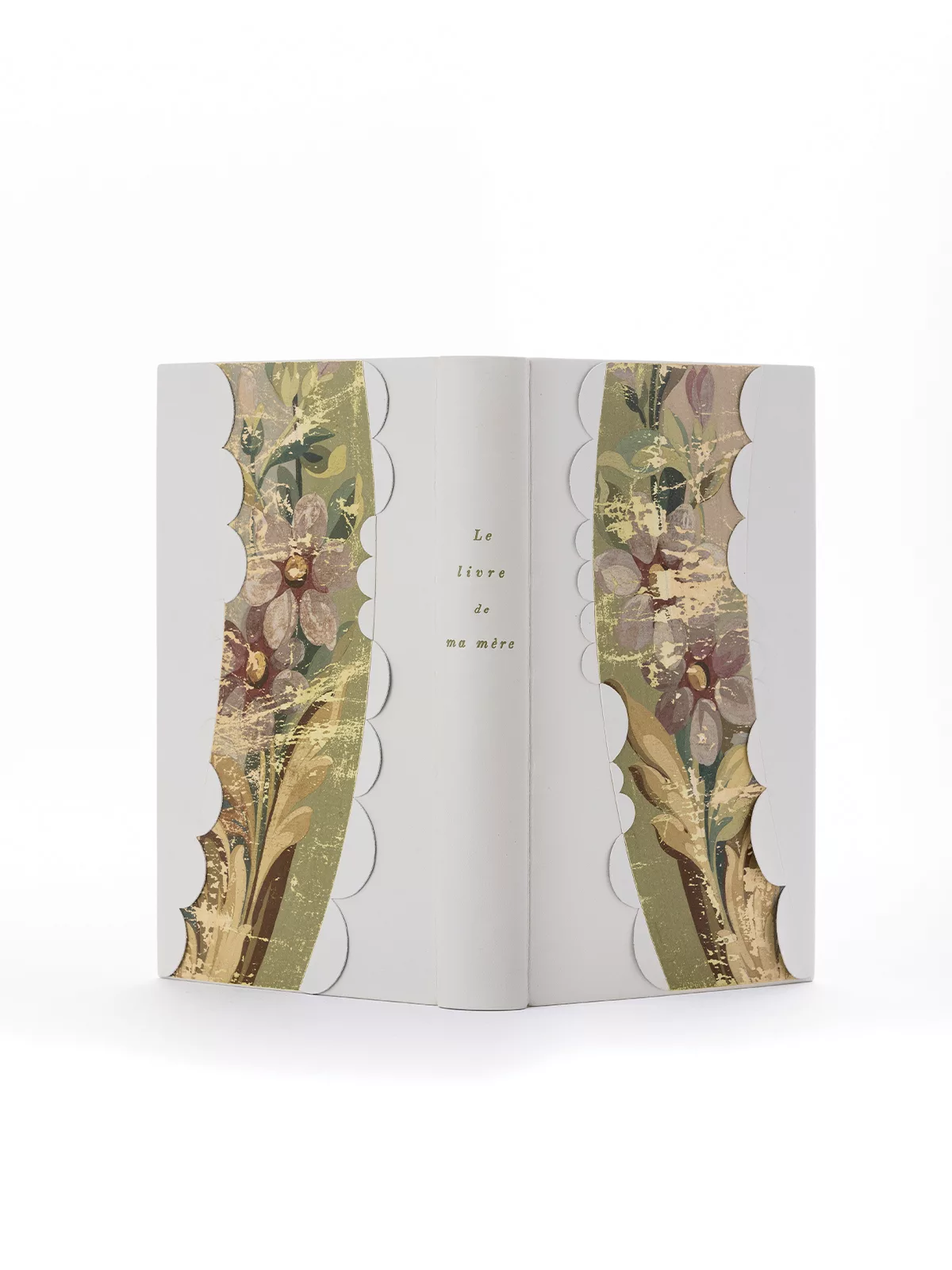
Le Livre de ma mère
One of the first 40 copies on vélin pur fil (no. 12).
“Death knell of the bereaved, song of the dead we have loved”: with a slight variation on these words, Albert Cohen titled the first version of the text, called “Chant de mort.” It was published in four installments, from June 1943 to May 1944, in the review La France libre, while Cohen was in London, where he had taken refuge in June 1940 with his wife and daughter to escape the Nazi advance. He undertook the writing so that his new companion, Bella Berkowich, whom he had met in 1943, could feel as though she had known Louise Judith Cohen, née Ferro, who had been unable to join them in exile. Left behind in Marseille, she died there on 10 January 1943 without seeing her son again. The guilt never left Albert Cohen, and this feeling gave his work the lyrical dimension of a “song of death.”
The final text was published in 1954, barely altered from the original version. Literary criticism hailed a powerful and sincere work, already called a masterpiece twelve years before Belle du Seigneur. Marcel Pagnol, Cohen’s childhood friend, was among the first to point out the universality of its message: “this tribute to a particular mother continually attains the general” (Combat, 27 May 1954).
“To weep for one’s mother is to weep for one’s childhood. Man wants his childhood, wants to have it back, and if he loves his mother more as he grows older, it is because his mother is his childhood. I was a child, I am no longer one, and I cannot get over it.” With sometimes Proustian overtones, he would later evoke, in his Carnets, the “angelic remedies” of his childhood: “never again, the soothing balm whose name I loved, dear green oil that with a cotton ball she spread on my back… Never again, camphorated alcohol, tolu syrup, eau des Carmes, elixir of Garus, vulnerary alcoholate, polygala syrup, charming healers of my childhood” (Gallimard, 1979, p. 43).
A delicate binding by Nobuko Kiyomiya, perfectly attuned to the text.