

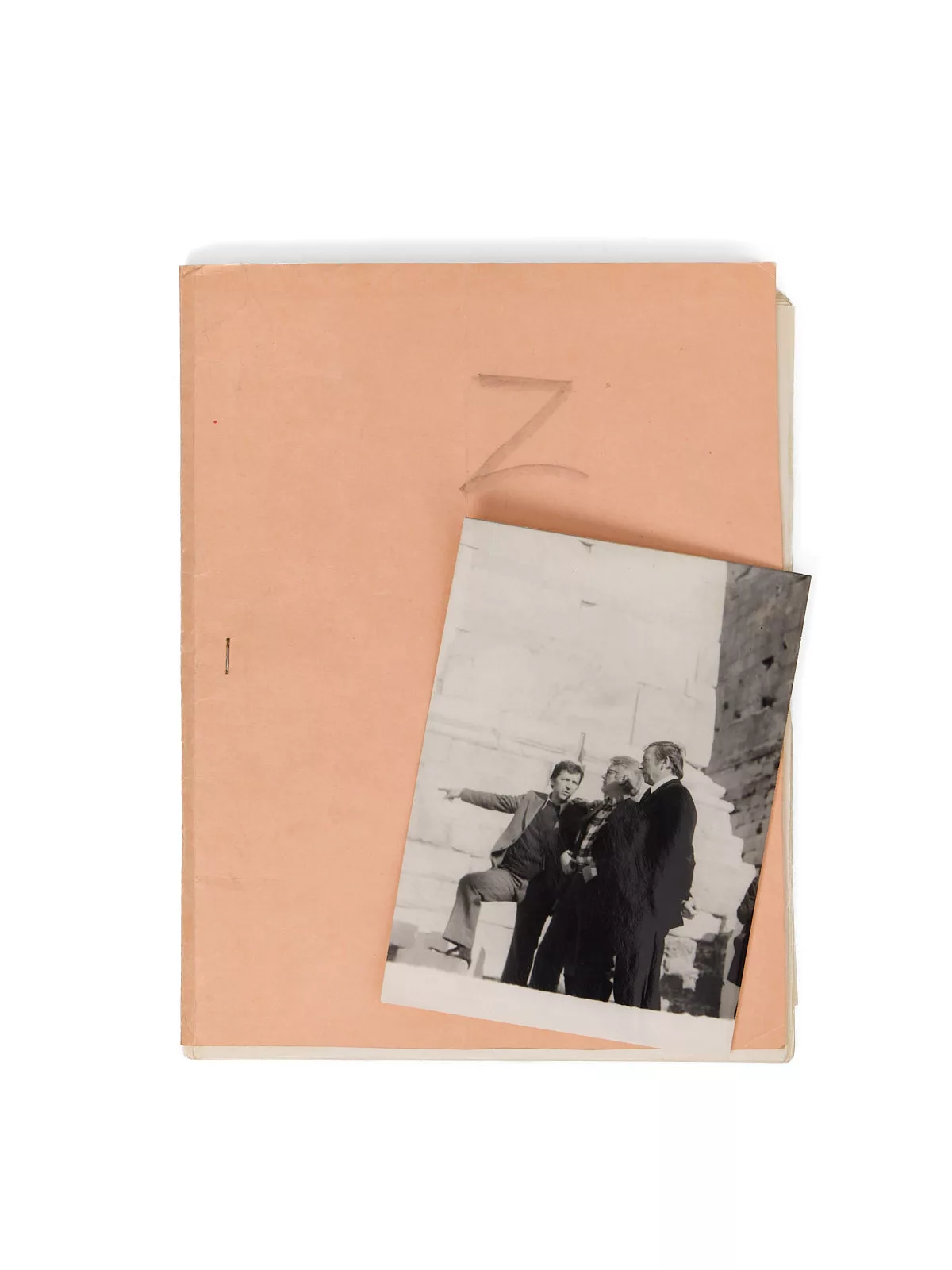
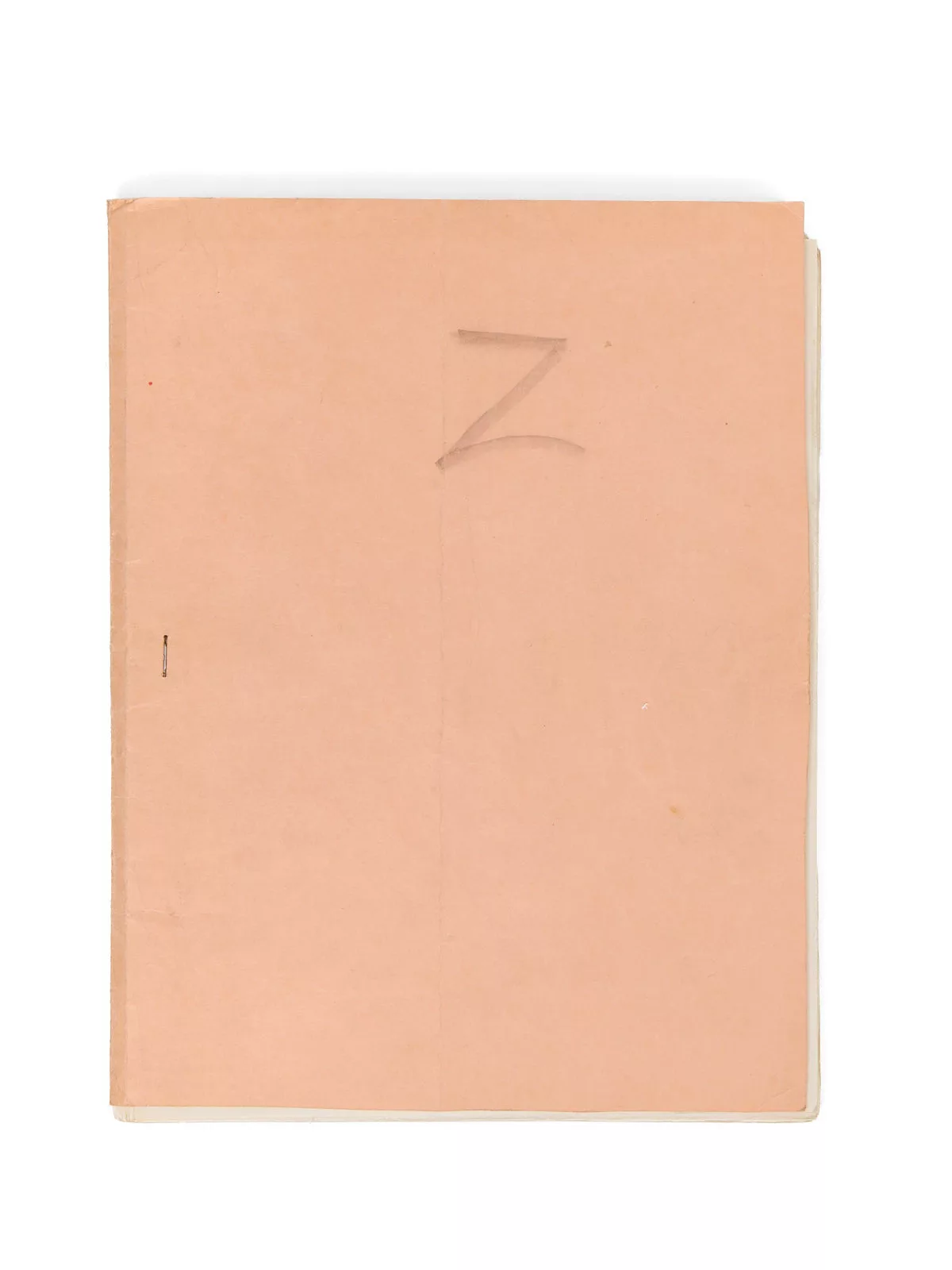
Jorge Semprún's copy.
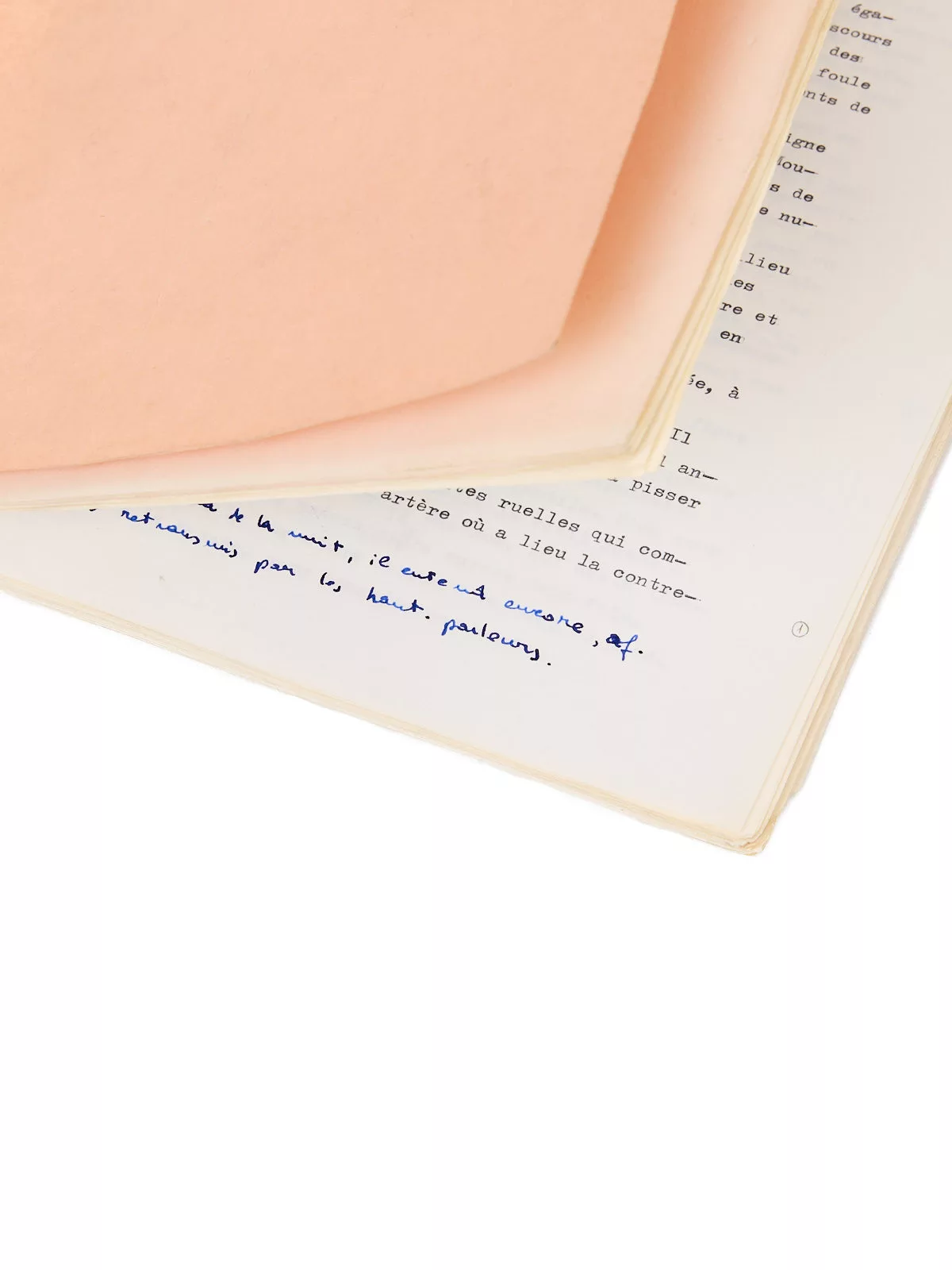
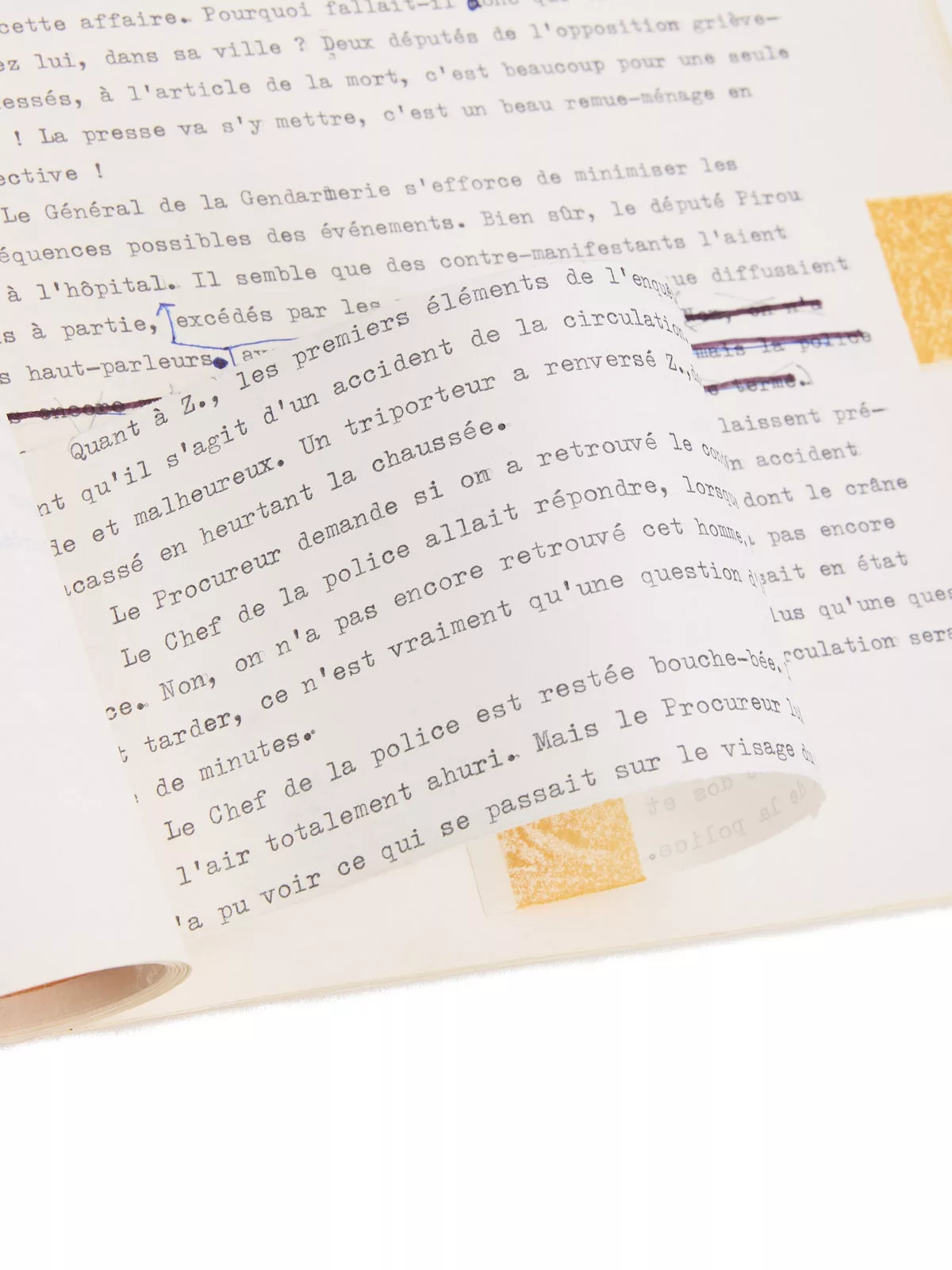
Corrected by the author, with about a hundred notes, second thoughts, additions and variants scattered throughout the document. Several tipped-in slips have been pasted in where the corrections are more extensive.
Costa-Gavras’s film, adapted from Vassilis Vassilikos’s novel, depicts the period of “incubation” of fascism in Greece, just before the country fell under the military dictatorship of the colonels. The director assembles a case built from witnesses and evidence, disguising his political indictment as a thriller, without sacrificing suspense or dramatic tension.
Z was Costa-Gavras’s third feature film and his first “dossier film,” a genre in which he would specialize over the following decade with political fictions conceived as detective stories or thrillers (from L’Aveu to Amen, via Missing). Semprun was responsible for the adaptation and dialogue, at Costa-Gavras’s request, following Vassilikos’s own attempt. What is offered here is Semprun’s own version of the adaptation he proposed.
Semprun knew Costa-Gavras without ever having worked with him: “we belonged to the same circle of friends, which included Yves Montand and Simone Signoret. Costa-Gavras had been struck by Vassilikos’s book about a left-wing Greek deputy eliminated by the military regime. He asked me to adapt it with him. We kept the plot but changed the narrative structure. In the book there were many interior monologues, much lyricism. Costa wanted to give the film more of a detective-story feel […]. When the screenplay was finished, in 1968, we could not find a producer. We received vague promises and a small advance, which we actually had to return because what we had written was not liked. Luckily, May ’68 happened, and politics, which no one in the industry cared about before, began to be seen more favorably. The screenplay was eventually filmed without the slightest change. But Jacques Perrin still had to move heaven and earth to put together the co-production. And Z was an enormous success worldwide…” (interview with Olivier de Bruyn, Télérama, June 2011).
Vassilikos had sent Semprun a copy as early as summer 1967, inscribed: “à Jorge Semprun, la guerre commence. Avec toute mon amitié et mon estime. Vassilis Vassilikos.” As soon as he accepted Costa-Gavras’s proposal, Semprun set to work on the adaptation in the autumn of 1967. It was refined several times in 1968, before being filmed at the end of the year and released in theaters on February 26, 1969.
Costa-Gavras had discovered Vassilikos’s novel during a stay in Greece. On his return, he obtained an advance from United Artists and asked Semprun to write the adaptation. But United Artists, deeming the screenplay too “political,” withdrew from the project; Costa-Gavras then turned to Éric Schlumberger and Jacques Perrin — whom he had known since the 1965 film Compartiment tueurs — who provided part of the financing and used their contacts, particularly in Algeria, where the film was shot since the colonels’ dictatorship obviously made filming in Greece impossible.
The film was showered with honors: Academy Award for Best Foreign Language Film, Special Grand Prize of the Jury (unanimously) at the Cannes Film Festival, Academy Award for Best Film Editing, Golden Globe for Best Foreign Language Film, Best Actor Award at the Cannes Film Festival (for Jean-Louis Trintignant), British Academy Film Award for Best Film Music, New York Film Critics Circle Award for Best Director and Best Film, National Board of Review Award for Best Film, Edgar Allan Poe Award for Best Screenplay…
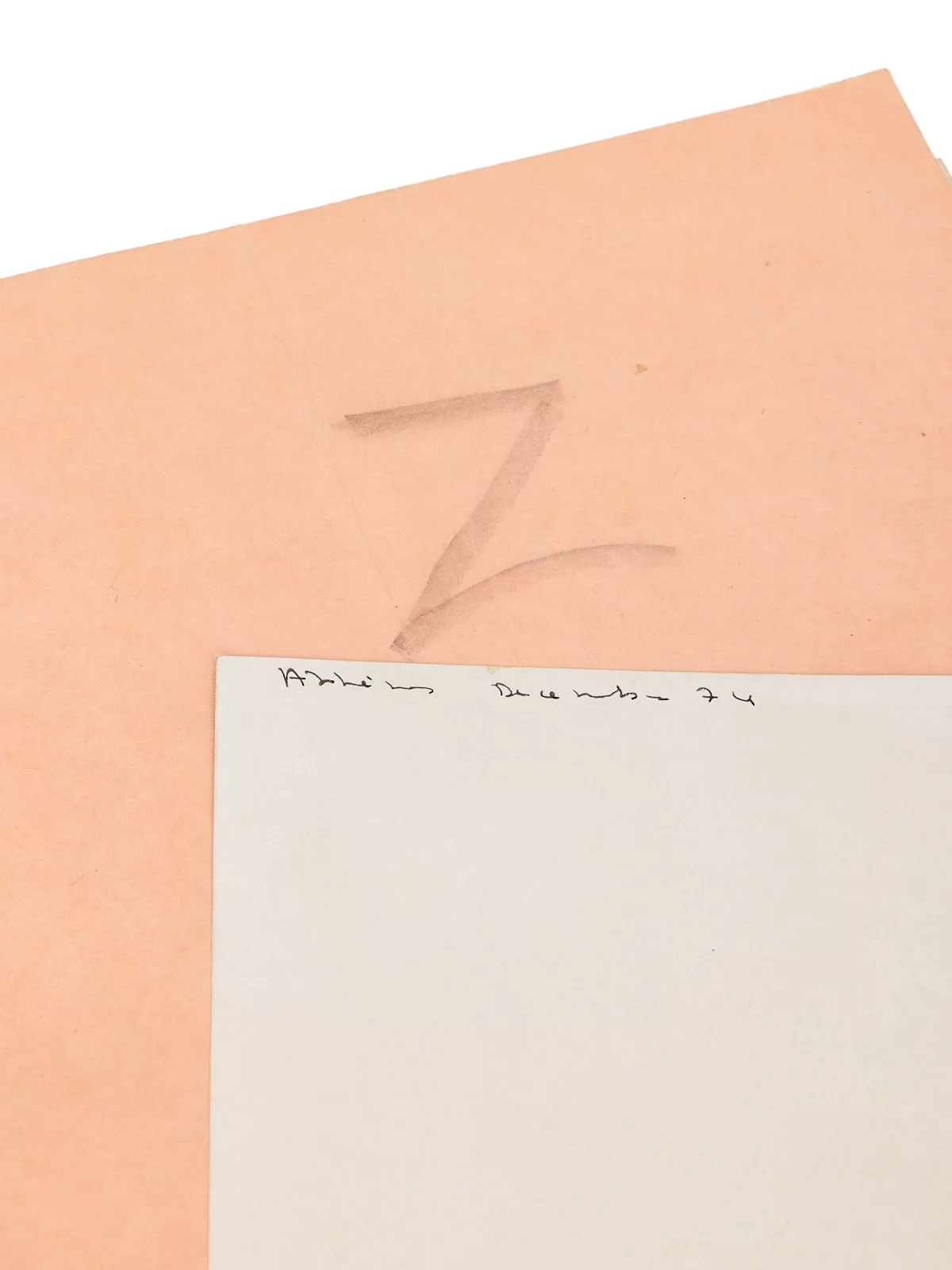
At the head, an original gelatin silver print of a photograph showing Jorge Semprun and Yves Montand in Greece, during the two men’s first trip to the country: the colonels’ dictatorship, denounced in Z, had just ended in July, on July 23. Four months later, on December 8, a referendum was held on the maintenance of the republic established at the end of the dictatorship: the Third Republic was confirmed, and presidential elections were to take place on December 18. Neither Semprun nor Montand, both deeply committed politically, could miss this moment.
The photograph is captioned on the verso, in Semprun’s hand, “Athènes, décembre 1974.”
“Bibliothèque Jorge Semprún” stamp on the verso of the photograph and on the preliminary leaves of the notebook; the document is dated at the end, “Ivry-la-Bataille [Eure] et Paris, 1967.”
An exceptional set.