

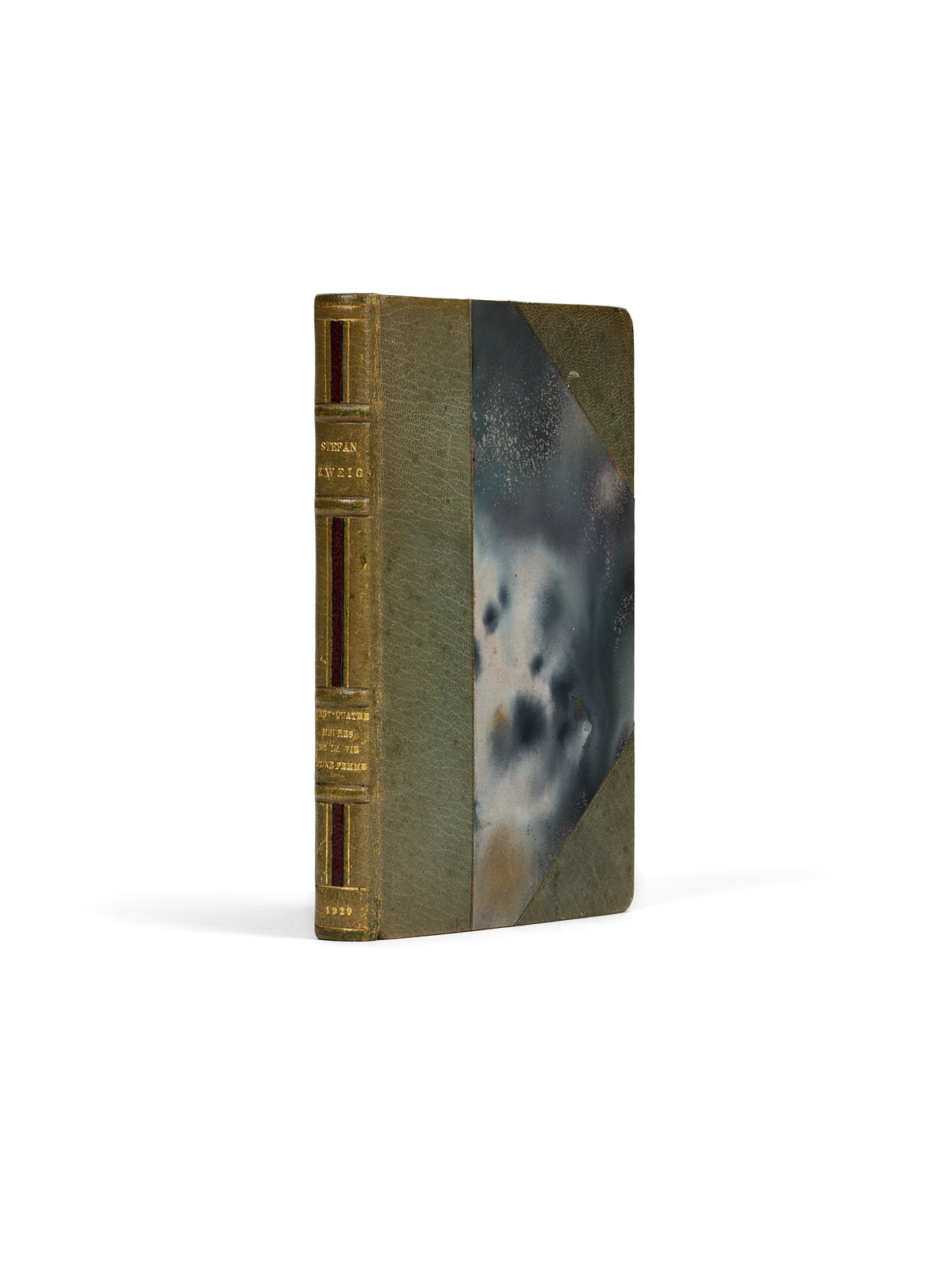
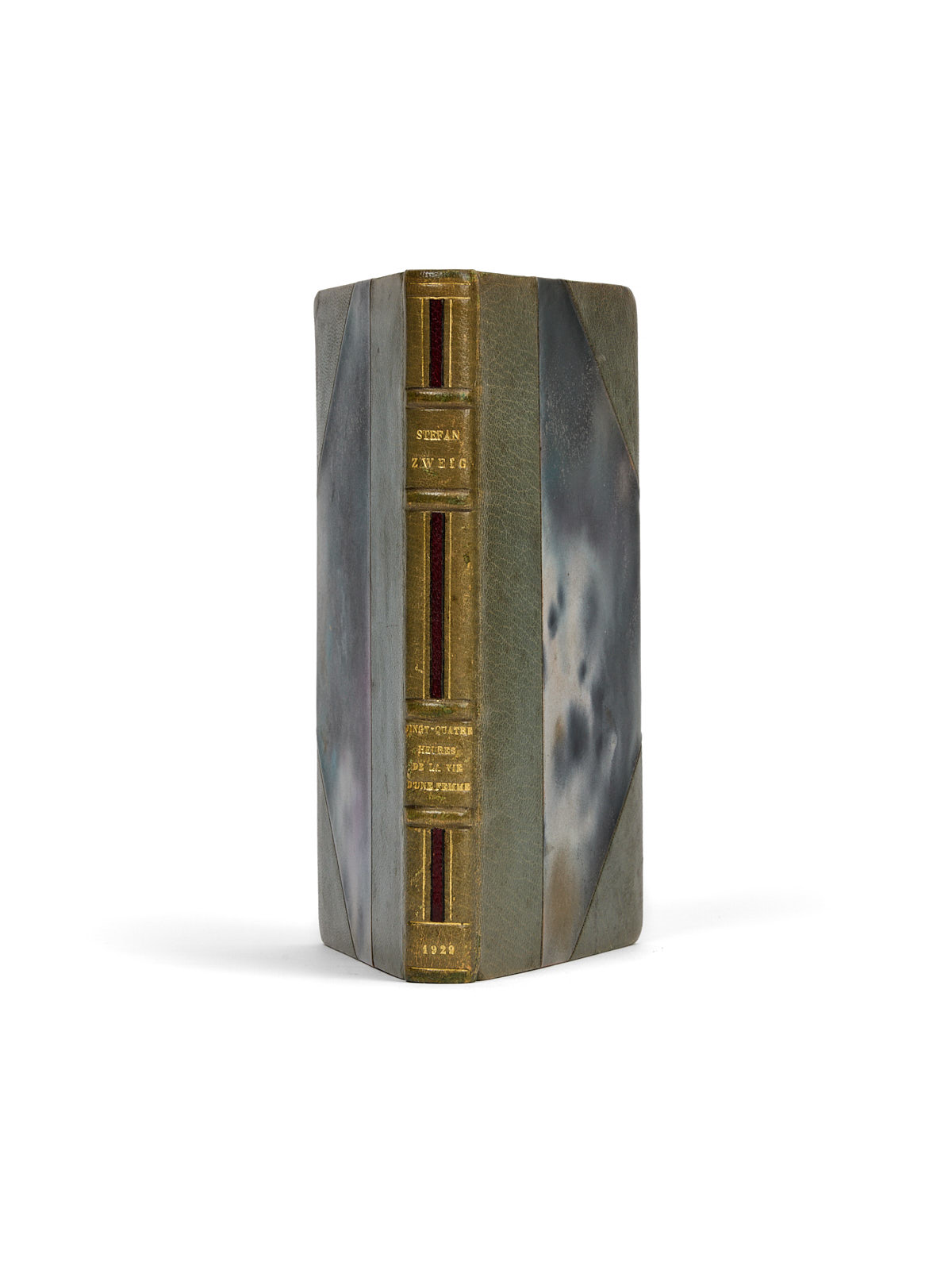
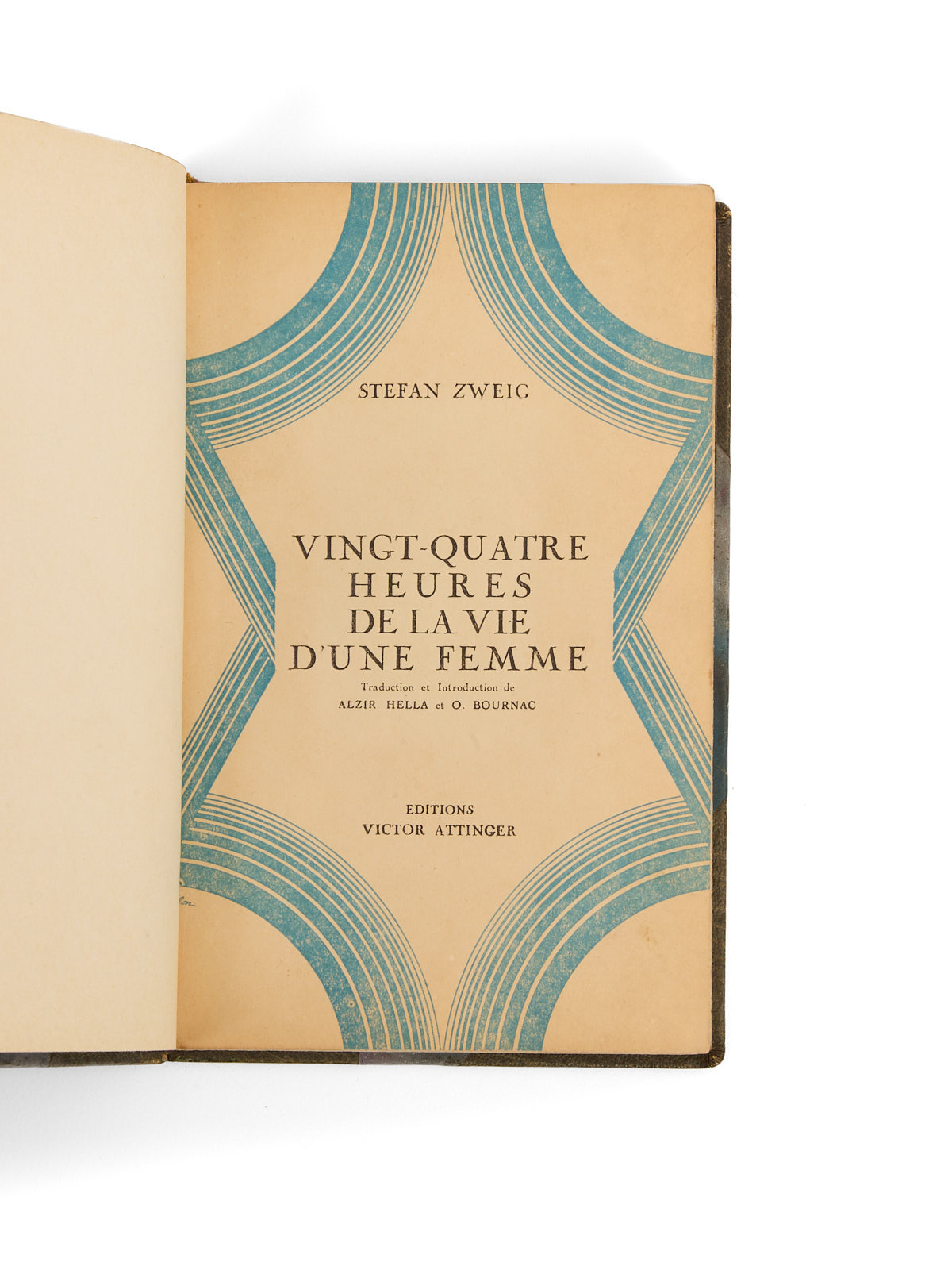
Vingt-quatre heures de la vie d’une femme
One of the first 50 copies on pur fil paper (no. 39).
A fervent pacifist, Zweig had been deeply wounded by the First World War and in 1919 decided to retire to Salzburg, the museum-city where Mozart was born. In less than ten years, Zweig — who had once considered work “merely a ray of life, something secondary” — published some ten novellas and as many essays on Dostoevsky, Tolstoy, Nietzsche and Freud. Among the novellas are Amok, Fear, Fear (Destruction d’un cœur), Confusion of Feelings and this Twenty-Four Hours in the Life of a Woman: the last three were published together in 1927.
Vierundzwanzig Stunden aus dem Leben einer Frau was translated two years later by Alzir Hella. Hella, who had met Zweig through Émile Verhaeren, had already been his translator for two years — since Amok — and would remain so, with Olivier Bournac, for the whole of Zweig’s work; he became his friend and unofficial literary agent.
For the first and only time, Alzir Hella wrote the preface, placing the work in its moral and literary context and testifying to the emotional shock it produced on first reading: a novel of rare psychological tension. The story begins in an English boarding house on the Riviera, where a scandal is the talk of the guests: a married woman elopes with a man she met the day before. The story sparks a moral debate among the guests; one of them, the narrator, defends the young woman’s passionate impulse against general indignation. An elderly English aristocrat, Madame Henriette C., moved by his point of view, decides to confide to him an episode from her own life, long buried in silence and shame. For this marvel of narrative construction, Zweig drew inspiration from a novel published in 1824 by Constance de Théis, Princess of Salm — her only novel, an epistolary one: Vingt-quatre heures d’une femme sensible.
A fine copy in a contemporary binding signed by Jules-Karl Van West. This Belgian-born binder settled in 1925 in Saint-Brice-la-Forêt, where he had his workshop built. His wife Jeanne worked alongside him, marbling the papers for the fine half-bindings that were sought after by Parisian bibliophiles of the 1920s and 1930s.
In March 1934, his fame spread beyond France’s borders through the sale of the Pierre Marteau library (Drouot, March 1934, expert Georges Andrieux), which included a large number of his bindings. This brought him even greater renown, and Queen Élisabeth of Belgium offered him the post of master bookbinder at the École Supérieure des Arts Décoratifs in Brussels; he returned to Belgium in December 1939. After the war, he became a professor of bookbinding at La Cambre, training, among others, August Kulche. Van West was one of the finest practitioners of his time, mastering binding, gilding and edge-gilding alike — three artistic disciplines rarely found together in a single craftsman. He was also the official binder for the Château de Beloeil, belonging to the Princes of Ligne, before becoming its curator; in 1950 he published his Mémoires d’un relieur.
A landmark title in Stefan Zweig’s œuvre, and also one of the rarest, despite this printing of 50 copies: this is only the third copy we have encountered, and only two others are recorded at public sale: the copy from the Hayoit library (Sotheby’s, 2005, V, no. 230, copy 42), in a half-binding by Huser, and a copy sold in Nantes in 2017 (Salorges, June 2019, no. 169, copy 45), in modern vellum. The title was notably absent from the JCM collection (Alde, June 2002, Un siècle de littérature), which included nearly all of Zweig’s works on deluxe paper.