

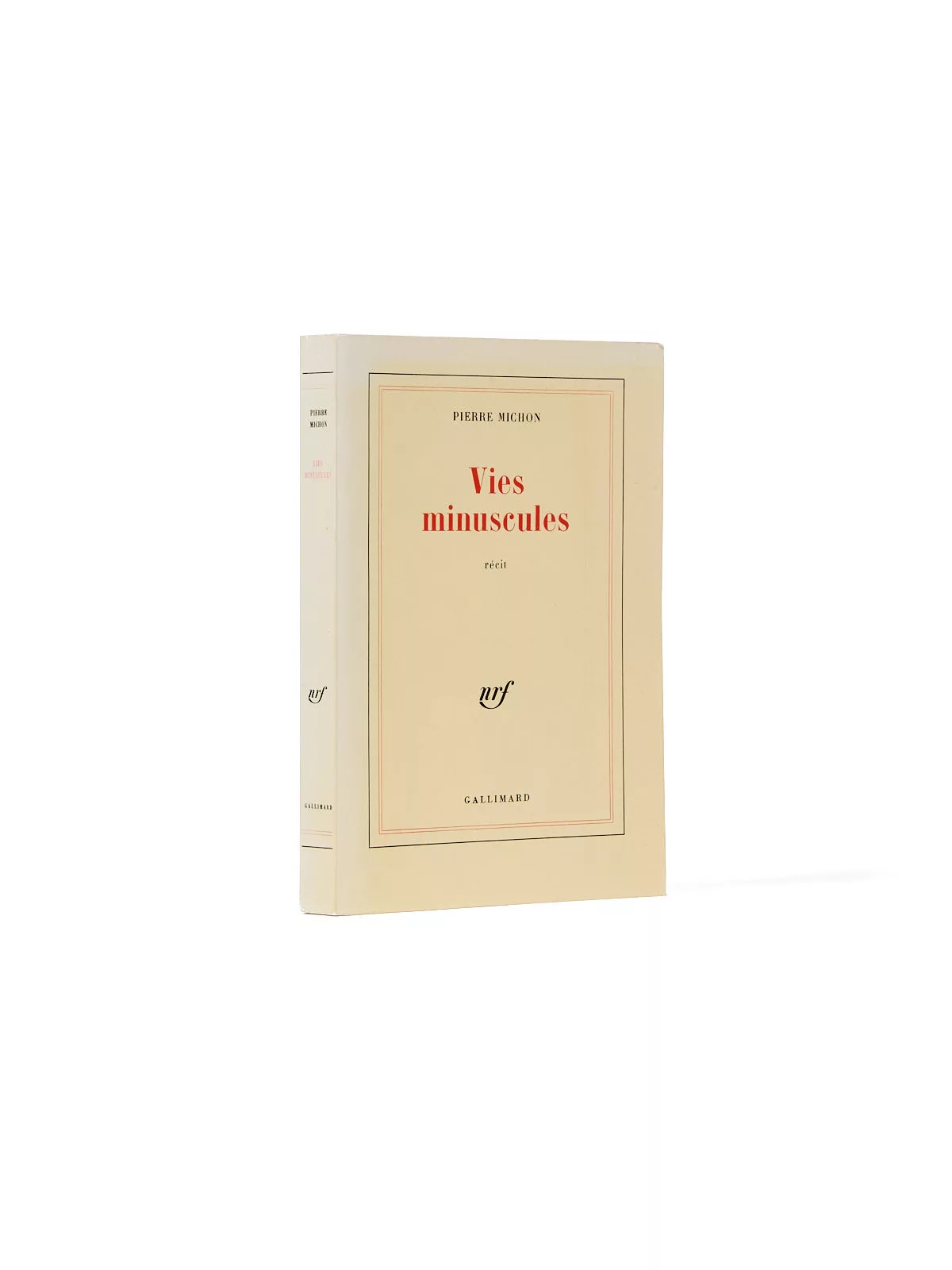
Vies minuscules
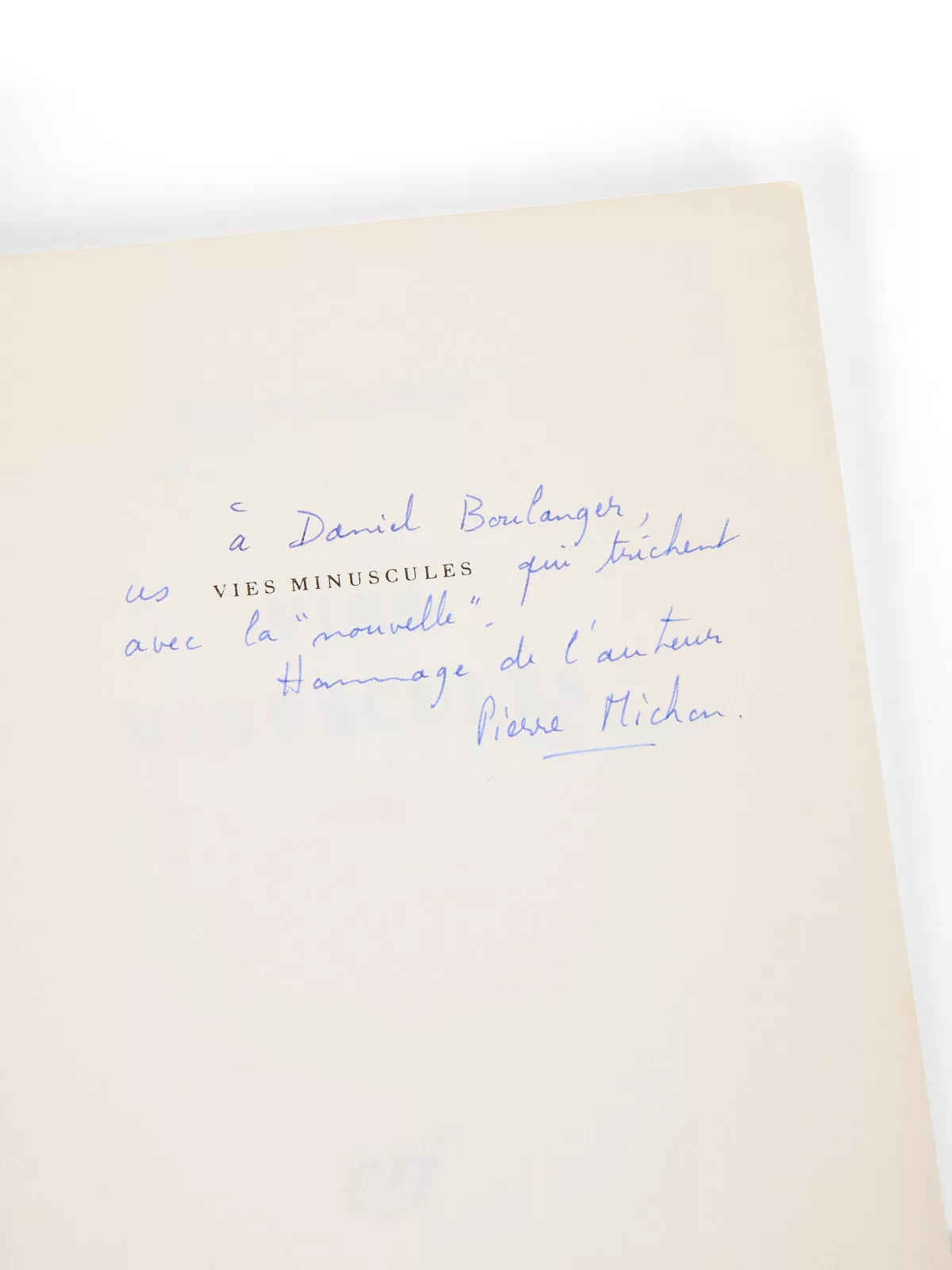
Presentation copy inscribed by Michon to Daniel Boulanger: “à Daniel Boulanger ces [VIES MINUSCULES] qui trichent avec la ‘nouvelle’. Hommage de l'auteur, Pierre Michon.”
If one wanted to characterize Pierre Michon’s work, one would certainly point to his talent for evoking “imaginary lives” — echoing Marcel Schwob’s title — whether he presents them as “minuscule” or magisterial: lives of painters or writers, lives of the poor lost to fate, sketched in a few striking strokes now inseparable from those they portray. One would also speak of his utterly singular style, which he himself hears roaring in the forge of writing and which he comments on and criticizes at the end of Vies minuscules: “[…] this leaning toward archaism, these sentimental liberties when style can do no more, this desire for an old-fashioned euphony — this is not how the dead express themselves when they have wings, when they return in pure speech and light.” Style, then, and the evocation of real people turned into characters, in what the writer calls his “fictive summers.” There is no need for further gloss; one need only be invited to read his works, especially Vies minuscules and Rimbaud le fils.
“It’s a book that set the bar extremely high, and I wonder if that was right […] I should have kept the essential for later […]. Something in me says: it would have been fitting for me to write that book and die the following year. The James Dean effect. Or rather the Rimbaud effect. I don’t think I ever again felt that necessity I had to write that book […]. I felt, for the people I was writing about, both pity and a sense of projecting myself into them. They were people bound to that extremely closed rural world, unable to leave it, in the very position I myself was in — someone who absolutely wants to leave, to leave, to leave that place. The room, the fire, the old folk. And I wrote Vies minuscules because suddenly a wave of forgiveness, of benevolence toward all these people swept over me” (in 21 cm, interview with Augustin Trapenard).
A writer, short-story author, novelist, screenwriter, poet and member of the Académie Goncourt, Daniel Boulanger was a singular figure in French literature of the second half of the twentieth century. His story collections (notably Fouette, cocher!, awarded the Académie française prize in 1960) and his numerous film scripts (Les Biches, L’Homme de Rio, Cartouche) brought him wide renown. A member of the Académie Goncourt jury from 1983, he became one of its influential voices until his resignation in 2008. It is probably in this capacity that Michon — for whom this was his first book — sent him this copy: addressing a writer celebrated for his mastery of the short form, while Michon himself was precisely blurring the boundaries between narrative, biography and fiction. This implicit complicity places the copy within a literary dialogue between two generations: Boulanger already established, Michon at the very outset of a career that would be immediately hailed by critics as one of the most distinctive voices in contemporary literature.
Spine and margins of the wrappers slightly sunned, otherwise a fine copy.