

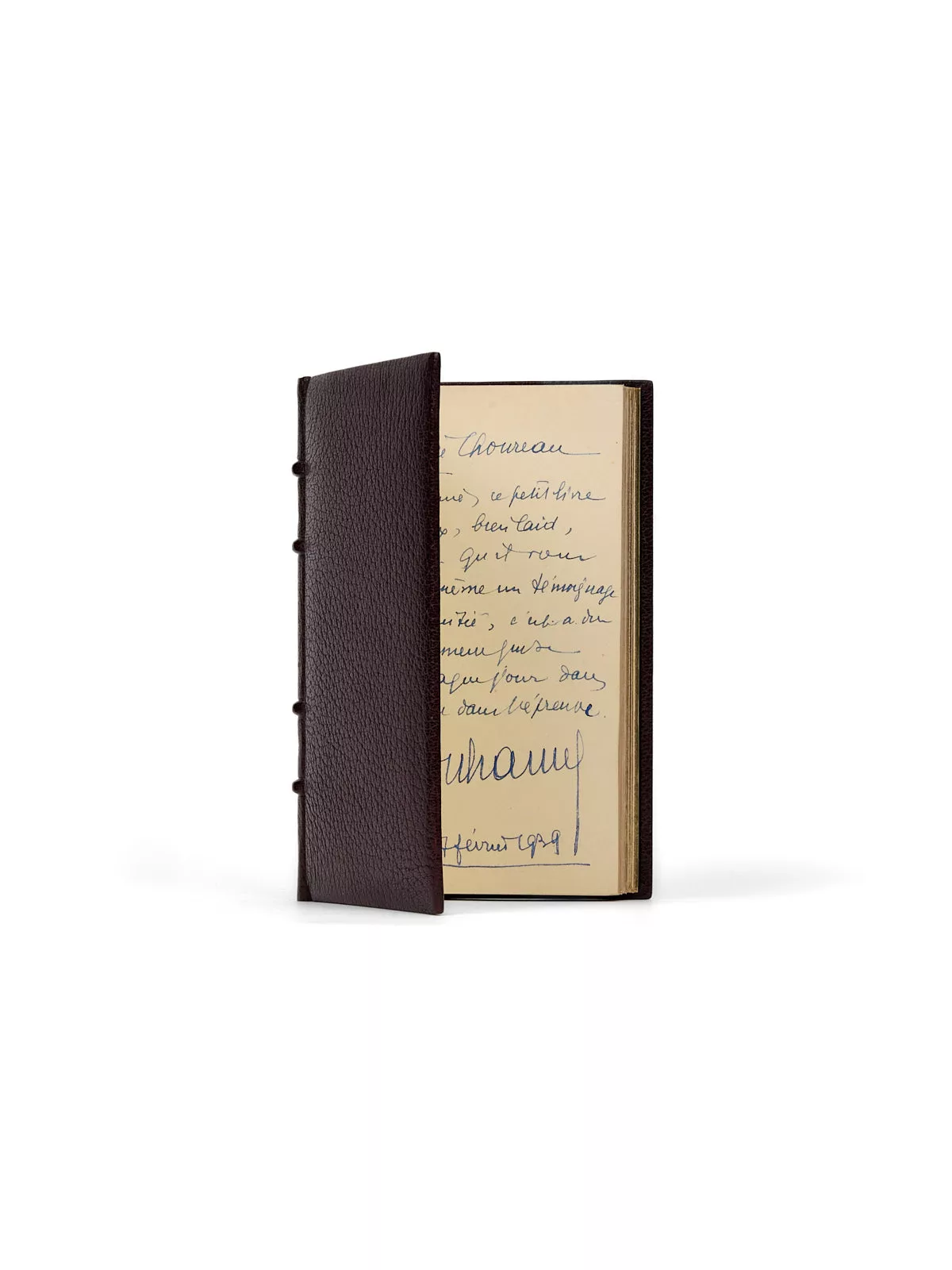
Signed presentation inscription: “ma chère amie, ce petit livre est bien vieux, bien laid, bien fragile. Qu'il vous soit quand même un témoignage de mon amitié, c'est-à-dire d'un sentiment qui se fortifie chaque jour dans le travail et dans l'épreuve.”
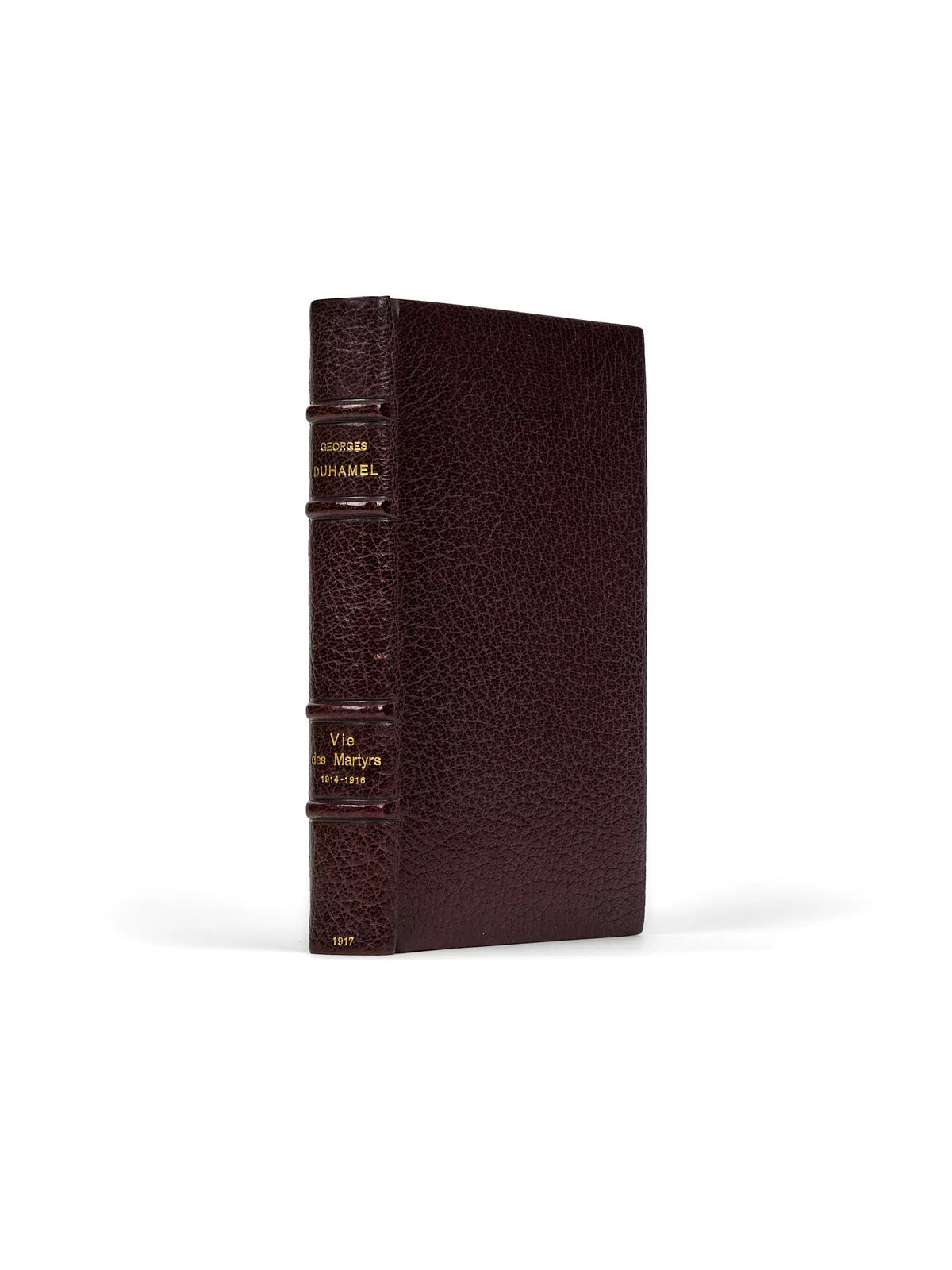
Duhamel’s first book on the war, written while he served as a volunteer surgeon at the front, Vie des martyrs grew out of the ambulance wards and the “Autochir” mobile surgical units through which the gangrened, the gassed and the mutilated passed. It is a cycle of short narratives in which Duhamel sets out to name, one by one, these “hundreds of human brothers,” in a stripped-down prose that refuses heroic rhetoric. Published by Mercure de France in 1917, the volume carries as epigraph the key sentence that became emblematic of his moral stance as witness: “Voici l’heure où l’on peut douter de tout… Mais on ne peut douter de la souffrance des hommes.”
Contemporary critics and later historians have often linked the book to Barbusse’s Le Feu for its anti-lyricism and its attention to the daily life of the “humble,” while stressing the singularity of a physician’s writing — precise and fraternal — that makes Duhamel a moral witness rather than a polemicist.
Above all, it is one of the very first eloquent testimonies and stands as a landmark of the literature of 1914–1918: its force lies in the sensitive exactness of its scenes, in the universality that emerges from them, and in the persistent fraternity that runs through the book and prepares the ground for Civilisation, awarded the Prix Goncourt the following year.
Because of its success and the circumstances of its publication, this first novel by Duhamel is particularly difficult to find in the first printing.
A copy of this quality, so bound, is exceptional, and the woman who had it bound in this way did so for evident reasons: Elvire Choureau.
An exceptional bookseller-publisher, Elvire Choureau (born Marie-Louise-Françoise-Émilienne Choureau, Vanvey, 2 June 1892 – Paris, 3 July 1986) founded in 1922, together with Georges Duhamel (then director of the Mercure de France), the bookshop L’Artisan du livre, at 22 rue Guynemer, a stone’s throw from the Luxembourg Gardens. Until 1976 she made it a center of fine bibliophily and literary sociability — frequented notably by Paul Valéry and Colette — its window mixing first editions, deluxe printings and bindings, under the guiding presence of her intellectual partner and friend Duhamel. Their closeness was decisive: together they conceived a militant bookshop devoted to “the French book,” then, faced with the paper crisis and the imbalances of the book trade, they created in 1937 the Alliance (nationale) du livre, an unprecedented scheme for mobilizing authors, publishers, booksellers and printers, which Duhamel theorized while Choureau ran its very concrete operations (press campaigns, “book voucher” projects, mailing lists to “true men of letters”). In the autumn of 1939, when the war made supplying books to the armed forces an urgent matter, it was again Choureau who, from the Alliance’s depots, organized the dispatch of books to soldiers — an activity whose “professional” tenacity Duhamel praised. A leading figure of the trade, the first woman elected president of the Chambre syndicale des libraires de France (1933–1934), and later honorary president, she took part in 1941–1942 in the profession’s corporate bodies while defending, not without friction, the dignity of the bookselling trade. Made a Chevalier de la Légion d’honneur (7 February 1938) for twenty-five years in the trade, she also carried on a genuine career as a publisher: scholarly and humanistic works (Carcopino, Radet, de Labriolle), editions of Mauriac and Maurois, and bibliophile ventures (Villon, Mac Orlan, Maeterlinck), among others. A friend of Colette — who dedicated Le Képi to her “au Patron” — Choureau embodied a bookseller of authority, both strategist and craftswoman: she ran the shop, nurtured her networks, and kept books and ideas in circulation. After 1976 the address passed under the name Giraud-Badin, and today that of the Alde house, continuing the bibliophilic vocation of the place.
The inscription is dated 17 February 1939.
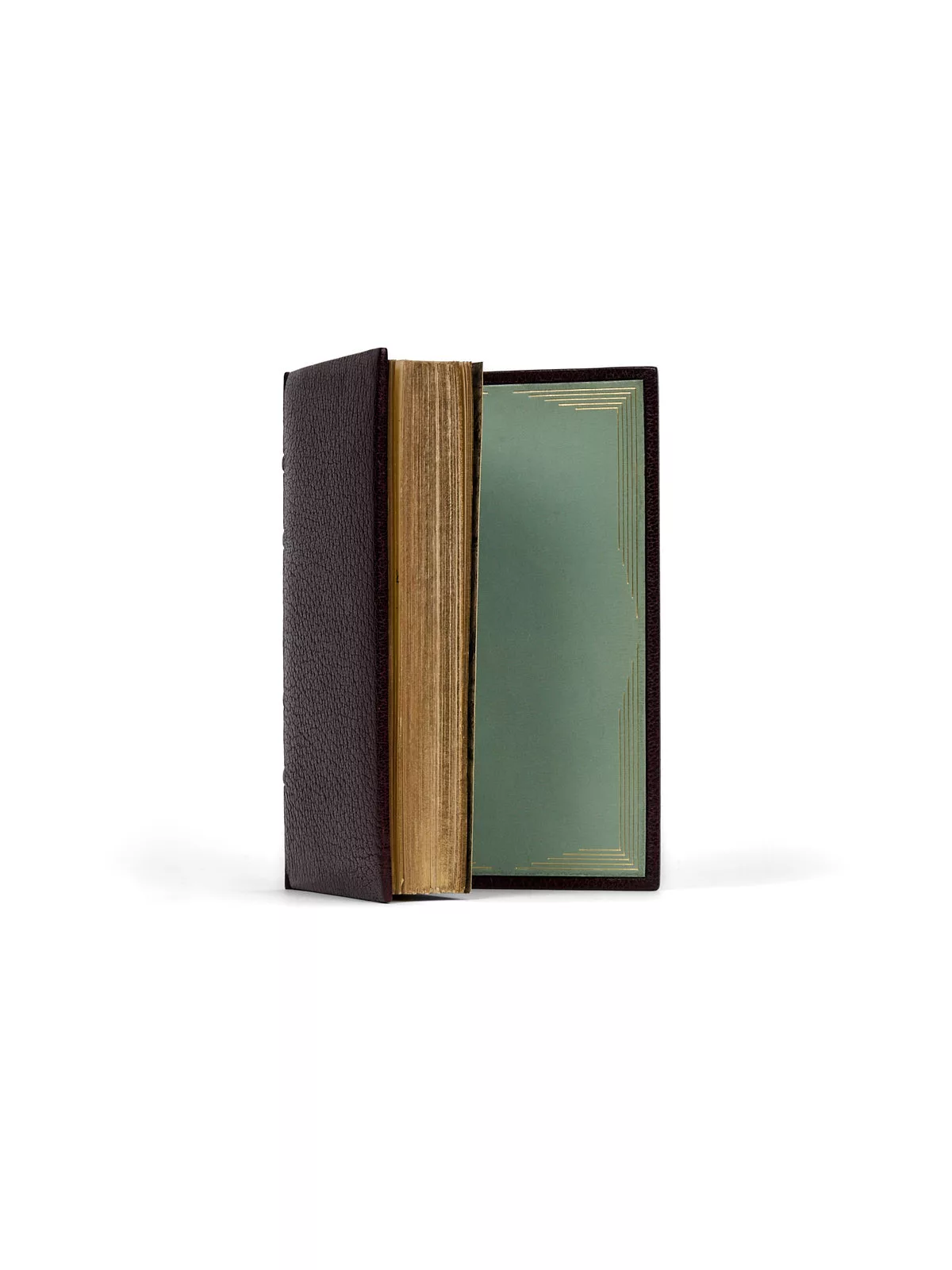
The binding is the work of Louise Lévêque, an excellent practitioner; her gilder was Fache (who worked, among others, for Paul Bonet and Rose Adler).