

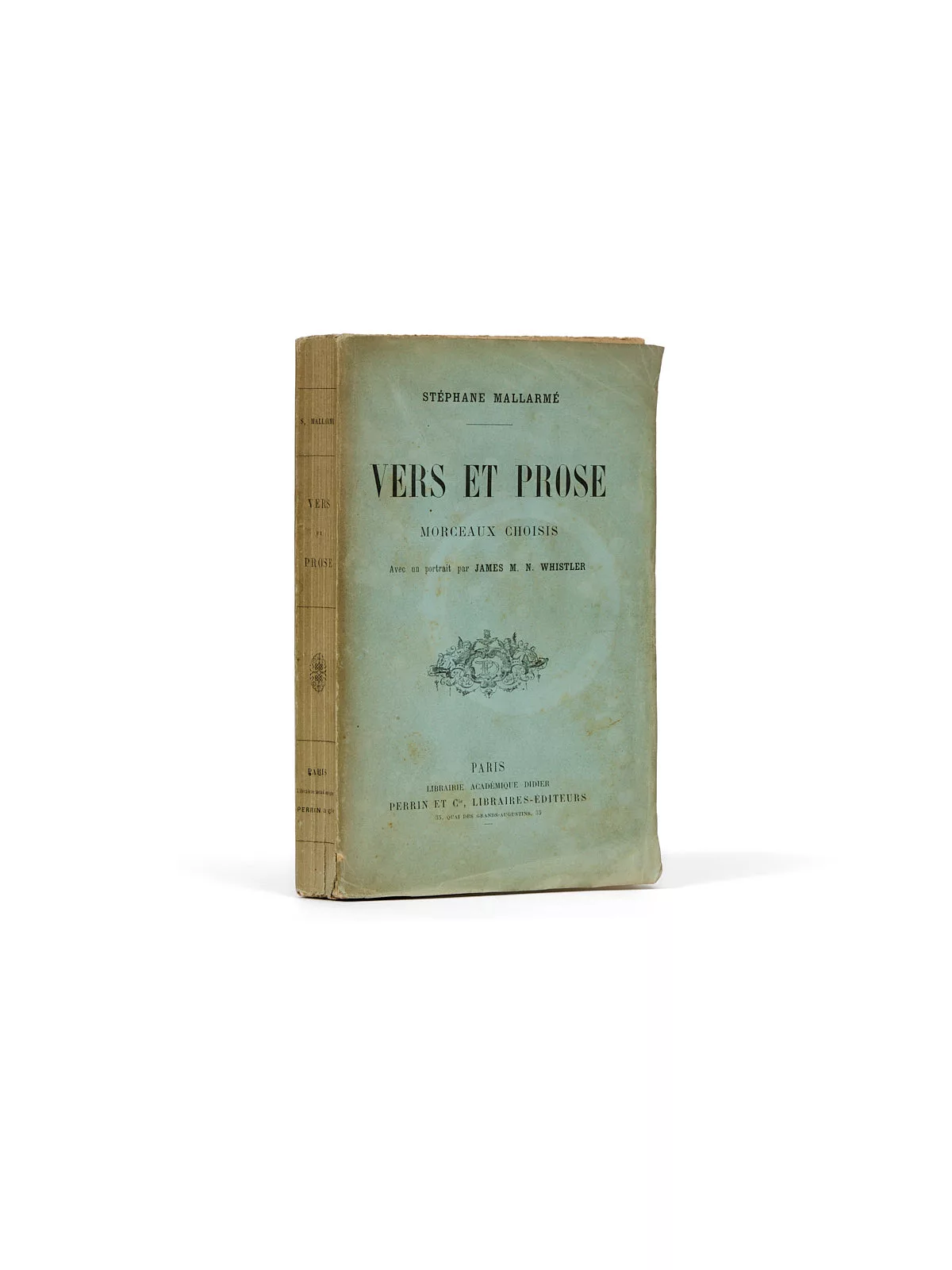
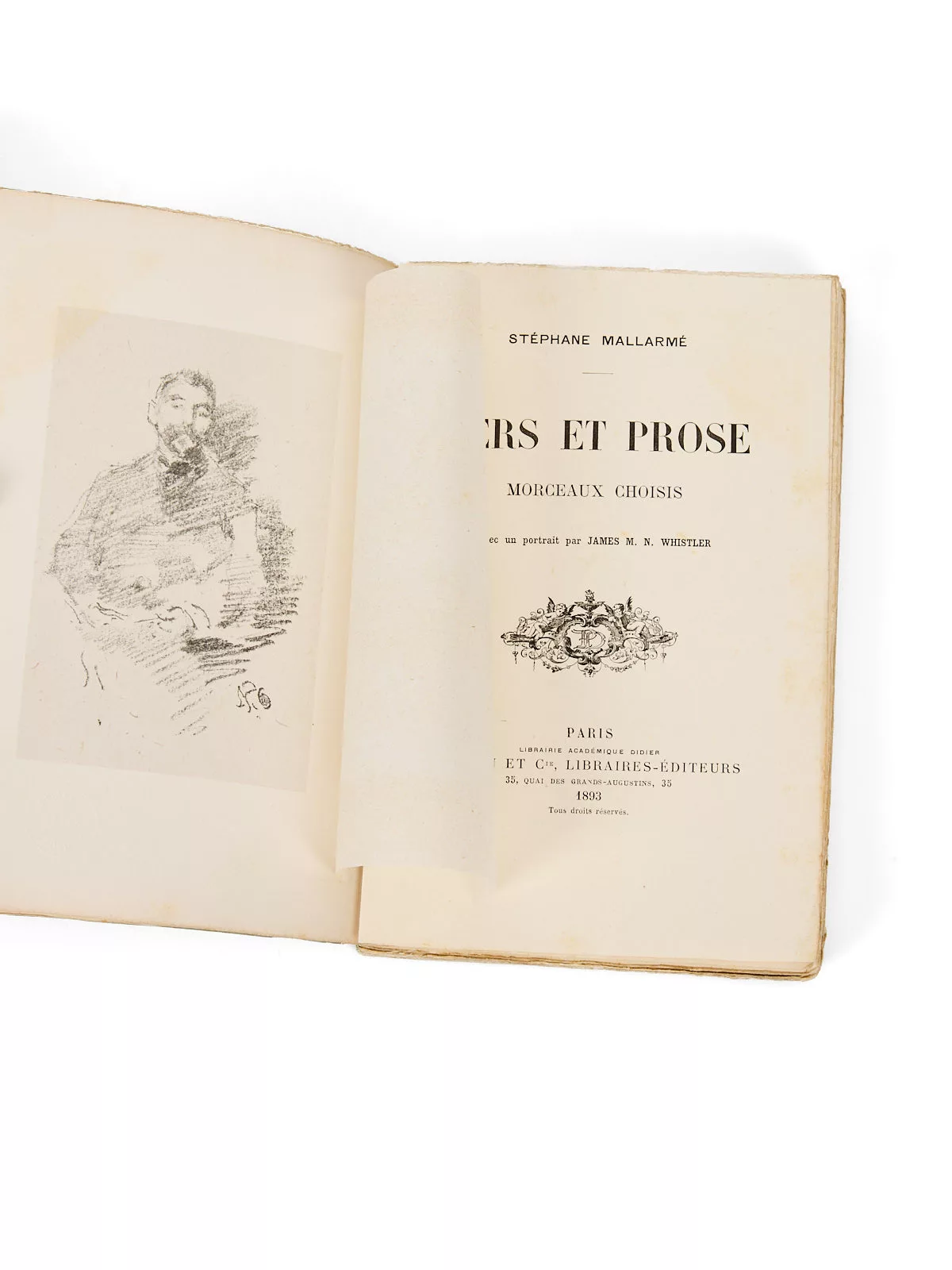
Copy of the first printing, with the embossed stamp of the printer Belfond in the lower margin of the portrait.
This collection brings together some of Mallarmé’s most celebrated texts, notably L’Après-midi d’un faune and Le Corbeau, his translation of Edgar Allan Poe’s poem. Several of the prose pieces show significant variants from their earlier publications, to the point of constituting, in some cases, almost entirely new texts, notably the two Divagations.
Whistler’s celebrated portrait of Mallarmé stands as one of the finest testimonies to their friendship. The painter had made the poet sit for a long time, destroying his first attempts, whose likeness he judged insufficient. Henri Mondor reports that Whistler insisted on having Mallarmé pose at length: “the first images obtained seemed weak to him and he tore them up to start again (…) But Whistler, in a few strokes, captured what had until then eluded him and obtained from his friend, in an intense and mobile likeness, an impression barely fixed but profound. A penetrating gaze had become a felicitous vision” (Vie de Mallarmé, pp. 639–640).
The poet himself considered this lithograph his most successful portrait. In a letter to Whistler of November 5, 1892, he expressed his admiration, believing that no earlier depiction had so accurately captured his features. Whistler, in turn, underscored the exceptional beauty of this likeness of the poet in a letter of October 15, 1894.
A good copy in its fragile water-green wrappers, spine skillfully restored.
Bookplate of L. Ponet.
Vicaire, V, 476; Carteret, II, 99; Talvart et Place, XIII, 122; Levy, Whistler Lithographs, no. 101.