

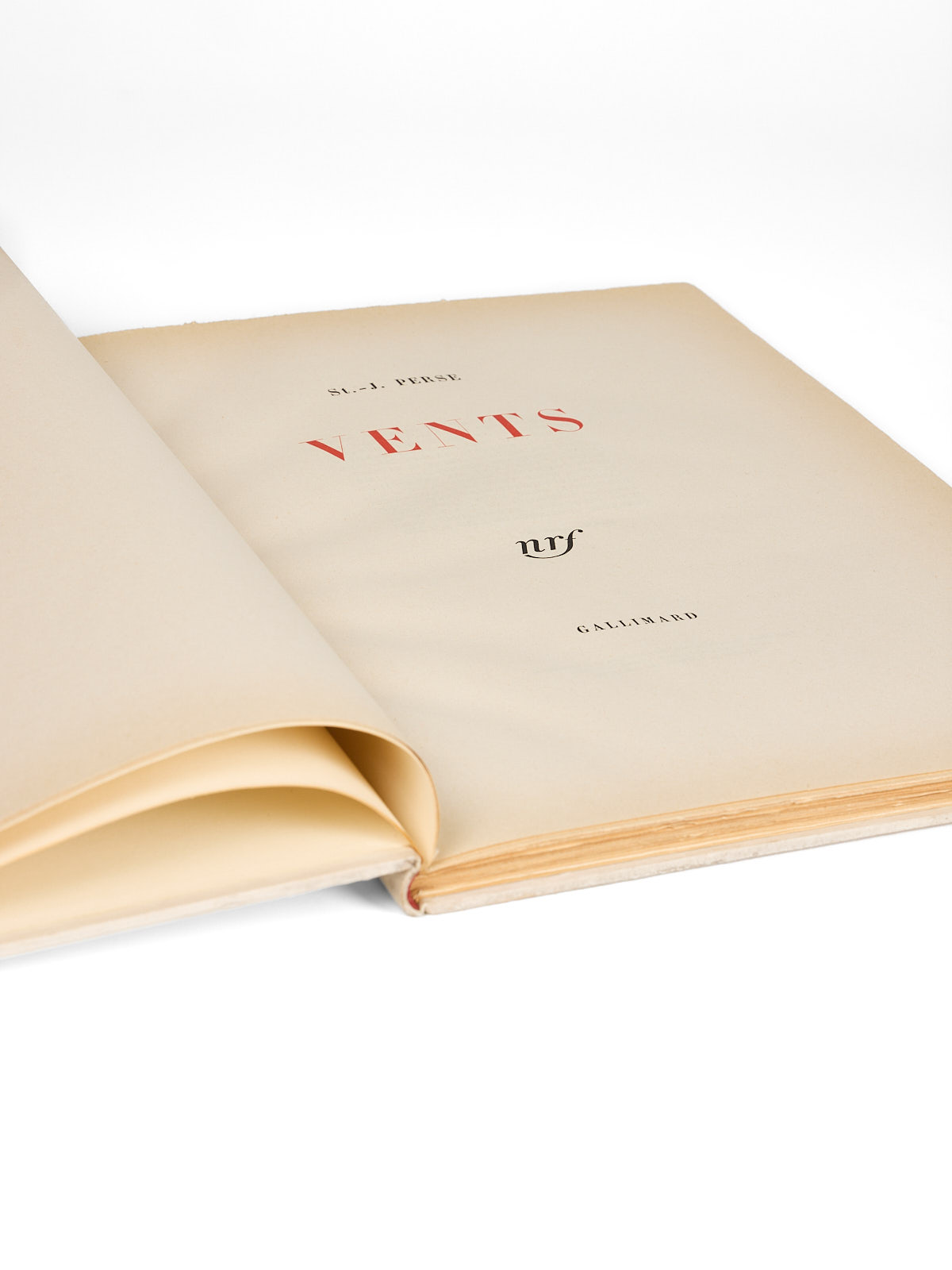
Vents
One of 2,350 copies on châtaignier paper (no. 1,298).
Vents constitutes the second major phase of Perse’s American output. After the four poems of the Exil cycle, which from 1941 to 1944 marked the poet’s return to creative work, Vents represents a certain American “anchoring,” as Perse settled into his new post as literary adviser at the Library of Congress in Washington. It was for him a time to resume poetic production, and the poem appeared in this year of Allied victory.
The composition of the collection is inseparable from the wild landscape of Seven Hundred Acre Island, off the coast of Maine in the Penobscot peninsula, which he had frequented since 1942. It was there that the poem, begun some months earlier, was completed — steeped in other striking American landscapes Perse had discovered that spring, traces of which remain in the poem: Arizona, Texas and Colorado, where the shamanic practices of the Navajo left a lasting impression on him.
Vents was published by Gallimard in 1946, in a deluxe edition limited to 2,425 copies. Much later, Perse himself wrote, in the note accompanying the poem in his Œuvres complètes: “Saint-John Perse always attached particular importance to Vents within his work. This poem was undoubtedly the least accessible to the French reader because, at the poet’s own request, it was first published only in a deluxe edition, of large format and large typography, in a fully numbered limited printing (Gallimard, 1946).”
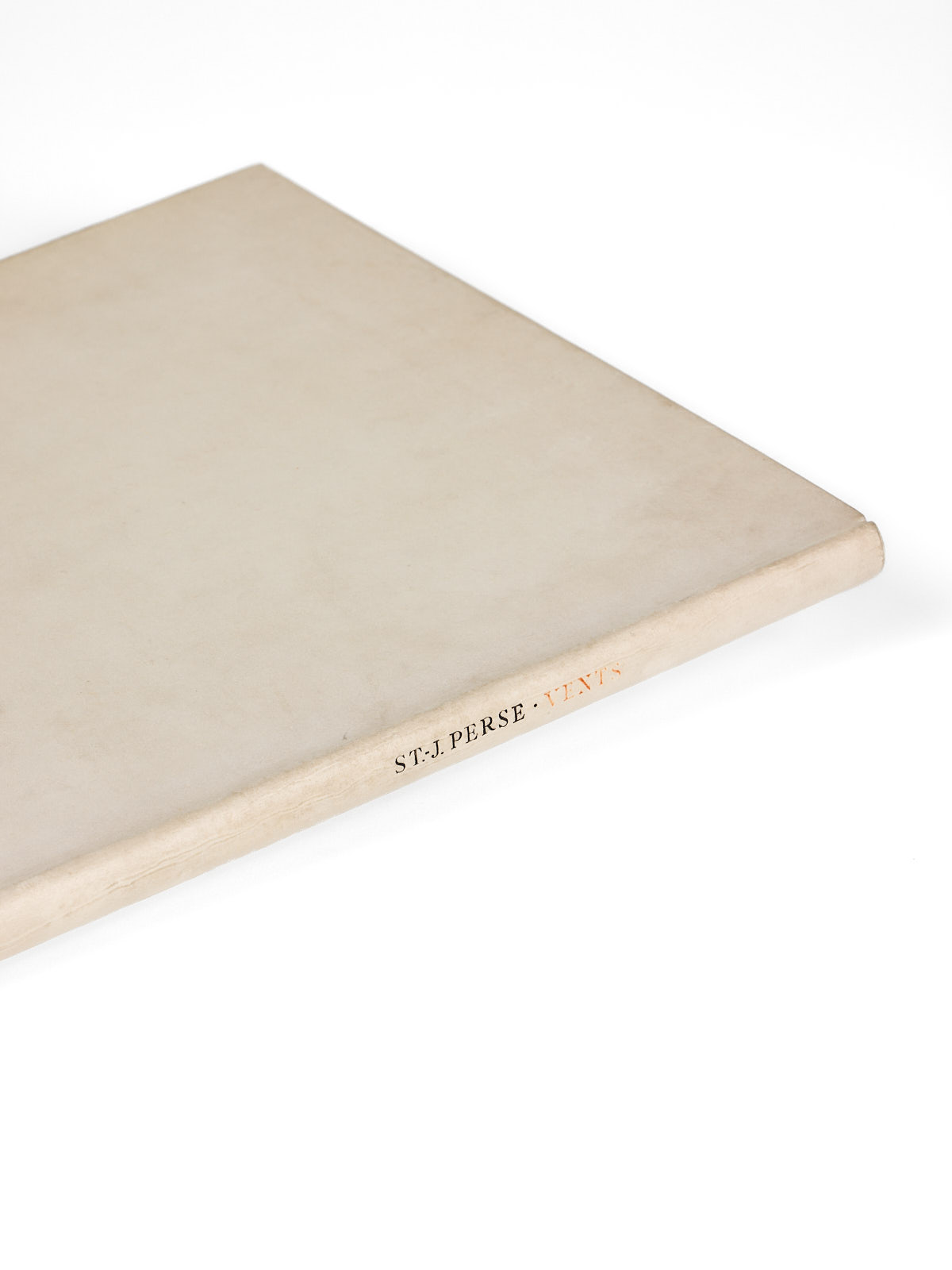
Henri Hoppenot’s copy. The copy was probably sent by Perse to Bern, just as Hoppenot had taken up his post as ambassador there in 1945. He had Pluies and Vents bound there by a renowned bindery on the Kramgasse, one of the main commercial streets of the old town: the Schumacher firm, founded in 1840.
The two men had known each other since August 1914, when Hoppenot joined the Press Bureau of the Ministry of Foreign Affairs. Alexis Léger, who had passed the entrance examination the previous year, was already in place. When they joined the ministry, the diplomat-writers Giraudoux, Morand and Claudel were already there. For more than sixty years, Alexis Léger and Henri Hoppenot’s paths crossed and diverged according to their postings, brought them together again at the Quai d’Orsay, and reunited them on the American continent.
Léger’s only foreign posting was to China, before a brilliant career in the central administration: after publishing Anabase in 1924 under the pseudonym Saint-John Perse, he set aside his literary career to devote himself entirely to diplomacy. Appointed head of the cabinet of Minister Aristide Briand in 1925, he became one of the highest-ranking officials at the Quai d’Orsay. He retained his position after Briand’s death in 1932 and succeeded Philippe Berthelot as Secretary-General of the Ministry of Foreign Affairs from 1933 to 1940 — the highest-ranking official after the minister himself.
Léger did much to advance Hoppenot’s career: “He helped me several times in my career, whenever he could” (Ina, Archives du XXe siècle, interview with Henri Hoppenot, 1971) — notably securing his appointment to China in 1933. In memory of this period, Hoppenot had a rarity printed in 1937: an account of one of Léger’s missions, printed by the Lazarist press in Beijing in ten copies, the Relation respectueuse addressed by secretary Lei Hi-Ngai [Alexis Léger] to his excellency minister Kang Te [Alexandre Conty, minister of France in Beijing]. This was shortly before the two men were reunited in Paris at the Quai d’Orsay, between 1937 and 1940.
Disavowed in 1940, Léger was dismissed from his post on 18 May 1940 by Paul Reynaud and went into exile in the United States. Hoppenot paid the price for his closeness to Léger: he was refused several postings in Europe and sent instead to Uruguay. He resigned his post in 1942, when the STO forced-labor draft was introduced and a new statute against Jews was promulgated. He then went to Argentina, was stripped of his diplomatic functions on 6 March 1943, and made his way to Washington, where he rejoined Léger in support of Free France. In 1945 he was appointed ambassador to Bern.