

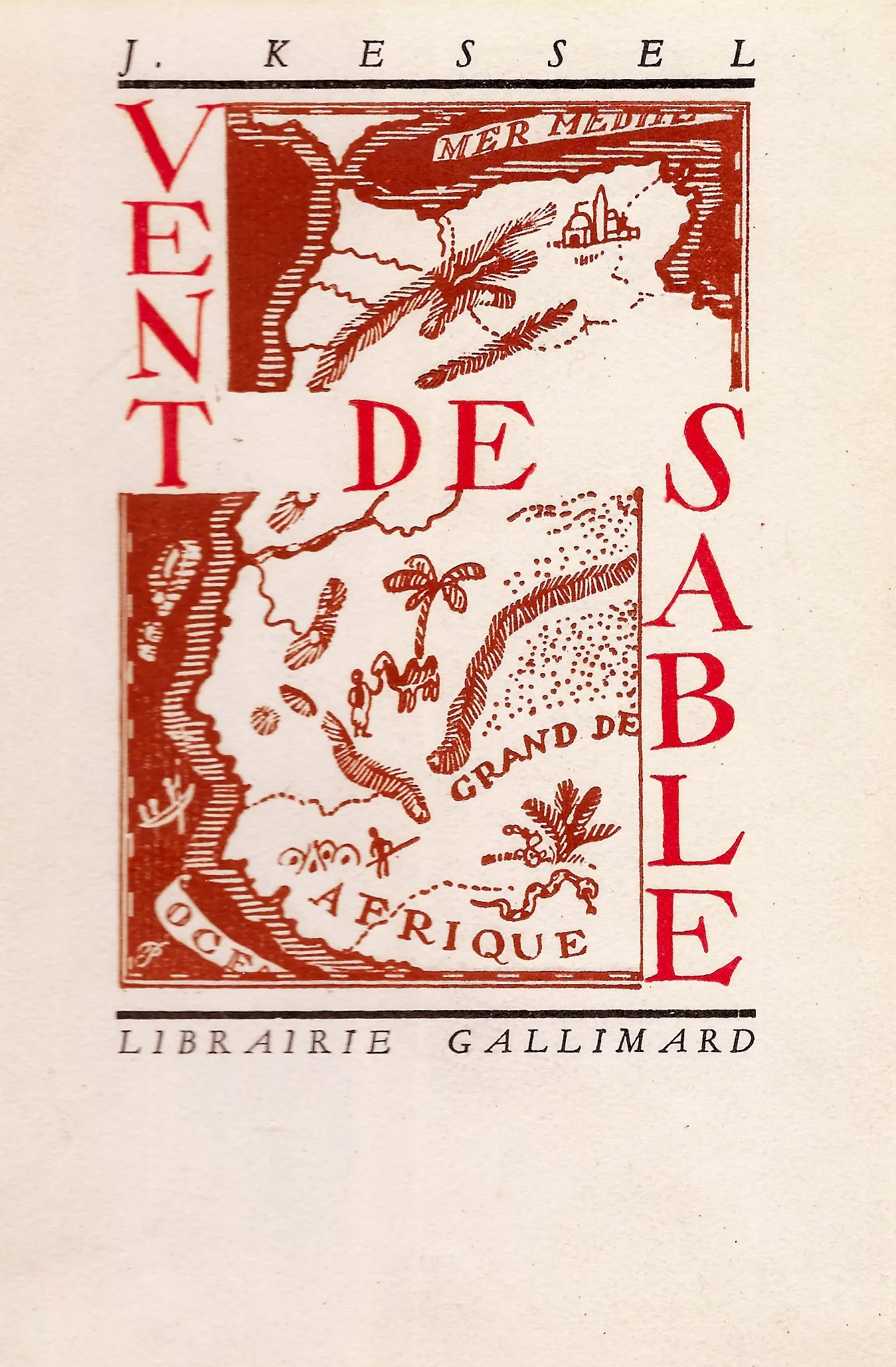
Vent de sable
One evening in December 1928, Joseph Kessel, then literary director of the newspaper Gringoire, was dining with naval officer Lablache-Combier and two former wartime pilots, Joseph Le Brix and Demougeot. The three men encouraged him to write a report on the Aéropostale airmail service and introduced Kessel to Didier Daurat’s team at the Latécoère operations base in Toulouse: the pilot Marcel Reine and radio engineer Édouard Serre, “precise as a theorem, gentle as a woman, polite to the point of refinement.” Both men, taken prisoner in June 1928 by Moorish tribesmen after an emergency landing in the desert, told Kessel the gripping story of their captivity.
Kessel accepted the assignment without hesitation and, less than a fortnight later, found himself on the tarmac. For three weeks he followed these aerial adventurers, who recognized in him a former member of Escadrille S.39, the Great War flying squadron, and the author of L’Équipage, the first literary work on aviation.
On his return from this expedition, Kessel began writing Vent de sable, based on the reports that would be published in Gringoire from May 1929 — at the very moment Courrier Sud (Southern Mail) was appearing. These accounts, centered on the pilots of “the Line,” recapture the atmosphere of a wartime squadron, which Kessel himself had known and had already described in his first literary success, L’Équipage, in 1923. Although the Aéropostale pilots had no “human enemies to fight,” he explains, they confronted daily the sierras, the mists, the winds and the desert, under a discipline “as rigorous as that of the army.” Kessel, who had never met Saint-Exupéry, recounts how “Saint-Ex” led the perilous rescue expedition into the desert to free Reine and Serre, portraying him almost as an Oriental sage: “he had very quickly adapted to the desert. Dressed in an everlasting dressing gown that had come to resemble a gandourah, his beard grown out, burned by the sun, he so resembled the Moors that when he visited the nomads who pitched their tents at the foot of Fort Juby, they at first mistook him for one of their own. Courage, curiosity and philosophy were his great virtues.”
Kessel finished his book in August 1929 in a small, isolated hotel at Cap Gris-Nez and returned to Paris to correct the proofs. In a clever maneuver, he had managed to sell his manuscript to two publishers: Horace de Carbuccia, director of Gringoire and head of Éditions de France, and Gaston Gallimard. Neither was particularly pleased with the arrangement, but both accepted the author’s terms and each promised a fine edition: Gallimard issued 1,075 copies, with a cover designed by R. Haury, an etched frontispiece by Geneviève Gallibert, and a deluxe issue of 75 copies on Japanese paper; Carbuccia issued 1,475 copies on alfa paper, including a deluxe issue of 10 copies on Japanese paper and 35 on pur fil paper. A third edition even appeared, illustrated with etchings by Jacques Simon, issued at year’s end by the Bibliophiles de l’Aéro-club de France, limited to 125 copies.