

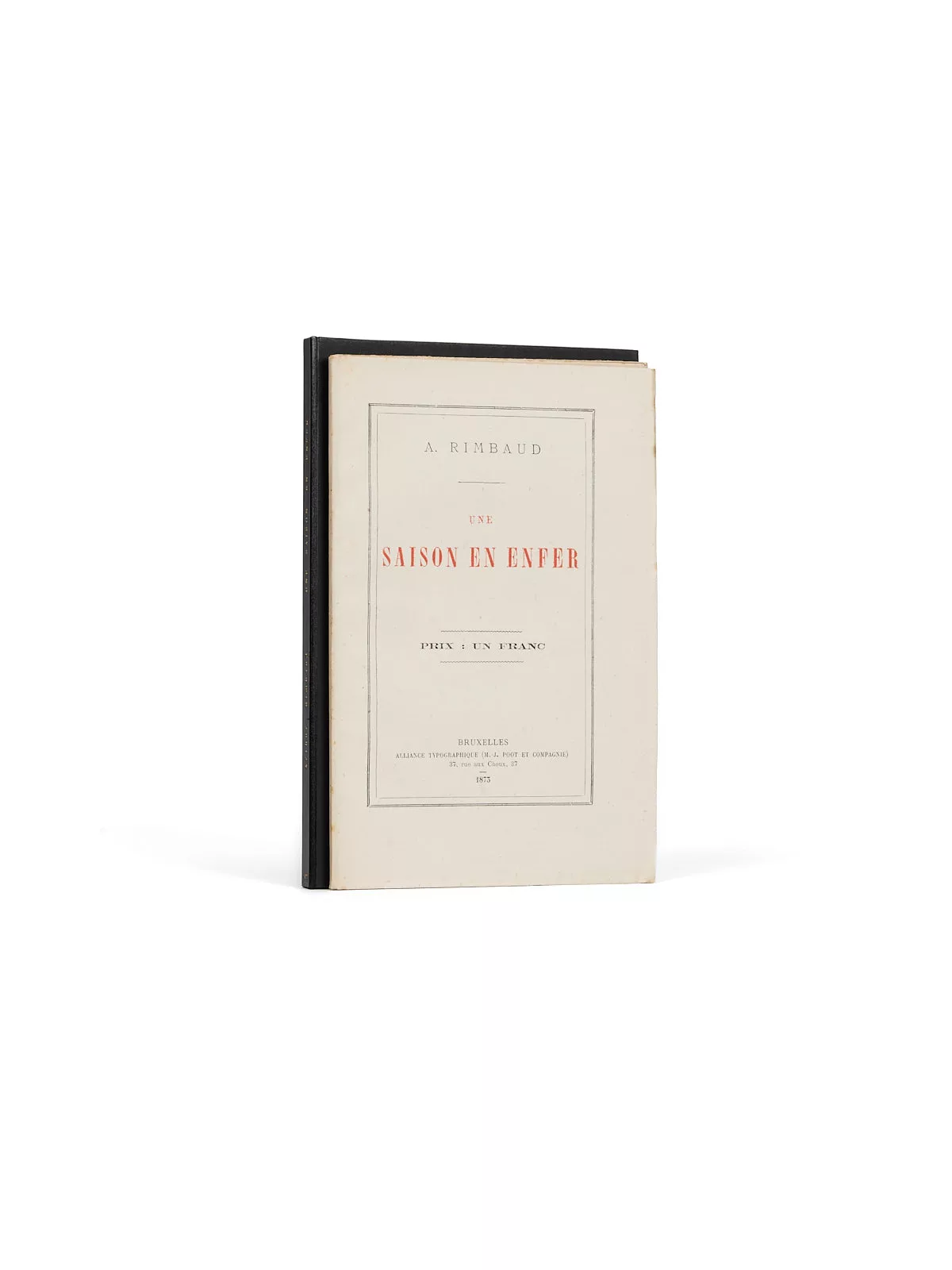
Une saison en enfer
The only volume of poetry published during Rimbaud's lifetime, and the only book he himself oversaw.
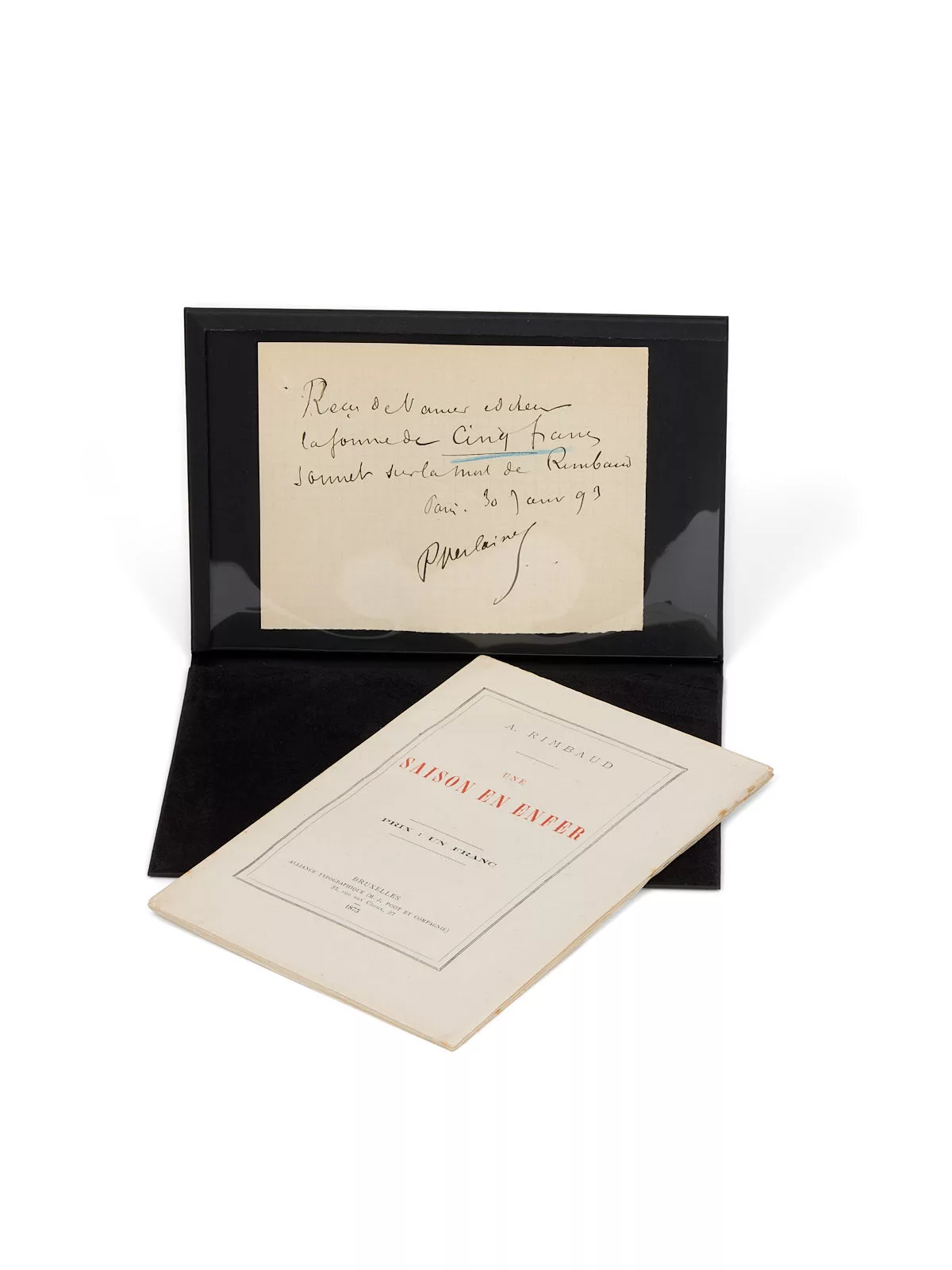
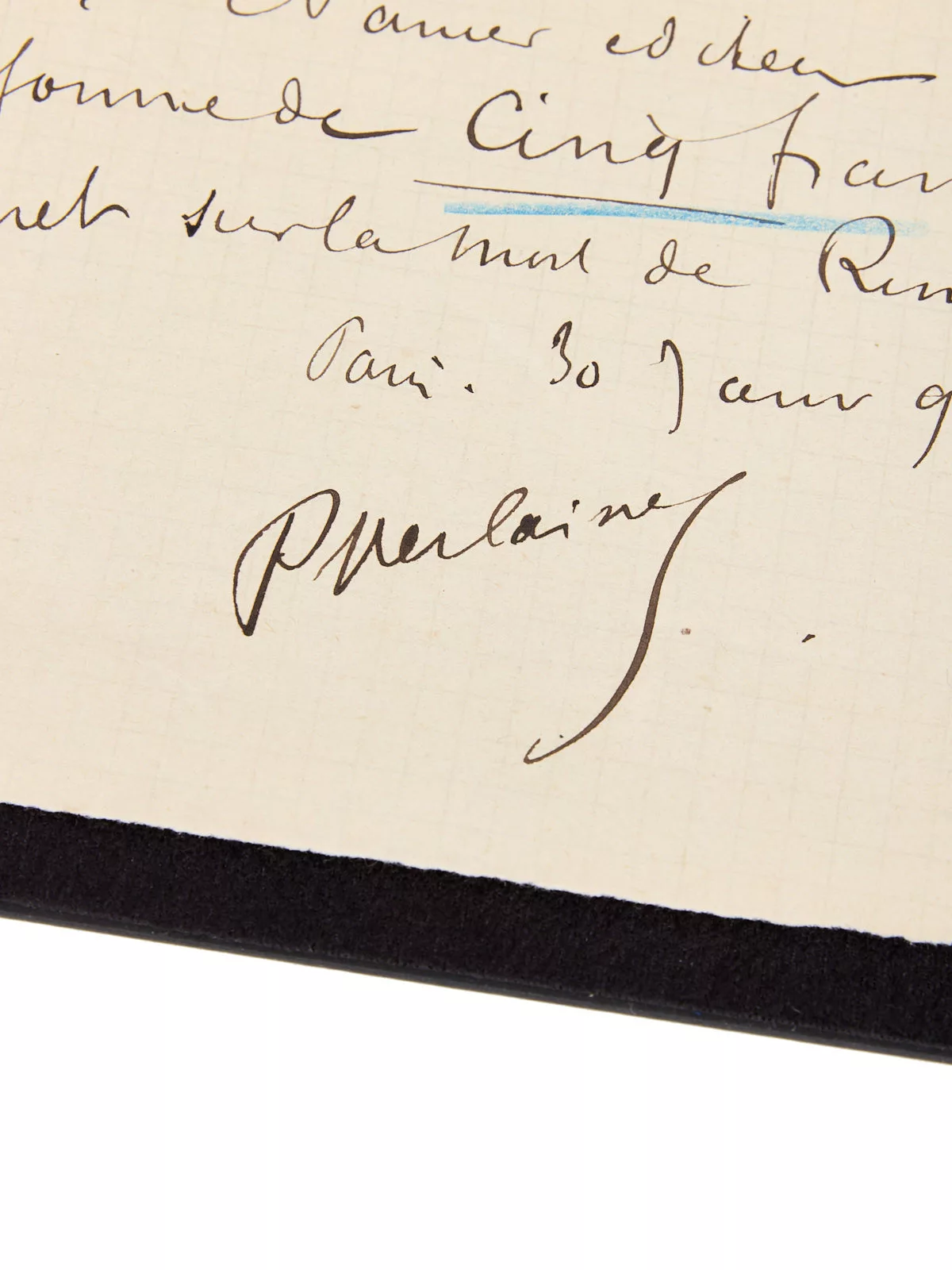
A very fine copy, enriched with an autograph note signed by Paul Verlaine, concerning his sonnet “À Arthur Rimbaud,” which he had just written and which the journal La Plume would publish less than a fortnight later:
“Reçu de Vanier éditeur la somme de cinq francs — Sonnet sur la mort de Rimbaud, Paris, 30 janvier 93, P. Verlaine.”
This sonnet, entitled “À Arthur Rimbaud. Sur un croquis de lui par sa soeur,” was inspired by a drawing by Isabelle Rimbaud depicting her brother as an Abyssinian, dressed in a gandoura and playing the harp. Verlaine, deeply moved by this posthumous image, wrote one of the first great tributes to the lost poet. The text appeared on 15 February 1893 in La Plume, then was reprinted the following year in Dédicaces.
One of the rare posthumous tributes addressed to Rimbaud:
“Toi mort, mort, mort ! Mais mort du moins tel que tu veux,
En nègre blanc, en sauvage splendidement
Civilisé, civilisant négligemment
(…)
Tu meurs en poète et soldat, grand comme un enfant.”
Published at the author’s own expense in October 1873, Une saison en enfer was printed in about 500 copies. Rimbaud, who never paid the printer, was only able to withdraw a very small number of copies, given to a few close acquaintances, including Verlaine, then imprisoned in Brussels. The remainder of the printing stayed with Poot, until it was rediscovered in the early twentieth century by the Belgian bibliophile Léon Losseau.
The legend of the family bonfire, long maintained by Isabelle Rimbaud and Paterne Berrichon, was thereby disproved: the copies had not been burned, but had lain for nearly thirty years in the printer’s storerooms.
We will not dwell too long on this well-known story: Léon Losseau visiting the printer Poot in Brussels, the descent to the cellar, the dusty bundle, the stove: “It was in 1901 [December 1902, in fact]. I was looking for an offprint of La Belgique judiciaire, a collection printed in Brussels for sixty years […]. You will understand the bibliophile’s emotion on seeing what a soiled, stained, dust-covered bundle contained, one he had just lifted among others: hundreds of copies of Rimbaud’s La Saison en enfer!” Rimbaud had never paid his bill. The printer had kept the books, and his assistant, Adrien-Roméo de Ghilage, a workman at the time of typesetting in 1873, had become Poot’s successor, at 49 rue aux Choux.
Losseau numbered, in pen, at the upper right corner, the first copies he distributed to friends and a few writers (Zweig, Rolland, Maeterlinck, Verhaeren), and to several libraries. The original printing amounted to a little more than 500 copies; Rimbaud distributed a few, generously granted by the printer (fewer than ten, given by the poet to Paul Verlaine, then in prison, to Ernest Delahaye, to Ernest Millot, to Jean-Louis Forain, and to Jean Richepin — the “others” remain unknown). These extremely rare copies long remained a source of pride among bibliophiles, and Losseau’s announcement in 1914 caused a sensation in France: “the press mocked collectors dismayed to see their supposedly extremely rare copy of the Saison lose much of its market value” (J.-J. Lefèvre, in Sur Arthur Rimbaud, vol. 3, 1914).
Losseau said he left with 425 copies (the receipt, dated 1 January 1903, records 400 copies). Paterne Berrichon, quickly informed of the “discovery,” wished Losseau simply to burn the books he had found. He refused; what he did destroy, however, was the fable — the lie of the bonfire that Isabelle and Paterne Berrichon had been spreading for years and wished to see perpetuated.
Losseau died in August 1949, having claimed in 1938 never to have sold any copies besides the few given away in 1914. It was only in 1943 that part of this stock of wrappered copies of Une saison en enfer was sold to a Brussels bookseller, who slowly and discreetly placed them on the market — but only part of the “Losseau stock”: in his fine townhouse on the rue de Nimy, his safe still held the famous copies discovered in 1901, carefully protected, inaccessible and inalienable. A philanthropist, patron, bibliophile and medal collector, he bequeathed on his death, to the city of Mons and the Province of Hainaut, his house on the rue de Nimy, containing his remarkable library of nearly 100,000 books and periodicals. A Doctor of Law from the University of Liège, a doctor of political and administrative sciences, and a member of the Mons bar, Léon Losseau pleaded only in defense of the humble and the destitute. A lawyer, bar president and company director, this scholar enjoyed sufficient means to avoid spending his days in court, preferring instead the gatherings of the many learned societies to which he belonged. His name remains forever linked to the discovery of the legendary copies of Une Saison en enfer.
A very fine copy.