

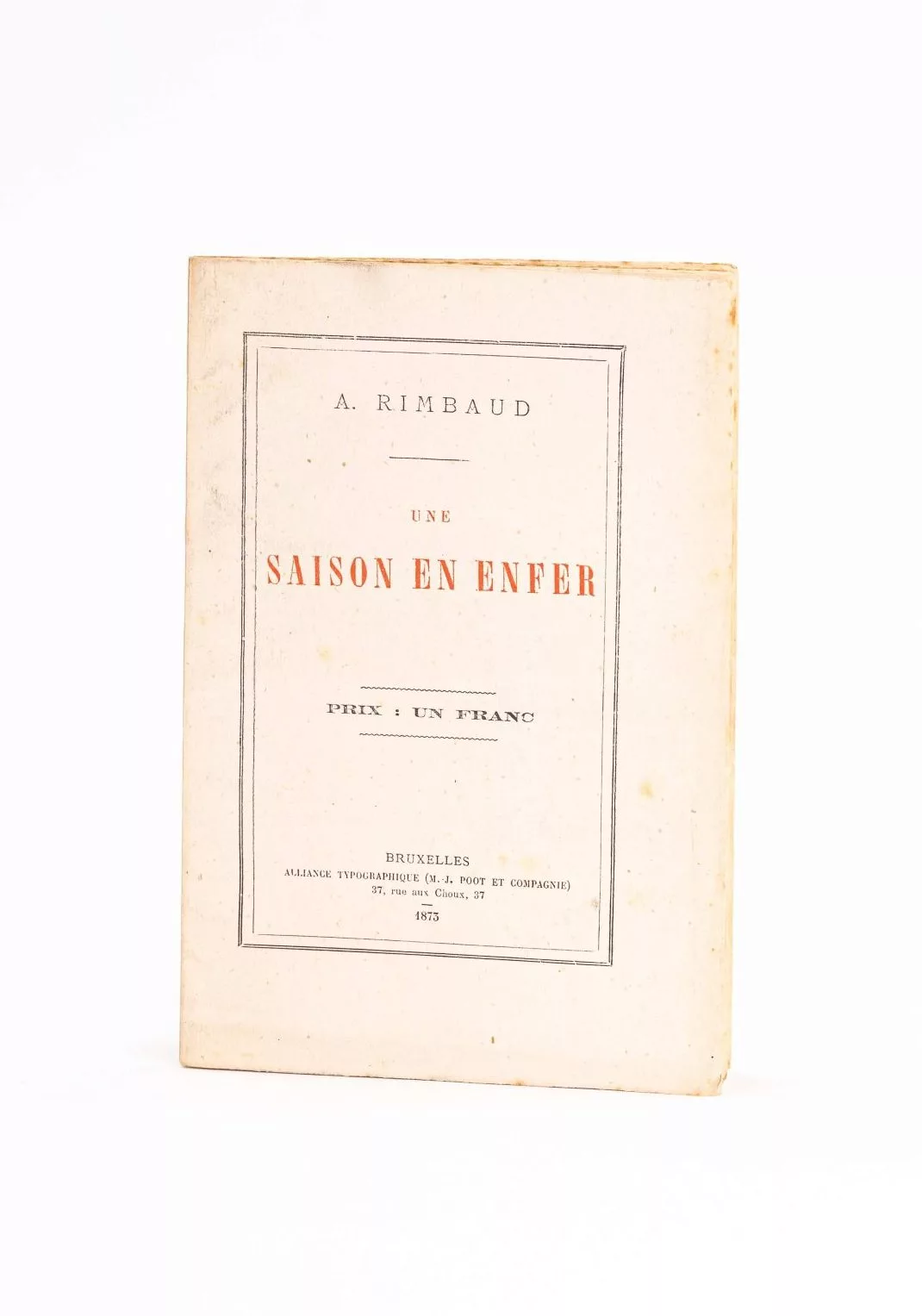
Une saison en enfer
The only edition and the only volume of poetry published during Rimbaud's lifetime.
A very fine copy.
It contains the following pieces:
– [Short preface]
– “Mauvais Sang”
– “Nuit de l’Enfer”
– “Délires I – Vierge Folle – L’Époux Infernal”
– “Délires II – Alchimie du Verbe” (which incorporates five of the last poems Rimbaud wrote in verse), conceived as early as November 1870.
– “L’Impossible”
– “L’Éclair”
– “Matin”
– “Adieu”
We will not dwell (too long) on this well-known story: Léon Losseau visiting the printer Poot in Brussels, going down to the cellar, the dusty bundle, the stove: “It was in 1901 [December 1902, in fact]. I was looking for an offprint of La Belgique judiciaire, a collection that had been printed in Brussels for sixty years […]. You can imagine the emotion felt by the bibliophile when he saw what a dirty, stained, dust-covered bundle contained, one he had just lifted among others: hundreds of copies of Rimbaud’s Saison en Enfer!” Rimbaud had not paid his bill. The printer had kept the books, and his clerk, Adrien-Roméo de Ghilage, a worker at the time of typesetting in 1873, had become Poot’s successor at 49 rue aux Choux.
Losseau numbered the first copies he distributed, in the upper right corner, in ink, to his friends and to a few writers (Zweig, Rolland, Maeterlinck, Verhaeren), and to a few libraries. How many? The original printing was a little over 500 copies; Rimbaud distributed a few of them, generously provided by the printer (fewer than ten, given by the poet to Paul Verlaine, then in prison, to Ernest Delahaye, Ernest Millot, Jean-Louis Forain and Jean Richepin — the “others” are unknown). These extremely rare copies were long a source of pride for bibliophiles, and the 1914 announcement caused a great stir in France: “the press mocked the collectors distressed to see their supposedly extremely rare copy of the Saison lose much of its market value” (J.-J. Lefèvre, in Sur Arthur Rimbaud, vol. 3, 1914).
Losseau said he left with 425 copies (the receipt, dated 1 January 1903, records 400 copies).
Paterne Berrichon, quickly informed of the “find,” wanted Losseau, no more and no less, to burn the books he had discovered. He refused; what he did destroy, however, was the myth, the lie of the book-burning that Isabelle and Paterne Berrichon had been spreading for years and wished to see perpetuated.
Losseau died in August 1949 and, in 1938, claimed never to have sold any copies. It was not until 1943 that copies of Une saison en enfer were sold to a Brussels bookseller. But only some of them: in the fine townhouse on the rue de Nimy, Léon Losseau’s safe still holds part of these famous copies discovered in 1901. They remain carefully protected, inaccessible and inalienable.
A Doctor of Law from the University of Liège, a doctor of Political and Administrative Sciences, and a lawyer at the Mons Bar, Léon Losseau pleaded only to defend the cause of the humble and the disadvantaged. A lawyer, bâtonnier and company director, this scholar enjoyed sufficient material comfort to avoid spending his days in court, preferring instead the gatherings of the many learned societies of which he was a member.
A philanthropist, patron, bibliophile and medal collector, upon his death he bequeathed to the city of Mons and the Province of Hainaut his house on the rue de Nimy, containing his remarkable library of nearly 100,000 books and periodicals!
A good copy — not as issued, but as rediscovered!