

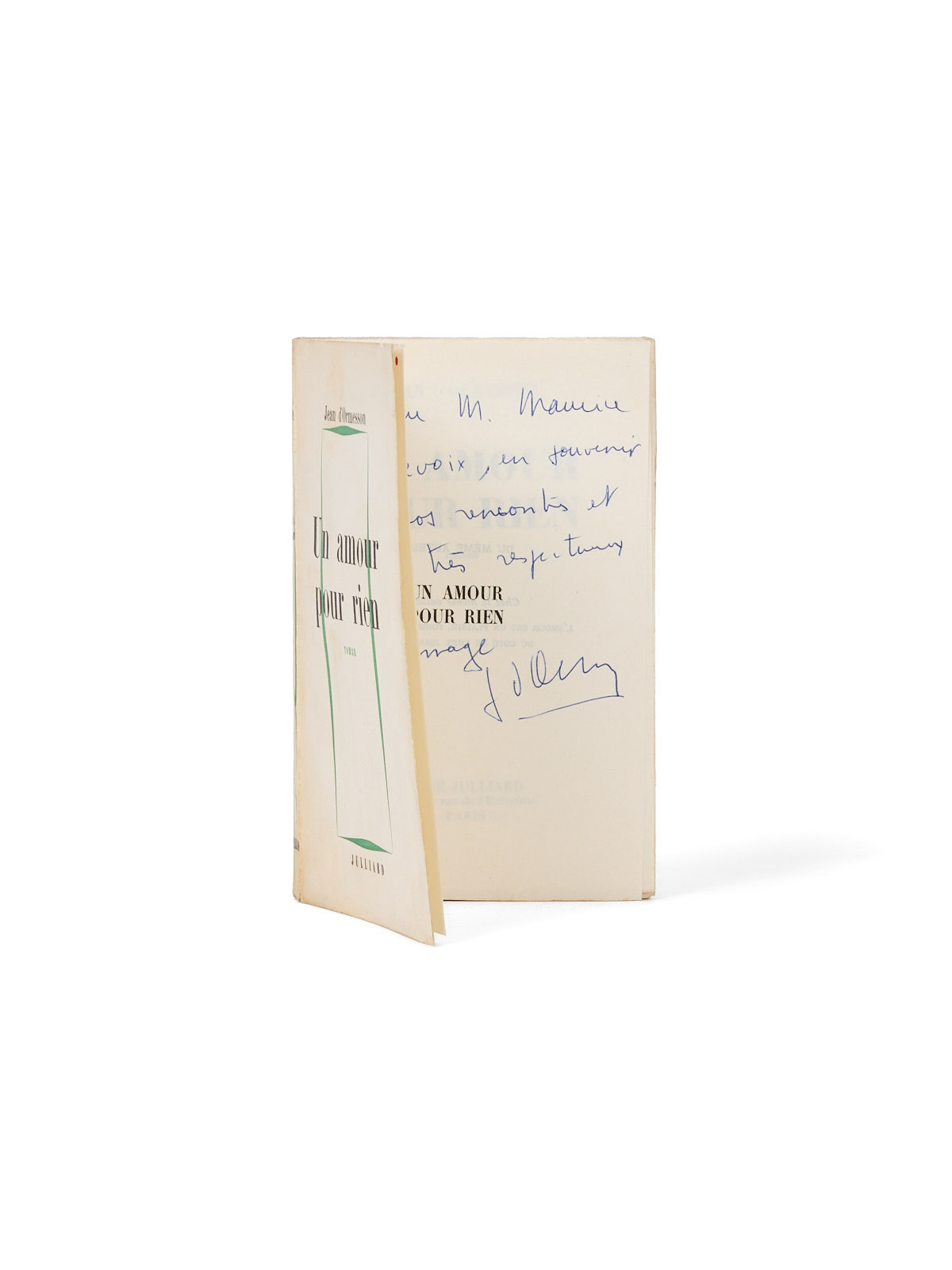
Un amour pour rien
One of the copies printed for the press.
Presentation copy inscribed by Jean d'Ormesson to Maurice Genevoix: “Pour M. Maurice Genevoix, en souvenir de nos rencontres et en très respectueux hommage, Jean d'Ormesson.”
After L’Amour est un plaisir (1956), Jean d’Ormesson published this second novel at the age of thirty-five, continuing the same vein of nonchalant elegance and amorous melancholy: “[…] it is the story of a love that could have been happy. I do not know whether I tell it in order to relive it or to forget it. I feel only, within me, the bitter and tender taste of remembered tears.”
Published by René Julliard, publisher of many young literary talents of the 1950s and 1960s, Un amour pour rien was noticed by critics for its brilliant style and, well before institutional recognition came, marks a step in the emergence of a novelist who already positioned himself apart from the major schools of the psychological or committed novel.
It was first with Jean d’Ormesson’s uncle, Wladimir d’Ormesson, writer and diplomat, member of the Académie française from 1956 to 1973, that Maurice Genevoix formed a close friendship. The nephew, Jean d’Ormesson, would succeed him, entering the Académie française in 1973. He held immense and affectionate admiration for Maurice Genevoix, both as a writer and as a man; in the wake of Genevoix’s death in September 1980, he paid tribute to him, recalling with emotion the happiness of having known him: “He knew his own worth: he was not proud. He could be sharp, incisive, but he was never unkind. He had tenderness for forests, for animals, for his native Loire, his Sologne, for those who suffer and die; men loved him in return. He knew everything: he was the opposite of a pedant. He understood everything. But he knew how to live. Every honor had passed over him without touching him. This man of the woods and this warrior was an intellectual. He had to bear witness to everything a generation of Frenchmen had known of sorrows and joys: the simple and happy life, love of the land, war and peace, memory.”
A fine copy attesting to the young novelist’s attentiveness toward his elder. The inscription, strictly contemporary with the novel’s publication, marks the beginning of a relationship that would only grow in warmth and friendship.