

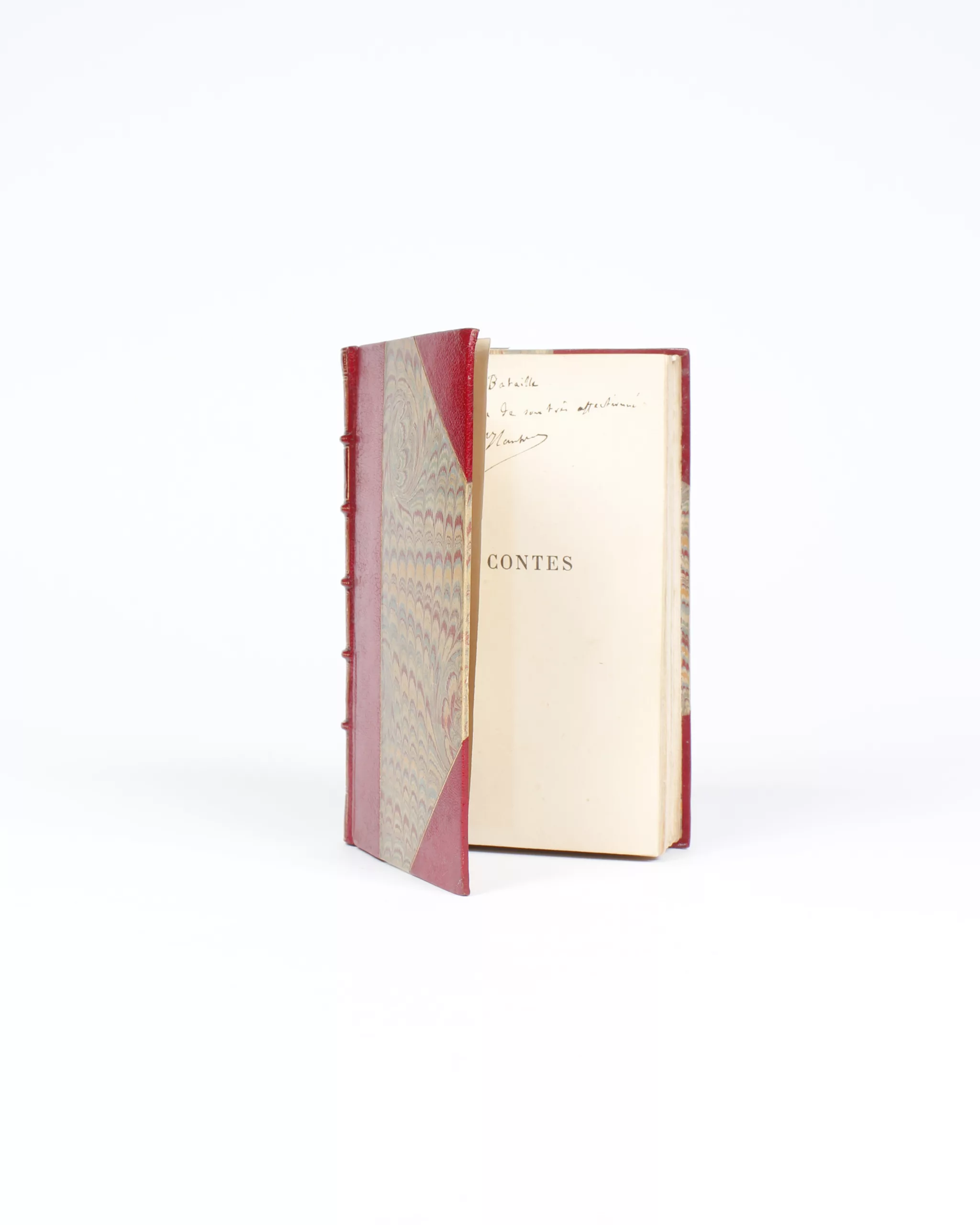
Trois contes Un coeur simple. La Légende de saint Julien l’Hospitalier. Hérodias
One of 100 copies on Hollande paper (no. 19), from the deluxe issue.
Presentation copy inscribed by Flaubert to Madame E. Bataille: “à Madame E. Bataille, humble hommage de son très affectionné, Gust. Flaubert.”
To help his niece, who was facing financial difficulties, Flaubert returned to an old project, “La Légende de saint Julien l’Hospitalier,” which he wrote between September 1875 and February 1876. It became the first of the Trois contes, to which he added “Un cœur simple” and “Hérodias.” The collection was published by Charpentier on 24 April 1877 and was well received, bringing welcome income.
In a letter of 4 December 1876, Flaubert invited Eugène Bataille and his wife to visit him at Croisset: “J’aurais besoin de conférencer avec ton Excellence (…) mets-moi aux pieds de Madame Bataille” (unpublished letter, held by a colleague). Although the visit could not take place at that time, Flaubert thanked his Excellency and his wife a few months later with this precious presentation copy, still in its first contemporary binding, almost certainly commissioned by the (near-)dedicatee after the volume had been given to his wife. Madame Bataille’s copy of Madame Bovary, formerly bound identically in half blue morocco (Matarasso catalogue, 1949, no. 281), is today in a doublure binding by Pierre-Lucien Martin (Lambiotte, no. 43).
Eugène Bataille (1815–1878) was a railway engineer who turned to politics. Arrested and imprisoned at the citadel of Doullens for his part, alongside the future Napoleon III, in the attempt to overthrow King Louis-Philippe at Boulogne, he later resumed an administrative career, became a deputy (July–December 1851) and was appointed to the Conseil d’État in 1852. He also served as a departmental councilor (1858–1864) for the canton of Pavilly, north of Rouen, and owned a summer residence at Hautot-sur-Seine, close to Croisset. A bibliophile, he had known Flaubert since their schooldays together at the Collège Royal de Rouen (1832–1838). Flaubert had given him a deluxe-paper copy of Madame Bovary in 1857. He is also mentioned in Le Bal donné au Czar, published in 2005 from the rediscovered archives of Caroline Commanville, Flaubert’s niece.
A fine copy.
Rare with an inscription and contemporary binding.