

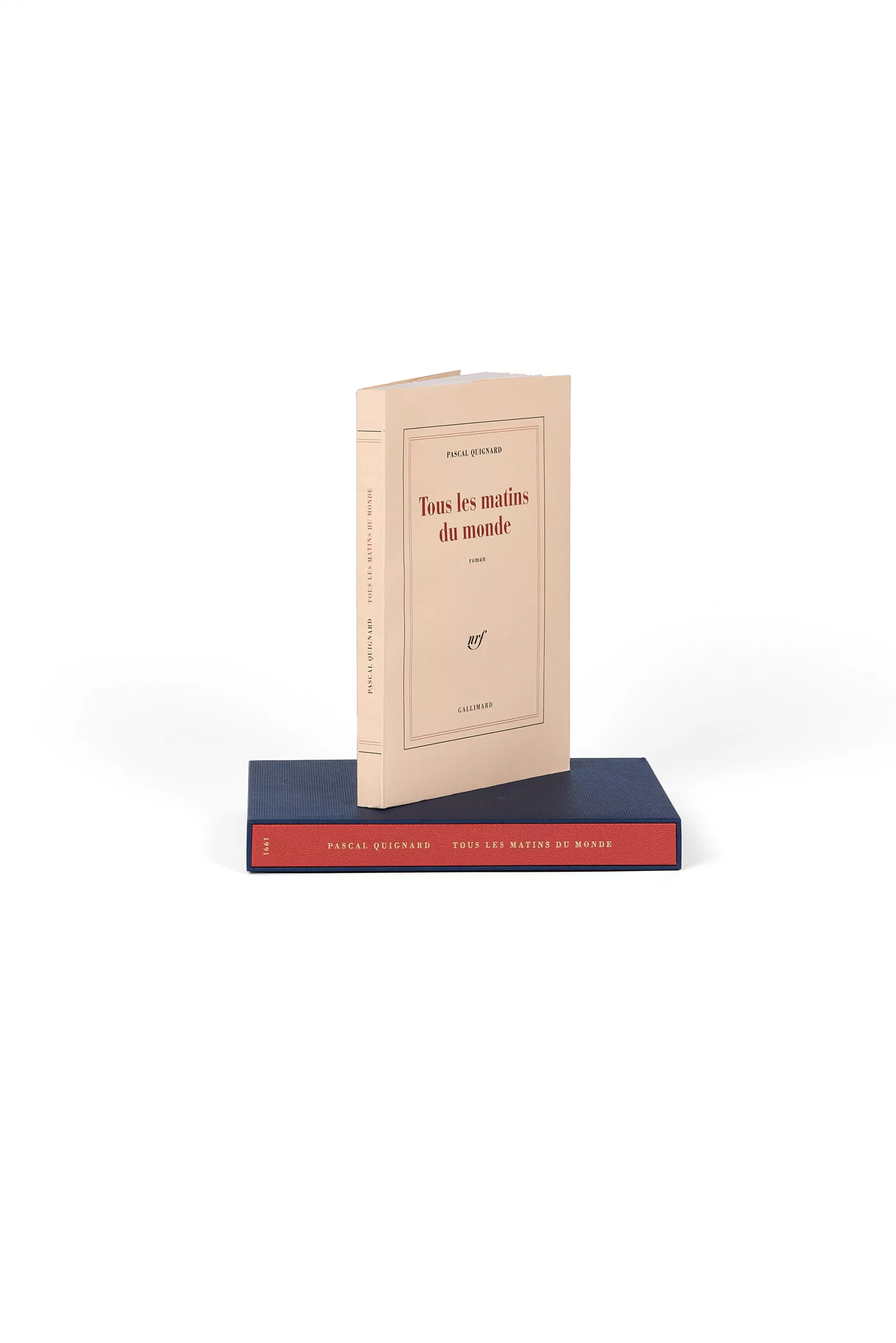
Tous les matins du monde
One of the first 50 copies on vergé de Hollande (no. 3), the only paper.
When Alain Corneau explained to Pascal Quignard his plan for a film in which music would play a central role, Quignard offered to write him a book rather than a screenplay. The filmmaker expected a long wait for the promised novel, but only a few months later Quignard brought him Tous les matins du monde. His discovery of the fate of Marin Marais opened, for the writer, a vein of memories and reflections that the “music lesson” had not exhausted. The result was a book born of a writer’s desire to recover the intonation of vanished voices that fascinated him, and a film carried by a director wishing to fuse his two passions — he could live only through music, and had once hesitated between a career as a musician and as a filmmaker. Alain Corneau remained faithful to Quignard’s text far beyond the page, keeping it almost unchanged in the film’s narration and dialogue, even though Quignard himself pared the script down into a bare, spare and thorny text: “If style means marking one’s manner, as certain painters, musicians or writers do, so as to be recognized, singled out, appreciated, then I am not at all a devotee of style. But if style is, in the Roman sense, the stylus — the instrument that cuts into the wax tablet, that erases, breaks, removes, shatters — then yes, that truly is my way of approaching writing. What I prefer is not the writing but the rereading: cutting away, abolishing, tearing up, smashing. The English call it ‘cut up.’ Every connective, every coordinating or consecutive conjunction, every length must fall away. There is a mad pleasure in demolishing partitions, even the reflections of symmetry.” (Magazine littéraire, November 2012).
Pascal Quignard did not merely allow himself to be fascinated by Sainte Colombe and share his destiny and his music with the public: in the three years following the publication of the book and the release of the film, he withdrew from all his official functions. In 1992 he “left the press and literary juries,” in 1993 he “resigned the presidency of the Concert des Nations,” and in 1994 he “dissolved the Versailles baroque opera festival and resigned from Éditions Gallimard … Since April 1994, I have done nothing but read and write.” He had taken Sainte Colombe’s demanding example as his own, withdrawing because “secrecy, distance, standing apart is the condition for being able to think” (Magazine littéraire, November 2012, on the occasion of the publication of the seventh volume of the Dernier Royaume cycle, Les Désarçonnés).