

They Shall Not Have Me
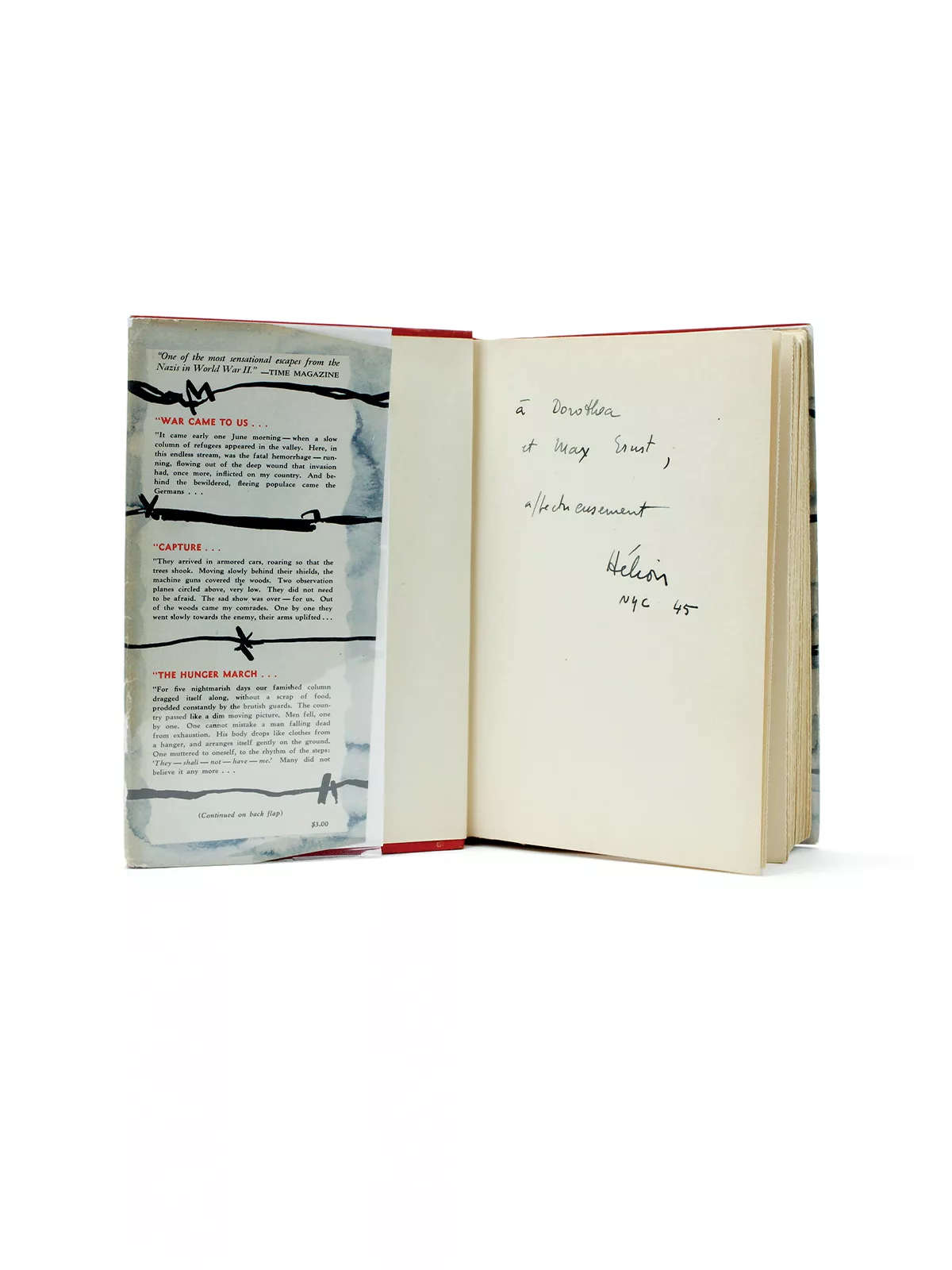
A remarkable association copy, inscribed by Jean Hélion to Dorothea Tanning and Max Ernst:
“à Dorothea et Max Ernst, affectueusement, Hélion, Nyc 45.”
They Shall Not Have Me is Jean Hélion’s remarkable account of his captivity in Germany, from the French defeat of June 1940 to his escape in 1942.
One of the leading figures of abstract painting, Hélion left New York in January 1940, where he was living with his wife Jean Blair, determined to take part in the war. Captured on 19 June, he was first interned in a disused barracks before being transferred to Pomerania, where he experienced the brutal world of forced-labor camps. He escaped on 13 February 1942 and eventually returned to the United States.
There he wrote They Shall Not Have Me, an extraordinary testimony to hunger, exhaustion and physical suffering, but also to humiliation and the guilt of survival: “A crack opened in me that will never close.”
A remarkable association copy inscribed to Dorothea Tanning and Max Ernst. Ernst had met Tanning in New York in December 1942, shortly after his arrival in America; she would become his wife and lifelong companion. The inscription has particular resonance: like Hélion, Max Ernst had himself experienced wartime internment in France, notably at the Camp des Milles near Aix-en-Provence.
The connections are even closer: Hélion moved within the same New York artistic circle and would later marry Pegeen Vail Guggenheim, Peggy Guggenheim’s daughter.
An exceptional provenance, bringing together three major figures of the European avant-garde in wartime New York.
This copy was exhibited at the Musée de l’Armée, Hôtel national des Invalides, in Un Exil combattant, February–June 2025.