

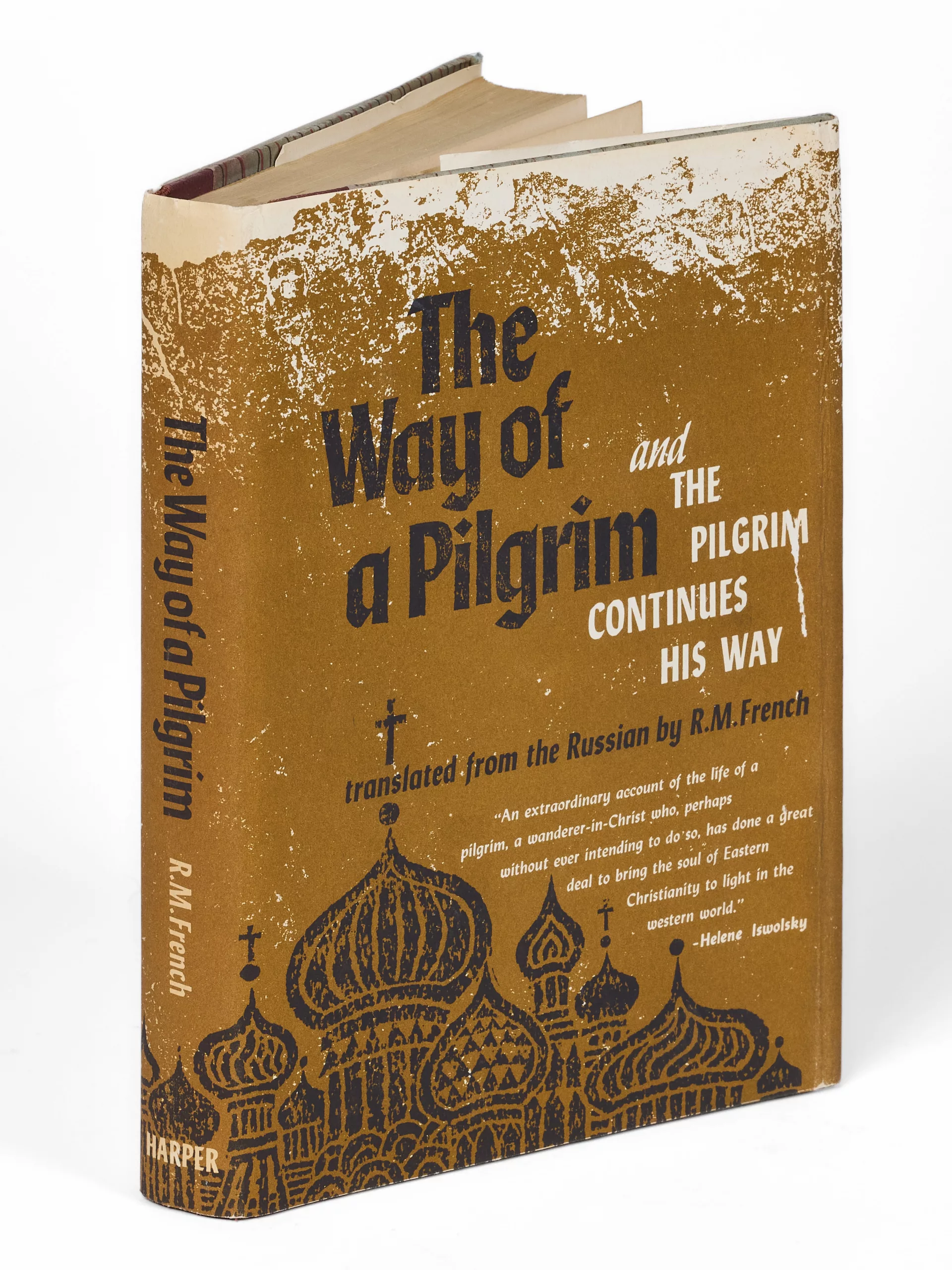
The Way of a Pilgrim
The Way of a Pilgrim is the English title of a late nineteenth-century Russian work, written by an anonymous author and considered one of the spiritual masterpieces of Russian Orthodoxy.
The work, published several times from 1880 onward in slightly different versions, circulated widely throughout Europe and was translated into numerous languages. It continues to be reissued by many publishers to this day; neither the original manuscript nor its author has ever been identified. According to the scholar Antoine Arjakovsky, the Russian original, or a copy of it, was long preserved at the monastery of Mount Athos and was first published in Kazan in 1865 under the Russian title Candid Tales of a Pilgrim to His Spiritual Father (Откровенные рассказы странника духовному своему отцу). It was not published in Paris until 1930.
Jack Kerouac’s own copy.
It was given to him by Robert Lax, “one of the great original voices of our time […], a pilgrim in search of a beautiful innocence,” in Kerouac’s own words. Circus of the Sun, a collection of poems, is one of Lax’s most acclaimed works. On its publication in 1959, the New York Times called it “perhaps the greatest poem in the English language of this century.” Lax left the United States in 1964 to live for more than thirty-five years in Greece, near Patmos.
The copy is accompanied by a typed note, signed by Robert Lax, addressed to Kerouac:
“Dear Jack,
Am sending you a book (from Russian) called The Way of a Pilgrim. Am reading it now and like it a lot and think you will. In part two which I just skipped to yesterday has a great thing on the power of prayer (page 207) another (146) on the essentials of confession. both are pretty traditional, but stated best here of almost any place. psychologically, for me at least, they’re very liberating. (…). Yours, Bob, Olean House, Olean, NY.”
“When Lax and Kerouac became friends in the 1950’s, Kerouac felt a strong attraction to Lax’s spirituality and talked about joining him at a Catholic retreat center on the outskirts of Paris, but those were the days just after the great success of On the Road, when fame, alcohol, and easy seduction were drawing Kerouac toward the slough of despond that would eventually kill him. Within a short time Lax himself was corresponding with Kerouac, beginning a friendship that would reach its apex five years later in New York. By then the deadly fame that followed On the Road was making Lax the kind of friend Kerouac needed (…) When Lax moved back to New York for a longer period, he and Kerouac would come to know each other quite well and talk about a wide range of subjects, but during their first encounters their conversations seem to have centered on Christianity and, more specifically, Catholicism. As he did for most of his adult life, Kerouac was living with his devoutly Catholic mother, and in those days before On the Road he was considering turning more fully toward Catholicism rather than away from it, as he did later. One of the things that initially attracted him to Lax was Lax’s friendship with Merton, whose writings and monastic life Kerouac admired. As he and Lax spent more time together, he began to see Lax himself as a paragon of what a Catholic could be: a man devoted to both art and the search for truth who chose to live in poverty and simplicity. When Lax was about to return to Europe, he invited Kerouac to come live with him at L’Eau Vive (which Kerouac thought was some kind of monastery) and Kerouac considered it.” (Michael Gregor, The Uncommon Life of Robert Lax, NY, 2015).
Kerouac’s literary writing was always bound up with the expression of his spiritual quest: “Always seeking. I’m coming to the conclusion that finding bores me. And it’s almost always disappointing.” (Journal, p. 137). He explored every form of writing, from prose to the briefest of literary forms, the haiku, but his spiritual search took shape principally in three books, On the Road, Desolation Angels and Dharma Bums, all written after the publication — and almost certainly the reading — of The Way of a Pilgrim.
The Way of a Pilgrim is also central to Salinger’s novel Franny and Zooey, published in 1961; Franny, a young student, is fascinated by the Tales, describing the book as a way of “seeing God,” and explaining that the “Jesus Prayer” resembles techniques used in Hinduism and Buddhism. Franny and Zooey became an international bestseller that helped spread the popularity of the Tales beyond Orthodox tradition.
With the estate stamp “Property of the Estate of Jack Kerouac, John Sampas, Executor the Estate of Jack Kerouac,” together with the embossed seal “Jack Kerouac Estate.”