

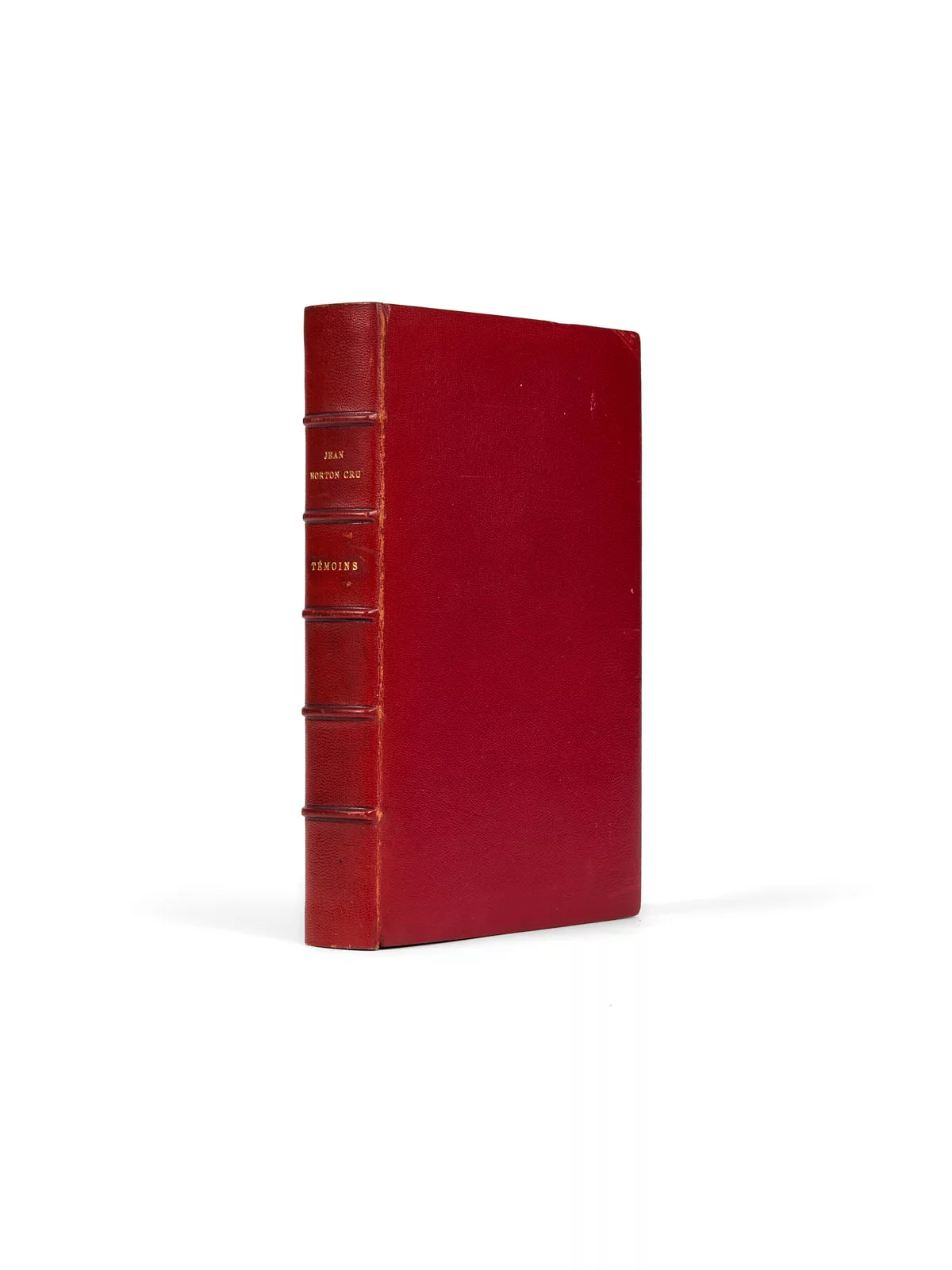
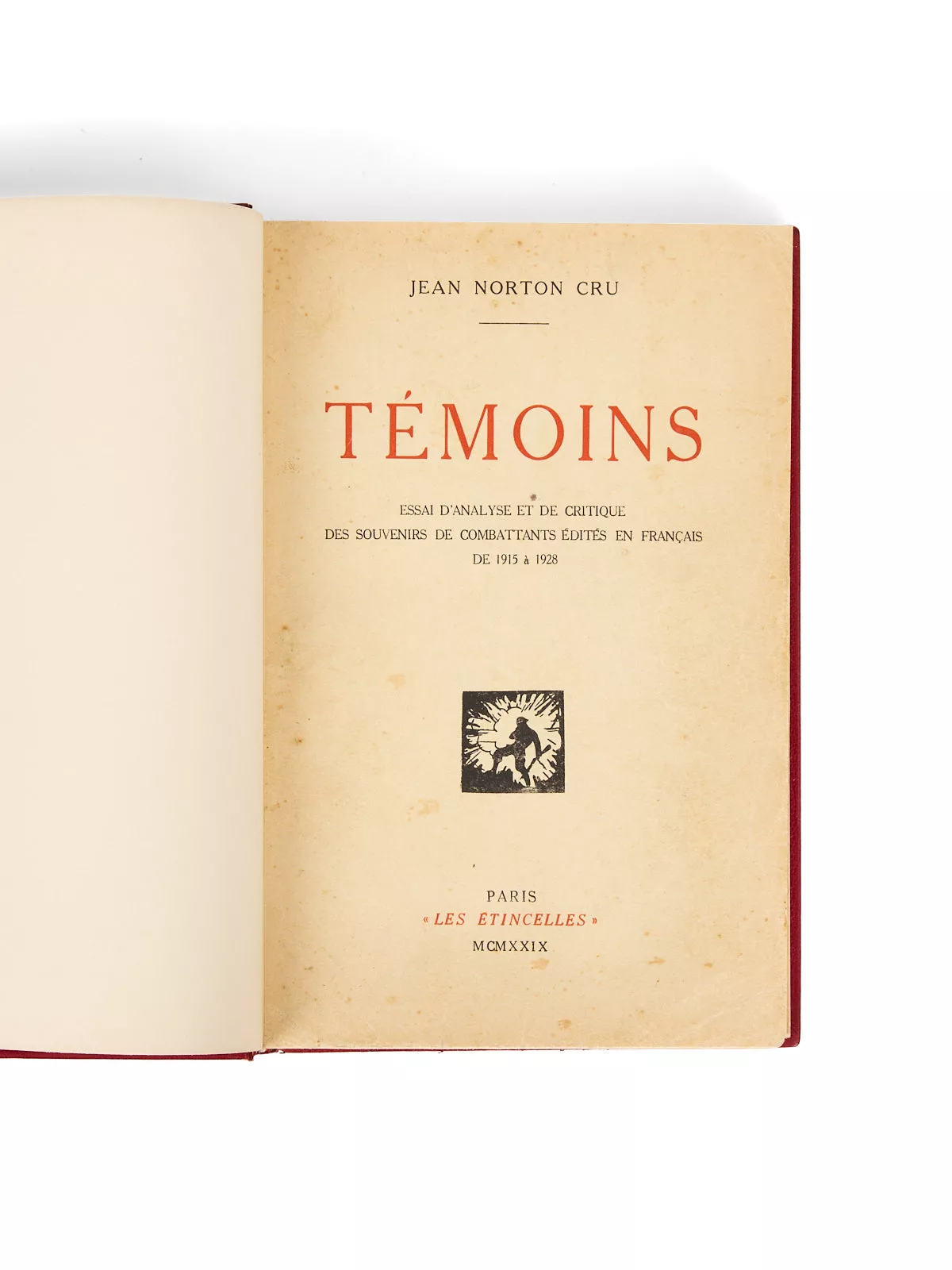
Témoins
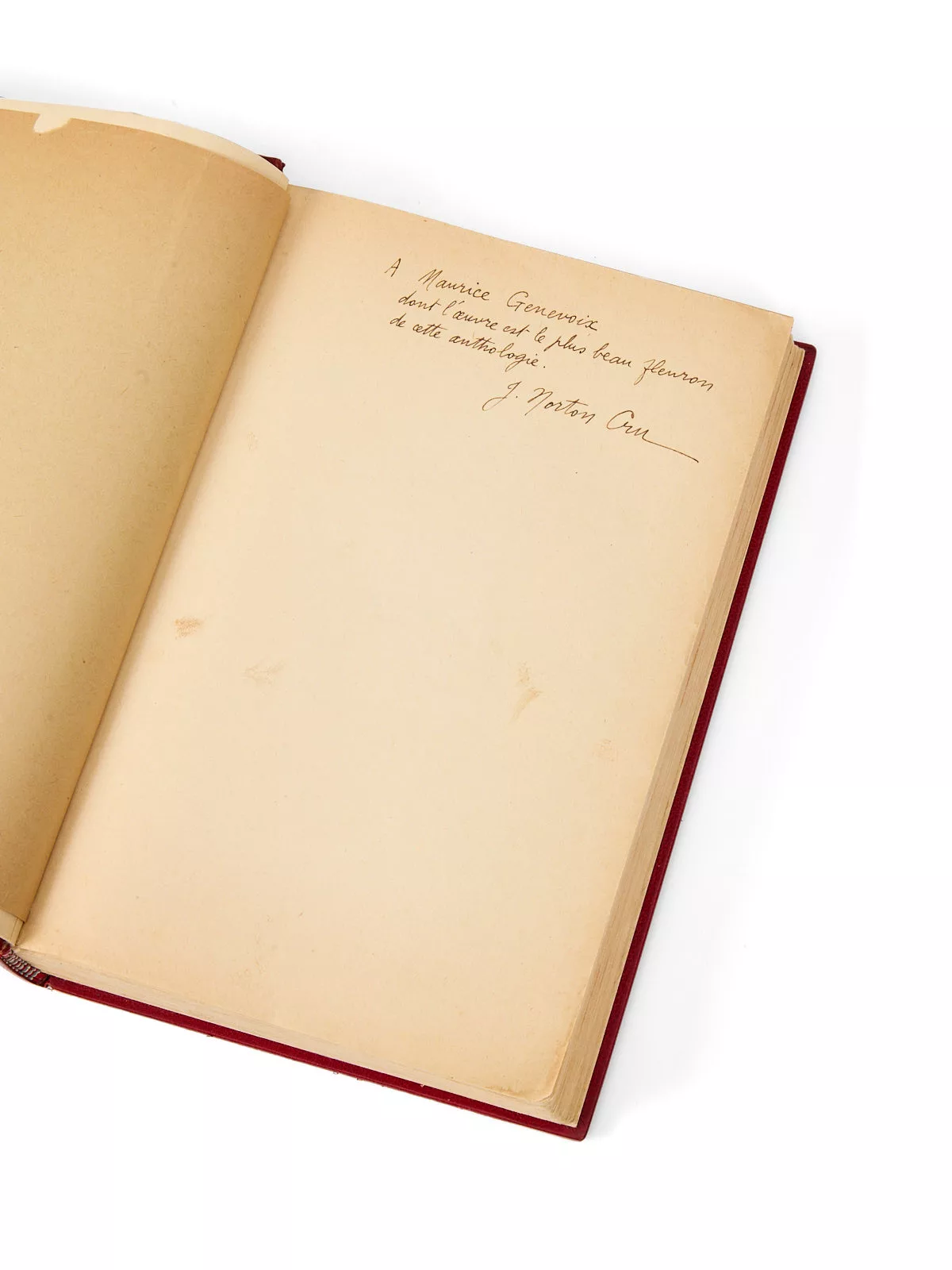
Presentation copy inscribed by Norton Cru to Maurice Genevoix: “à Maurice Genevoix, dont l'œuvre est le plus beau fleuron de cette anthologie. Norton-Cru.”
Ten years after the end of the conflict, an encyclopedic dictionary appeared, offering an “essai d’analyse et de critique de souvenirs de combattants édités en français de 1915 à 1928” (an essay of analysis and criticism of combatants’ memoirs published in French from 1915 to 1928), as the subtitle of the book, titled Témoins, states. Its author was then a complete unknown, a professor of literature at a private American university, Williams College, in Williamstown, Massachusetts. Jean Norton Cru — who took his middle name from his English mother, Catherine Norton — was born in Labatie-d’Andaure, in the Ardèche. Perfectly bilingual, he first became a schoolteacher, before going to teach in Kent, then joining his brother, who was already teaching at Williamstown.
The First World War marked him for the rest of his life. He served first in the territorial army, then as a sergeant in the 240th Infantry Regiment, with which he fought at Verdun between 1915 and 1917. He was then attached to the rear as an interpreter, to the 51st British Infantry Division, then to the 1st American Infantry Division. After the war ended, he returned to the United States, but soon felt the need to write about those four terrifying years. In August 1922 he made a pilgrimage back to Verdun: this was the turning point that led him to begin reading, or rereading, all the published testimonies of the Great War. As he wrote to his sister, he wondered what form his work should take: “I think about it every day. It will certainly be about the war, and among the various plans, two present themselves clearly.”
Amid the abundant wartime literature, the works of genuine witnesses tended to be drowned out by patriotic literature that deliberately masked the reality of soldiers’ lives. His project aimed to redress this imbalance, and he contacted those he thought best able to testify to this period, in order to expose and denounce the legends of the war fostered by conventional literature or the imagination of certain witnesses. This aim, underlying the Témoins project, rested on the twin pillars of experience and scientific rigor. For Norton Cru, the Great War had been glorified and heroized to an extreme degree, often at the expense of the soldiers themselves. At other times, as in the case of Barbusse’s Le Feu, excess and a marked taste for the morbid disqualified the witness’s account, to the detriment of those who had genuinely lived through the war.
He first recognized this merit in Maurice Genevoix when he read him for the first time. Praising to his sisters the quality and authenticity of Genevoix’s testimony, Norton Cru wrote that this “young graduate of the École normale had seen.” This is almost word for word the praise he gave to another author, André Pézard, of Nous autres à Vauquois (1925): “You are one of those who have seen.”
In Norton Cru’s eyes, as in the eyes of many today, these two accounts are the two most important war narratives ever written.
He then began a long and methodical process of reading, cross-checking and research, in order to “gather together the accounts of the narrators who acted and lived through events, excluding the accounts of spectators, whether at headquarters… or in their offices.” His aim was to “assemble a body of combatants’ testimonies,” separating them “from the enormous mass of war literature in which they are drowned.” Between 1914 and 1918, nearly 340 combatants’ testimonies were published in France, some of which achieved immediate fame among contemporaries or critics (including five Prix Goncourt and two Prix Femina winners): diaries, memoirs, essays, novels. He analyzed 304 titles by 252 authors. In the end, 250 entries, each devoted to one author, were produced, each comprising three parts: a short biography of the author, a bibliographical description of the testimony, and a critical analysis of its documentary and literary value. Norton Cru classified all the testimonies into six categories: only 29 authors were given the “excellent” rating — Maurice Genevoix among them, of course.
This was a long undertaking, first submitted to Paris publishers, who each made greater leniency toward their own house authors, often harshly treated, a precondition. In 1928, the Carnegie Foundation, through its endowment — which had just given Reims the splendid Art Deco library that now bears its name — also took an interest in Norton Cru’s work, going so far as to have him sign an author’s contract. But it too was troubled by the omnipresence of personal judgments and, through its director James Shotwell, asked the author to soften a number of remarks and criticisms. Norton Cru refused to compromise with either party, and resolved to publish at his own expense, through Les Étincelles, which printed and distributed the book.
The book provoked strong reactions, being severe toward the writings of Roland Dorgelès and Henri Barbusse, and highly critical of Erich Maria Remarque’s All Quiet on the Western Front. Some praised it to the skies, others condemned it utterly. To some, Norton Cru was a kind of Galileo of testimony; to others, closer to Tartuffe. With his human and scientific ambition, Cru wanted to be the guide who would give the keys of understanding to those who had not lived through the war yet attempted to describe it.
His work, since acclaimed, was reissued by Jean-Jacques Pauvert in 1967, and an abridged edition was recently published, in 2022.
Maurice Genevoix said of Jean Norton Cru that he had “devoted fifteen years of his life to this mission of discernment… An immense labor, undertaken with a rigor of judgment whose narrowness is sometimes explained by an excess of scruples, by an obsessive concern for honesty…” (in Vie et mort des Français, 1914–1918, Hachette, 1959, preface).
A fine copy of unmistakable and perfect provenance.
Jean-Marie Guillon, “Préface. Jean Norton Cru, la mémoire et l’histoire,” in Jean Norton Cru, Aix-en-Provence, Presses universitaires de Provence, 2007; Gilles Benjamin, “Interroger les anciens combattants: Norton Cru et la préparation de Témoins,” in Écrire en guerre, 1914–1918, Presses universitaires de Rennes, 2017; Témoins, preface by Philippe Olivera, Agone, 2022.